
Key Point:
• Pool owners owe a duty to keep the pool reasonably safe; injuries often trace to missing fences, slippery decks, inadequate supervision, or faulty drains.
• Under the attractive nuisance doctrine, an owner can be liable for a child's pool injury even if the child was technically trespassing.
• A pool injury is a premises liability claim, generally filed within two years under N.J.S.A. 2A:14-2, with as little as 90 days to act if a public pool is involved.
Swimming pools provide a place to relax and cool off, but pool owners sometimes fail to appreciate the danger on their property. Drowning is a leading cause of injury death for young children, and most swimming pool injuries in New Jersey can be prevented through proper maintenance and supervision. When they are not, the premises liability attorneys at Villani & DeLuca, P.C. can help.
Pool Safety Saves Lives
There are several measures pool owners can take to prevent pool-related injuries and drowning:
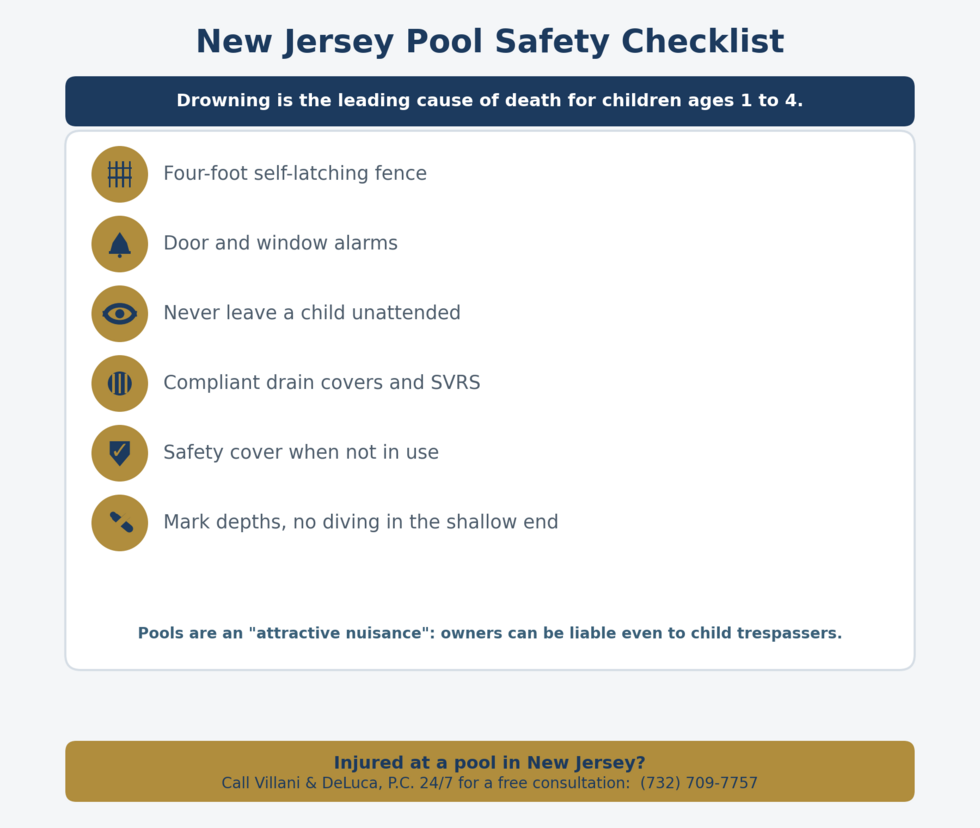
- Install a four-foot fence around all pools, even shallow ones. A child can drown in as little as two inches of water. Make sure the gates are self-closing and self-latching.
- If your home is the fourth side of a fence around the pool, install audible alert door alarms. You should also install window guards on any windows facing the pool.
- Install a safety cover on your spa and make sure it is securely closed.
- Use a pool safety cover to cover your pool during extended periods of inactivity.
- Never leave a child unattended in a pool or spa.
- Prevent overcrowding during pool use by designating a maximum number of occupants. Once the number is reached, others must wait their turn.
- Designate an experienced swimmer to serve as a lifeguard. The lifeguard should be watching the swimmers at all times, not texting or reading.
- Keep children away from pool pipes, drains and other openings to prevent entrapment.
- Use drain covers that comply with federal safety standards. Suction entrapment due to a faulty drain cover may be fatal.
- A Safety Vacuum Release System (SVRS) is necessary to prevent entrapment, entanglement and evisceration. It works by monitoring pump pressure and venting the suction line when an outlet is blocked.
- When a child is missing, always check the pool and spa first.
- At the end of the day, remove all toys and flotation devices from the pool and place them at least ten feet away to dry.
- To prevent slip and falls around the pool, apply a textured finish to the concrete, stone, or other decking material for improved traction.
Pool Owners and Premises Liability
While in most cases a property owner is not responsible for the harm that occurs to an individual trespassing on the property, there is a special rule applicable to structures on the private property that have a tendency to attract children. Swimming pools are an example of what is known as an “attractive nuisance.” Other examples of attractive nuisance include decorative fountains, old appliances like refrigerators or washing machines, and construction debris. If a pool is not properly fenced in, it is possible for a child to wander onto the property and suffer a potentially fatal injury as a result.
When a pool owner invites guests to enjoy the premises, there is a duty to keep the premises safe. A pool owner may be held liable if a child or adult is injured due to a slippery deck, diving board or ladder. Such injuries can be prevented through the use of non-slip materials on the area surrounding the pool as well as on diving boards, ladders, and walkways.
Head injuries and lacerations that occur due to diving into shallow water may be attributed to the owner's failure to properly label the shallow end of the pool. Additionally, any diving boards or water slides should be placed in the deep end of the pool.
Recreational Swimming Pools and Premises Liability
Swimming pools located at water parks, amusement areas, and in hotels can be dangerous because swimmers assume the owners will provide a safe and secure place to enjoy the water. When accidents and injuries occur on these types of property, there may be multiple parties responsible. A negligent lifeguard or distracted swim instructor may be responsible for a child drowning, but the owner of the premises should still be held liable in the death of the child.
How We Handle Your Pool Injury Case
We investigate whether the owner met safety standards (fencing, supervision, drain compliance, deck condition), identify every responsible party, and, where a defective drain or cover contributed, evaluate a product claim against the manufacturer or maintenance company alongside the premises claim.
Client Testimonial
"Well worth the money. Got exactly what I was looking for. Carmine knows what he's doing and talking about. Will use this firm again if needed and recommend to others to use as well." – Harrison Utter
"Vince and his staff were very professional. Listened to the needs of the client. Great results." – Glen Vandeventer
"Villani and his firm were extremely knowledgeable and professional handling my case. I'm extremely satisfied with the outcomes. God bless you and your firm for your dedicated work" – Bernard Perutti
Frequently Asked Questions
1. What are the most common causes of swimming pool accidents?
Swimming pool accidents often stem from property owner negligence. Common causes include a lack of proper fencing or locking gates, slippery surfaces around the pool deck, inadequate supervision at public pools, and malfunctioning equipment like drains or filters. Whether the accident occurred at a private residence or a hotel, a swimming pool injury lawyer can help determine if the owner failed to meet safety standards.
2. What is the "Attractive Nuisance" doctrine?
This is a legal principle that often applies to swimming pools and children. Even if a child is technically trespassing, a property owner can be held liable for injuries if they have something on their property—like a pool—that is likely to attract children but fails to provide barriers to prevent them from entering. While general premises liability laws were clarified in 2026 to further define property boundaries, the core protection for children remains a fundamental part of New Jersey law.
3. Can I still seek compensation if there was a "Swim at Your Own Risk" sign?
Yes. A sign does not automatically grant a property owner total immunity from lawsuits. While a sign may serve as a warning, owners are still required to maintain the pool area in a reasonably safe condition and comply with local safety ordinances. If the owner was negligent—for example, by failing to repair a broken ladder—the presence of a sign may not be enough to shield them from a claim handled by a personal injury attorney.
4. How long do I have to file a claim for a swimming pool accident in New Jersey?
In most cases, the statute of limitations for personal injury in New Jersey is two years from the date of the incident. However, if the injury occurred at a public or government-run pool, you may have as little as 90 days to file a formal "Notice of Claim." Because these deadlines are strict and missing them can bar you from recovery, consulting a swimming pool injury lawyer as soon as possible is highly recommended.
5. Do I need an attorney if the insurance company offers a settlement?
It is often wise to have a professional review any offer. Insurance companies may attempt to settle quickly for an amount that does not cover long-term medical needs or the full extent of swimming pool injuries. An experienced premises liability lawyer can evaluate the true value of your claim and negotiate on your behalf to ensure you are treated fairly.
As of 2026, many pool equipment manufacturers are facing updated federal safety standards regarding suction outlet covers (to prevent entrapment). If we determine that a defective product caused the injury, we may pursue a claim against both the manufacturer and the maintenance company for negligence.
When it Comes to Premises Liability Claims, Experience Matters
Swimming pool accidents and injuries fall under premises liability, a complex area of the law that requires extensive knowledge. The attorneys at Villani & DeLuca have a combined 100 years of legal experience and will work towards getting you a settlement you are comfortable with. We are also seasoned trial lawyers and will advocate zealously in court to ensure fair compensation and justice for your injury or loss. Contact our offices today at (732) 709-7757 for a free consultation.
The Bottom Line
Swimming pool accidents fall under premises liability, a complex area of law. The attorneys at Villani & DeLuca have a combined 100 years of legal experience and are seasoned trial lawyers who will advocate for fair compensation for your injury or loss. Contact our offices at (732) 709-7757 for a free consultation.
About the Firm: Villani & DeLuca, P.C. represents premises liability and personal injury victims throughout Ocean and Monmouth Counties, New Jersey.
Related Articles
- Personal Injury Lawyer in NJ (overview)
- Slip and Fall Accidents in NJ
- Amusement Park Injury in NJ
- Wrongful Death in NJ
Trusted Resources
- U.S. Consumer Product Safety Commission, Pool Safely: https://www.poolsafely.gov/
- New Jersey Courts, Self-Help (Civil): https://www.njcourts.gov/self-help/civil
- New Jersey Legislature, N.J.S.A. 2A:14-2 (Personal Injury Statute of Limitations): https://www.njleg.state.nj.us/laws/2a/2a-14-2
- Villani & DeLuca, P.C., Legal Glossary: https://www.villanideluca.com/resources/legal-glossary