
Key Points
- A DWI or DUI is a motor vehicle violation, not a criminal offense. Under N.J.S.A. 39:4-50, it still carries license suspension, thousands in fines and surcharges, a mandatory ignition interlock device, possible jail time, and a permanent mark on your driving record that cannot be expunged.
- New Jersey does not allow a DWI to be plea bargained down to a lesser charge, and no work permits or hardship licenses are available during suspension. A defense is built by challenging the validity of the stop, the officer's observations, the field sobriety tests, and whether Alcotest and implied-consent procedures were followed correctly.
- Eligible first-time alcohol-based offenders can install an IID before conviction and earn 2-for-1 credit toward suspension. Under N.J.S.A. 39:4-50.17, acting quickly after arrest can substantially shorten penalties.
What You Need to Know About NJ DWI Penalties and Defense
If you are arrested for a DUI or DWI, you would be wise to have an NJ DWI lawyer by your side in court.
Driving While Intoxicated (DWI) or Driving Under the Influence (DUI) are motor vehicle violations in the State of New Jersey (defined in N.J.S.A. 39: 4-50). Also known as “drunk driving," DWI charges are considered the most serious motor vehicle violations in NJ and should to be handled by a qualified DWI lawyer serving both Ocean County and Monmouth County.
If you or a loved one been charged with a DWI, DUI or a Breath Test Refusal and are you seeking to keep the DWI charge off your record and save your driver's license, you will need an experienced New Jersey DWI attorney to represent you and to fight on your behalf.
Our Qualifications

Carmine R. Villani, Esq., founding partner of Villani & DeLuca, P.C., is a former Municipal Prosecutor and has experience in both the prosecution and defense of DWI, DUI and refusal charges in New Jersey. Mr. Villani is one of a small number of NJ DWI lawyers trained on both the Alcotest® breath testing device, currently used in New Jersey, as well as the Breathalyzer previously used. When you need a DWI lawyer in Monmouth or Ocean County, New Jersey, you can't afford to waste time before seeking representation to defend yourself and your rights in court; your choice of legal counsel is important and can mean the difference between a DWI conviction and a dismissal.
Know the New Jersey DWI and DUI Laws
DWI Law: N.J.S.A. 39:4-50 Driving While Intoxicated
Every state deals with such cases differently, but regardless, driving while intoxicated is against the law in New Jersey (as it is everywhere across the nation). A person who operates a motor vehicle with a blood alcohol concentration (BAC) of 0.08% or above is considered to be driving under the influence. New Jersey is a zero-tolerance state.
New Jersey's implied consent law requires you to take a breath test after an arrest for DWI. If you are detained and refuse, you'll be subject to the refusal penalties which in some instances can have a harsher sentence than a first offense DWI. Blood alcohol concentration is measured through a breathalyzer or Alcotest®. BAC evidence is not necessarily required to prove a DWI in court, but without it, prosecutors must rely on police officer observations and a more subjective series of tests called Standardized Field Sobriety Testing (SFST). Therefore, you can be convicted of a DWI even without a blood alcohol reading if the officer testifies that in their opinion, you were drunk.
DUI Law: N.J.S.A. 39:4-50 Driving Under the Influence of prescription or illicit drugs
If you are pulled over for suspicion of a DUI violation, New Jersey law enforcement will treat you the similarly if you appear impaired because you had taken a prescribed medication. This means that you could be charged with a DUI (driving under the influence) of drugs and could face the same charges as a person who was driving under the influence of an illegal drug. All too often people get themselves into trouble because they either admit to taking a prescribed medication or the officer sees prescription bottles in the car or in a drivers purse. The penalties for driving under the influence of drugs are the same penalties a person would receive with an above a .15 BAC which the the highest penalty in an alcohol case.
Underage DUI Law: N.J.S.A. 39:4-50.14 Underage Driver Under the Influence
Requirements and penalties for drivers that are under the legal drinking age are even more strict. If a chemical test determines that a driver under 21 has a BAC of .01-.07%, the driver can be charged with underage driving with alcohol in their system and lose his or her license for 30 to 90 days, among other penalties. This is not a finding that the driver was intoxicated but it is a zero tolerance law meaning penalizing an underage driver for having any alcohol in their system. Something that is super important, however, is that an underage drinking and driving under this section is NOT CONSIDERED A DWI. Should the driver have blood alcohol content measuring .08% or more or is otherwise deemed intoxicated, he or she will face the same charges and penalties as a driver over the age of 21 under the DWI statute.
DWI and DUI Penalties in New Jersey
Being convicted of a DUI is a serious offense, carrying heavy penalties. Penalties for driving while intoxicated vary according to BAC level and how many times you've been caught; New Jersey law allows the courts and the Motor Vehicle Commission (MVC) to suspend your license (anywhere from 4 months to 8 years), charge thousands of dollars in fines, fees and surcharges, requirement of an ignition interlock device, jail time and community service. Work permits or hardship licenses are not available in New Jersey.
Allowing a Drunk Driver to Drive Your Car Can Result in Your Being Charged with DWI
Did you know that you could be arrested for a DWI even if you are not driving? If you let another person drive your car and you know that that person is drunk, then New Jersey law says that you, too, can be convicted of a DWI. The State has made this law to punish people who put drunk drivers on the road just the same as the drunk drivers themselves.
DUI drug offenses in the State of New Jersey are governed by N.J.S.A. 39:4-50. Anyone who is found to be operating a motor vehicle while under the influence of drugs is subject to penalties just as severe as a DWI.
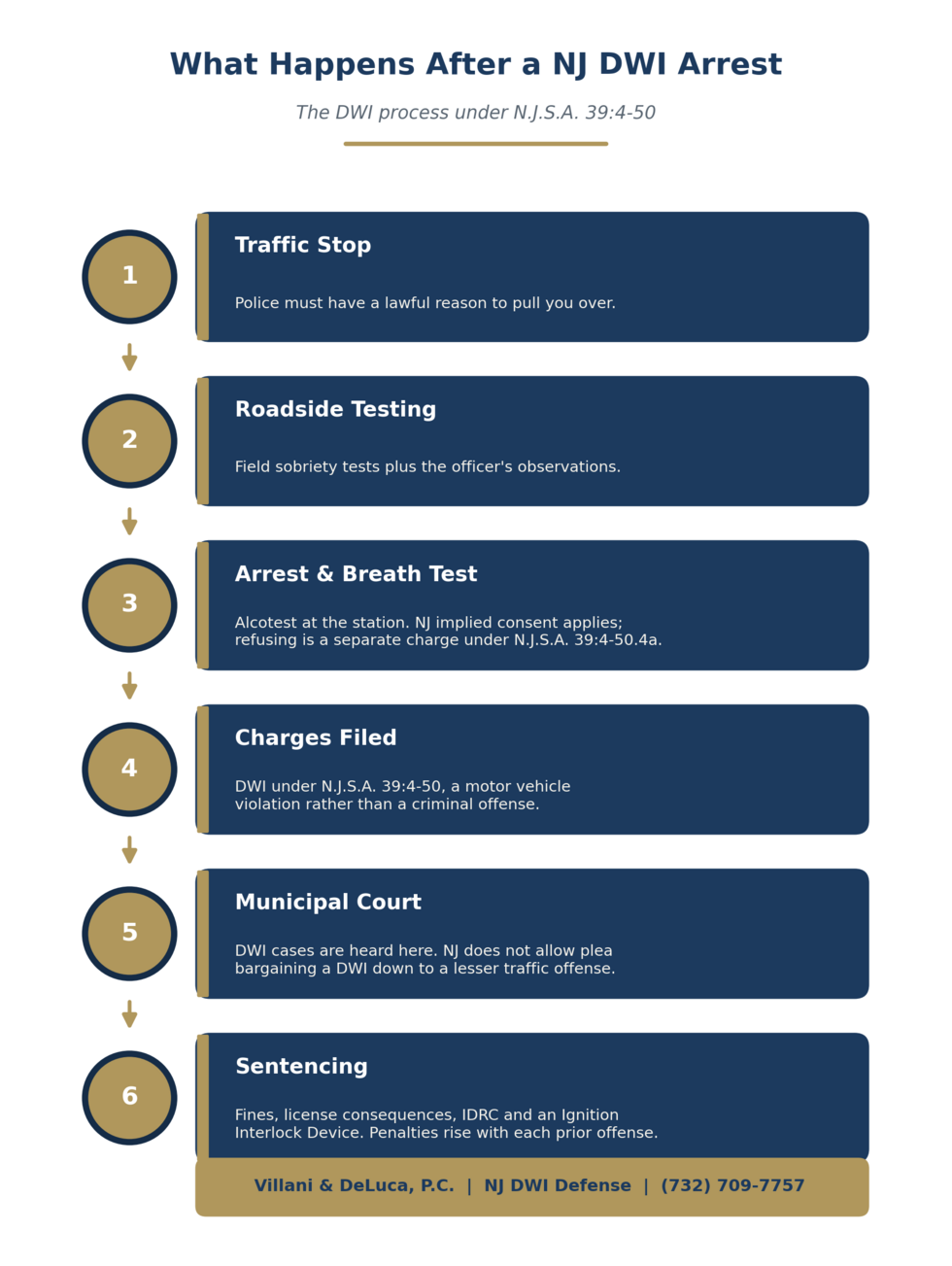
Understanding how a case moves through the system helps you see where a defense can be built. The chart below shows how a New Jersey DWI typically progresses from the traffic stop through sentencing, and where an experienced attorney can challenge the State's evidence at each stage.
Client Testimonial
Ocean County: "Thank you again for being a wonderful lawyer! I know you did the best you could for me. I am very appreciative." – R.T.
"The staff is great, professional, responsive and always super helpful. Mr. Carmine is great at his job. Even through a pandemic things were hassle free. He kept everything super simple and stress free. Even when I had questions and just emailed him and he literally responded back immediately. I would recommend to anyone that needs a lawyer. He is the BEST." – Jayson Le
"Great team and a pleasure to work with. Extremely happy I decided to move forward with Villani and Deluca. Definately reccomend this firm." – Sarah Gutman
Frequently Asked Questions
How can Villani & DeLuca, P.C. help in the defense of my DWI case?
As experienced New Jersey DWI defense attorneys we will review and thoroughly scrutinize every aspect of the facts and discovery (investigation reports) of your case. We will examine whether the arresting officer had a legally valid reason to pull you over, the observations made by the police officer, and validity of field sobriety tests conducted. Police officers may not pull over any driver on a mere whim or hunch. We will review and challenge every aspect of your arrest, leaving no stone unturned in ensuring that all laws governing police officers were followed and that your Constitutional rights were not violated. Depending on the facts of your case, Villani & DeLuca may contact one of our many outside experts to assist in your defense.
Furthermore, we will ensure that the State and Police Department have met their burden of supplying all required proofs prior to trial. We will review and challenge the Police Department's reliance on the Alcotest 7110 in your arrest. Thousands of pages have been written on the laws of New Jersey Drunk Driving. The lawyers at Villani & DeLuca have encyclopedic knowledge of these laws and will use their decades of legal experience to protect your rights.
Are DWI or DUI charges Criminal Offenses?
NO. In New Jersey a DWI or DUI is a motor vehicle violation and is not considered a criminal offense.
Will I have a criminal record if convicted of DWI, DUI or Refusal?
NO. Unlike many other states, DWI and DUI offenses are not criminal offenses under New Jersey Law. Even though not criminal, DWI, DUI and Refusal offenses in New Jersey carry very serious penalties. In addition to the loss of your New Jersey driving privileges you could be sentenced to jail under certain circumstances. The conviction will, however, remain on your motor vehicle record.
Can I still drive to school with a DUI conviction and suspension?
NO. A DWI driver's license suspension is absolute in NJ from the time of conviction until reinstatement. There are no work permits or conditional licenses available under any circumstances. Some other states have such licenses but New Jersey has a complete ban on driving during the period of suspension. Driving while suspended will result in mandatory jail.
What is the difference between DUI and DWI?
DUI is the acronym for Driving Under the Influence, and DWI is the acronym for Driving While Intoxicated. New Jersey law treats both terms under the same statute, N.J.S. 39:4-50.
Can a DWI or Refusal be expunged?
NO. Under New Jersey Statute 2C:52-28, arrests or convictions for motor vehicle offenses, including DWI or Refusal, contained in Title 39 (New Jersey Motor Vehicle and Traffic Laws) cannot be expunged.
Can I be convicted of a DUI for legally prescribed drugs in my system?
Yes. If the prescription drugs impair your ability to safely operate your motor vehicle, you can be convicted of DUI. You should carefully read all warnings on any prescription drugs. Your ability to safely operate your motor vehicle can also be caused by combining prescription drugs with alcohol or with the mixing of other drugs.
What are the penalties for a first-offense DWI in New Jersey?
Under N.J.S.A. 39:4-50, New Jersey DWI penalties are tiered by blood alcohol concentration. For a first offense with a BAC of 0.08% to 0.10%, penalties include fines of $250–$400, 12–48 hours of detention at an Intoxicated Driver Resource Center, up to 30 days of imprisonment, and mandatory installation of an Ignition Interlock Device (IID). For a BAC of 0.10% or higher, fines increase to $300–$500 with similar detention and potential imprisonment. For a BAC of 0.15% or higher, a three-month license forfeiture following IID installation is also required. As of 2026, a significant change now gives eligible first-time alcohol-based DWI offenders the ability to earn a 2-for-1 IID credit meaning two days of installation count toward one day of suspension potentially allowing some drivers to avoid a full license suspension altogether by acting quickly after arrest.
What is an Ignition Interlock Device and when is it required?
A) An Ignition Interlock Device is a breath-testing instrument installed in a vehicle that prevents it from starting if the driver's BAC registers above a preset limit. Under N.J.S.A. 39:4-50 and its companion statute N.J.S.A. 39:4-50.17, IID installation is mandatory for virtually all DWI convictions in New Jersey regardless of offense level. Following amendments that took effect April 3, 2025, and now being applied by courts in 2026, eligible drivers charged with an alcohol-based DWI may voluntarily install an IID before conviction and begin earning credit toward their mandatory IID and suspension periods immediately. This pre-conviction installation option is one of the most significant recent changes to New Jersey DWI law and can meaningfully shorten the overall length of a defendant's penalties when handled correctly.
What happens if I refuse to take a breathalyzer test in New Jersey?
A) Refusing a breath test is a separate offense under N.J.S.A. 39:4-50.4a, with its own distinct penalties — including license suspension, IID requirements, and fines — that run independently from any underlying DWI charge. New Jersey's implied consent law deems every driver on state roads to have consented to a breath test upon a lawful DWI arrest. For a refusal to be valid, the arresting officer must have probable cause for the stop, must read the Attorney General's Standard Statement in full, and must give the driver two clear opportunities to comply. As of 2026, there remains an open legal question about whether the 2025 IID credit amendments apply to refusal convictions — courts have not yet definitively resolved this, making skilled legal representation especially important in combined DWI-refusal cases.
Can a prior DWI conviction from years ago still affect my current case?
A) Yes — DWI convictions in New Jersey never expire from your driving record. However, the 10-year step-down rule under N.J.S.A. 39:4-50(a) provides meaningful relief for repeat offenders: a second DWI occurring more than 10 years after the first is sentenced as a first offense, and a third occurring more than 10 years after the second is sentenced as a second offense. The 10-year period is measured from conviction date to the date of the new offense. As of 2026, this rule remains fully in effect and can significantly reduce penalties when properly raised at sentencing with supporting documentation such as certified driver abstracts and prior judgments. Invoking the step-down provision is not automatic — it requires an attorney to affirmatively present the record to the court.
Can a DWI charge be dismissed or reduced in New Jersey?
A) New Jersey does not permit plea bargaining a DWI charge down to a lesser traffic offense — meaning prosecutors cannot agree to downgrade a DWI to reckless driving or a similar non-DWI charge. However, a DWI charge can be dismissed outright if there are constitutional or procedural defects in the case, such as lack of probable cause for the stop, an improperly administered breathalyzer test, failure to follow the Alcotest device calibration protocols, or failure by the officer to correctly read the implied consent statement before a refusal charge. As of 2026, New Jersey courts continue to scrutinize the technical reliability of breath test evidence, and defense attorneys routinely challenge test results, field sobriety evaluations, and Drug Recognition Expert testimony. A thorough review of the arrest record and discovery is essential in every DWI case.
Contact an Experienced NJ DWI Law Firm for Help
Every day, hundreds of Americans die as a result of drunk driving. Driving under the influence is a dangerous situation for everyone that is involved. Because of the serious nature of this offense, penalties for DWI and related offenses in New Jersey can be severe. If you or a loved one has been charged with driving while intoxicated, contact the lawyers of Villani & DeLuca, P.C. to protect your rights as soon as possible. The attorneys at Villani & DeLuca can be reached 24 hours a day, 7 days a week at 732-709-7757. Call today for a free consultation on how to protect your rights.
Related Articles
Learn more about specific New Jersey DWI charges, tests, and defenses:
- First Offense DWI Lawyer in New Jersey
- New Jersey Breath Test Refusal Lawyer
- Alcotest® Trained NJ DWI Attorney
- Driving Under the Influence of Drugs (DUID) Lawyer in NJ
- DUI & DWI Checkpoints in NJ
- Facing DUI Charges After a Shore Weekend?
Trusted Resources
- New Jersey Courts, Municipal Division, https://www.njcourts.gov/courts/municipal
- New Jersey Motor Vehicle Commission, https://www.nj.gov/mvc/
- Villani & DeLuca, P.C., N.J.S.A. 39:4-50 Driving While Intoxicated, https://www.villanideluca.com/resources/new-jersey-statutes/nj-drunk-driving-laws/intoxicated-nj-39-4-50
- Villani & DeLuca, P.C., N.J.S.A. 39:4-50.2 Consent to Breath Test, https://www.villanideluca.com/resources/new-jersey-statutes/nj-drunk-driving-laws/consent-to-breathalyzer-nj-39-4-50-2
- Villani & DeLuca, P.C., N.J.S.A. 39:4-50.4a Refusal to Submit to Breathalyzer, https://www.villanideluca.com/resources/new-jersey-statutes/nj-drunk-driving-laws/refusal-to-submit-to-breathalyzer-nj-39-4-50-4a
- Villani & DeLuca, P.C., N.J.S.A. 39:4-50.14 Underage Driver Under the Influence, https://www.villanideluca.com/resources/new-jersey-statutes/nj-drunk-driving-laws/underage-driver-under-the-influence-nj-39-4-50-14
- Villani & DeLuca, P.C., N.J.S.A. 39:4-50.17 Ignition Interlock Device Installation, https://www.villanideluca.com/resources/new-jersey-statutes/nj-drunk-driving-laws/interlock-device-installation-nj-39-4-50-17
- Villani & DeLuca, P.C., NJ Legal Glossary, https://www.villanideluca.com/resources/legal-glossary