

Key Point:
• A disorderly persons offense in NJ is the equivalent of a misdemeanor, handled in Municipal Court, carrying up to six months in county jail and a $1,000 fine under N.J.S.A. 2C:43-8
• Petty disorderly persons offenses carry a maximum of 30 days in jail and a $500 fine; examples include disorderly conduct and mutual fighting under N.J.S.A. 2C:33-2
• A conviction creates a permanent criminal record but may be expunged after five years, or sooner under New Jersey's Clean Slate Law (N.J.S.A. 2C:52-5.3)
Disorderly Persons Offense Lawyer in NJ
Disorderly persons offenses in New Jersey cover a range of minor criminal charges that can still have significant consequences for your record and future opportunities. Although these offenses are less severe than indictable crimes, a conviction can impact employment, professional licensing, and your reputation.
Charges such as disorderly conduct, trespassing, resisting arrest, simple assault, or using a fake ID require skilled legal guidance to protect your rights. Villani & DeLuca, P.C. has decades of experience defending clients against disorderly persons offenses and can provide knowledgeable advice and representation.
Understanding Disorderly Persons Offenses in New Jersey
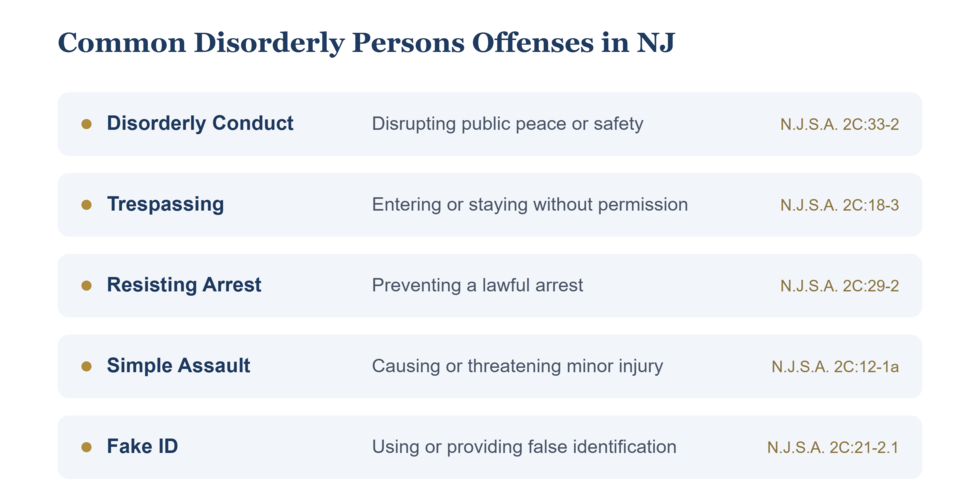
New Jersey law classifies disorderly persons offenses as more serious than petty offenses but less severe than indictable crimes. Convictions can still carry jail time, fines, and a permanent criminal record.
These laws cover a wide range of behaviors that disrupt public order, threaten safety, or violate minor laws. Each offense has unique legal elements, and understanding them is essential for mounting an effective defense.
Disorderly Conduct
Disorderly conduct involves actions that disrupt public peace or create a risk of alarm or annoyance to others. Examples include fighting in public, using offensive or abusive language, making excessive noise, or acting recklessly or disruptively. Officers have discretion when enforcing these laws, so even minor incidents can result in charges.
Under New Jersey law (N.J.S.A. 2C:33-2), a person may be charged if they:
-
Engage in fighting, threatening, violent, or tumultuous behavior, or create hazardous conditions without a legitimate purpose
-
Use unreasonably loud or offensive language in public with the intent to offend or in reckless disregard of the likelihood of offending others
“Public” areas include streets, schools, businesses, apartment buildings, or any place accessible to a substantial group of people. Convictions may carry fines up to $500, potential jail time, community service, restitution, and a permanent criminal record.
Trespassing
Trespassing occurs when someone knowingly enters or stays on property without permission. Examples include entering a neighbor's property without authorization, remaining in a bar after being asked to leave, going onto school grounds, operating an off-road vehicle on private property, or peering through windows.
New Jersey law allows limited defenses depending on the circumstances. Convictions can carry fines, community service, jail time, and a permanent criminal record that can affect employment or future opportunities.
Resisting Arrest
Resisting arrest occurs when a person intentionally prevents a law enforcement officer from making a lawful arrest. Even minor acts, sometimes arising from misunderstandings, can escalate the situation and lead to additional charges.
Charges for resisting arrest or eluding law enforcement are serious and can result in fines, jail time, and a permanent criminal record. Certain convictions may also limit employment opportunities, especially in public trust positions such as education or government work.
Simple Assault
Simple assault involves intentionally, knowingly, or recklessly causing minor bodily injury to another person or putting someone in fear of imminent serious physical injury. This can occur in fights, disputes, or situations where no serious injury results. Depending on the circumstances, it may be classified as a disorderly person's offense or, in mutual fights, a petty disorderly persons offense.
New Jersey law (N.J.S.A. 2C:12-1a) defines simple assault to include:
-
Purposely, knowingly, or recklessly causing bodily injury to another person
-
Negligently causing bodily injury with a deadly weapon
-
Using physical menace to put another person in fear of imminent serious bodily injury
Certain factors, such as assaults against police officers, school employees, or family members, can elevate the charge to aggravated assault. Domestic violence cases often result in immediate arrests, even when injuries are minor. Convictions carry fines, possible jail time, and a permanent criminal record.
Fake ID / False Identification
Using, possessing, or providing false identification in New Jersey is a criminal offense. This includes presenting a fake ID to purchase alcohol, gain entry to restricted venues, or misrepresent your identity in other situations. Even minor involvement can result in criminal charges, fines, community service, or jail time and leave a permanent record affecting employment, education, and other opportunities.
Penalties and Legal Consequences for Disorderly Persons Offenses
Disorderly persons offenses are classified as more serious than petty offenses but less severe than indictable crimes. Convictions can carry fines of up to $1,000, up to six months in county jail, probation, community service, and restitution for damages caused.
A disorderly persons conviction also creates a permanent criminal record that can affect job prospects, professional licensing, college admissions, and other long-term opportunities.

Understanding Aggravating Factors in Disorderly Persons Charges
Certain elements can increase the severity of a disorderly persons charge under New Jersey law. Offenses committed against public employees, repeated violations, domestic disputes, or conduct that endangers others may result in higher fines or longer jail sentences. Understanding these aggravating factors is key to building an effective defense and minimizing consequences.
Defense Strategies and Legal Representation
Experienced legal counsel is critical when facing a disorderly persons charge. Defense strategies can include challenging whether the prosecution can prove every element of the offense, demonstrating a lack of intent, or negotiating alternative resolutions such as diversion programs or reduced charges. An attorney can help protect your rights, limit legal exposure, and, in some cases, prevent a conviction from appearing on your record.
Contact Villani & DeLuca, P.C.
Facing a disorderly persons charge can be stressful, but you do not have to handle it alone. Villani & DeLuca, P.C. is here to help you work through the legal system and protect your future. Call us today at (732) 709-7757 to schedule a free consultation with one of our experienced New Jersey criminal defense attorneys.
Client Testimonial
"After a recent serious incident with another driver on the highway, I found myself in some legal hot water and in critical need of a competent attorney. I contacted Carmine Villani's office very late on a Saturday night and someone picked up right away. My initial consultation with Mr Villani was a lot like talking to a caring brother or a very smart, very direct, and level-headed friend. He had a strategy mapped out for my case within the 1st ten minutes of that 1st call before I even announced that I was hiring him. The direct end result of that strategy was a swift 100% dismissal of all charges filed against me. Never in my wildest dreams did I expect anything even remotely close to the results he was able to achieve. Bottom line is this: Should you ever find yourself in legal trouble for any reason anywhere in Ocean County you may get deluged by a big pile of lawyer junk mail. Do yourself a big favor. Don't even even bother looking at it; just throw it all in the trash and contact Carmine Villani.Thank me later . ." – Chuck Wright
"The staff is great, professional, responsive and always super helpful. Mr. Carmine is great at his job. Even through a pandemic, things were hassle-free. He kept everything super simple and stress free. Even when I had questions and just emailed him, he literally responded back immediately. I would recommend to anyone that needs a lawyer. He is the BEST." – Jayson Le
"Great firm ...great attorneys..." – Chris H
Frequently Asked Questions
1. What is the difference between a "crime" and a "disorderly persons offense" in New Jersey?
In many states, offenses are classified as felonies or misdemeanors. New Jersey uses different terminology. A "crime" (indictable offense) is equivalent to a felony and is heard in Superior Court. A disorderly persons offense is similar to a misdemeanor. While it is considered less severe than a crime, it is still a criminal charge handled in Municipal Court. It will appear on a criminal background check and can carry significant penalties, including jail time and fines.
2. What are some common examples of a disorderly persons offense?
New Jersey law categorizes a wide variety of behaviors under this heading. Common examples include simple assault, shoplifting (for merchandise valued under $200), possession of less than six ounces of cannabis (prior to recent legalization shifts), possession of drug paraphernalia, and harassment. There is also a sub-category called a "petty disorderly persons offense," which includes even less severe actions like disorderly conduct or mutual fighting.
3. What are the potential penalties if I am convicted?
Do not let the name mislead you; a disorderly persons offense nj carries serious consequences. If convicted, you could face up to six months in county jail and fines of up to $1,000. For a petty disorderly persons offense, the maximum jail time is 30 days with a fine of up to $500. Beyond jail and fines, the court may impose probation, driver's license suspension, or mandatory restitution to victims.
4. Will a disorderly persons conviction stay on my permanent record?
Yes. If you plead guilty or are found guilty, the offense will appear on your New Jersey criminal record. This can impact your ability to secure employment, obtain professional licenses, or rent an apartment. However, New Jersey law allows for the "expungement" of these records after a certain period—typically five years, or sooner under specific "clean slate" laws if you meet certain criteria. It is important to consult with an attorney to see if your record can be cleared.
5. I received a summons for a municipal court date. Do I really need a lawyer?
While you have the right to represent yourself, it is highly discouraged. Because a disorderly persons offense can result in a permanent criminal record and jail time, having legal counsel is vital. An experienced attorney can often negotiate with the prosecutor to have the charges downgraded to a local ordinance violation (which is not a criminal conviction) or seek a dismissal through a diversionary program.
Trusted Resources
- New Jersey Courts, Municipal Courts - Directory, https://www.njcourts.gov/courts/municipal
- New Jersey Division of Criminal Justice, Official Website, https://www.njoag.gov/about/divisions-and-offices/division-of-criminal-justice-home/
- Villani & DeLuca, P.C., NJ Criminal Statutes Resource Library, https://www.villanideluca.com/resources/new-jersey-statutes
- Villani & DeLuca, P.C., Disorderly Conduct N.J.S.A. 2C:33-2 Breakdown, https://www.villanideluca.com/resources/new-jersey-statutes/nj-disorderly-conduct-laws/disorderly-conduct-nj-2c-33-2
- Villani & DeLuca, P.C., Legal Glossary, https://www.villanideluca.com/resources/legal-glossary