
Key Point:
• A rideshare crash is a personal injury claim, but the available coverage shifts with the driver's app status under New Jersey's Transportation Network Company Act, N.J.S.A. 39:5H-1.
• When a passenger is in the car or a ride has been accepted, a $1.5 million liability policy generally applies; lower limits apply when the driver is only logged in and waiting.
• Trip logs and driver-status data are controlled by the rideshare company and can disappear quickly, so preserving that evidence early is critical.
There are moments that change everything in an instant. If you are here because you or someone you love was injured in a rideshare crash, and you are unsure what comes next, I am sorry.
A ride share accident lawyer can protect your rights, preserve time-sensitive evidence like trip logs and driver-status records, and handle the insurance calls so you can focus on treatment and recovery. If you are unsure whether you have a case or who may be responsible, a brief conversation is often enough to identify next steps and what information matters.
Rideshare crashes happen every day across Ocean County and Monmouth County - including incidents involving Lyft shared rides and an Uber share ride. These cases differ from standard car accidents because coverage can change depending on what the driver was doing at the moment of impact. The attorneys at Villani & DeLuca, P.C. can help.
Ride Share Accident Claims in New Jersey
A rideshare accident case is a personal injury claim brought when someone is hurt due to another party's negligence in a crash involving a transportation network company vehicle (such as Uber or Lyft). These claims may arise if you were a passenger, another driver, a pedestrian, or even a cyclist impacted during pick-up or drop-off.
Most cases still come down to the same fundamentals: duty of care, a breach of that duty, and a clear connection between the breach and your injuries. But rideshare claims add extra layers that standard crash cases do not. Liability can be shared among multiple parties, and insurance coverage can change based on driver status.
A ride share accident attorney can evaluate liability, identify all potentially responsible parties, and move quickly to preserve critical evidence before it disappears, including trip data, GPS records, driver logs, phone records, vehicle damage documentation, and witness statements.
Who Can File and How Deadlines Work
If you were injured in a rideshare collision, you can generally pursue compensation for medical bills, lost wages, pain and suffering, and other damages tied to the crash. Whether you were in the rideshare vehicle, a separate vehicle, or on foot, the key is documenting injuries and proving liability and damages clearly.
Timing matters. In New Jersey, personal injury claims are typically time-sensitive, and waiting can make evidence harder to obtain, especially rideshare app data and video footage. A ride share accident lawyer can help you understand what deadlines apply to your situation and what needs to be preserved right away.
If the accident resulted in a fatality, additional rules may apply, including estate-related steps. If you are unsure how the claim should be filed or who should act on behalf of the injured person or family, we can explain the process and protect the case while those administrative details are handled.
Insurance Coverage and How Our Firm Helps
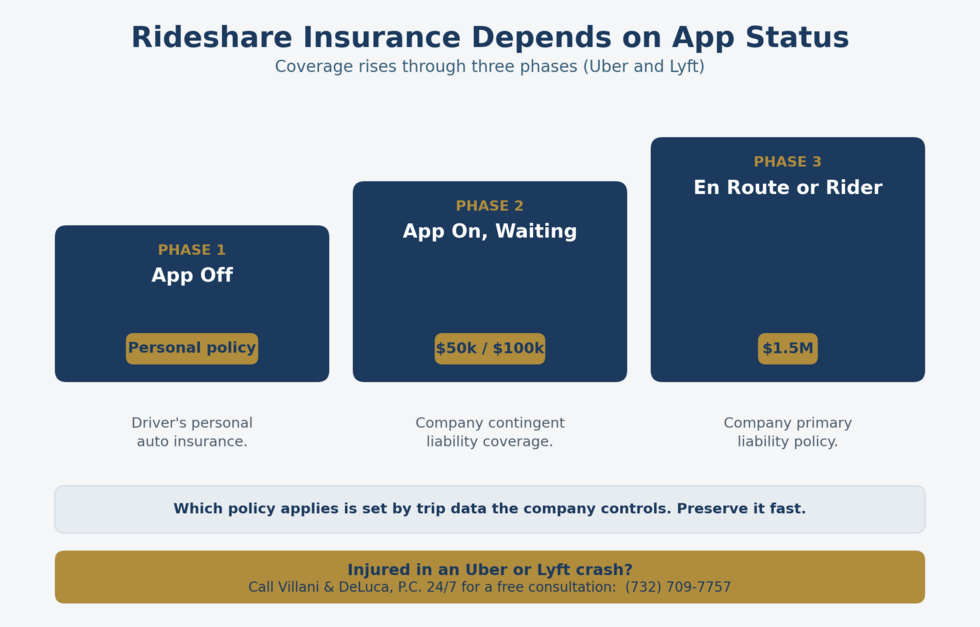
Insurance is often the most confusing part of a rideshare case. Coverage commonly depends on whether the driver was offline, logged in and waiting, en route to pick up a passenger, or actively transporting someone. That status can determine which policy applies and how much coverage is available.
If the driver was offline, personal auto insurance typically applies. If the driver was logged in and waiting, rideshare platforms often provide contingent liability coverage. Once a ride is accepted and the driver is en route, coverage typically increases significantly. And when a passenger is in the vehicle, the highest tier of coverage often applies.
Determining which coverage applies usually requires access to driver status data and trip records controlled by the rideshare company. An accident lawyer knows how to secure that evidence, pressure insurers to follow the correct coverage tier, and prevent delays that weaken your claim.
Our job is to bring structure to a chaotic time. We investigate liability, preserve evidence, manage insurer communications, document damages, and negotiate firmly for a fair result. If litigation becomes necessary, we prepare the case accordingly. An accident lawyer should be able to explain your options clearly, keep you informed, and reduce the pressure you face throughout the process.
Common Injuries in Ride Share Accidents
Rideshare crashes can cause serious injuries, especially for passengers who do not see the collision coming and cannot brace for impact. Common injuries include whiplash and neck injuries, concussions and other traumatic brain injuries, broken bones, back injuries such as herniated discs, and in severe cases spinal cord trauma. Emotional injuries such as anxiety, depression, and post-traumatic stress are also common and should be taken seriously.
Client Testimonial
"I would highly recommend him for all your legal needs" – Ken Murphy
"Villani and his firm were extremely knowledgeable and professional handling my case. I'm extremely satisfied with the outcomes. God bless you and your firm for your dedicated work." – Bernard Perutti
"Carmine is a great lawyer and my case was resolved in a minimal amount of time. Even during a pandemic, he responded quickly to any questions and concerns I had. I highly recommend him and his firm. Thank you so much Carmine!" – Karina Testa
Frequently Asked Questions
Who is responsible for my medical bills after a rideshare accident?
New Jersey is a "no-fault" state, but ride share accidents follow specific rules under the Transportation Network Company Safety and Regulatory Act. Generally, if you have your own auto insurance (or live with a relative who does), your own Personal Injury Protection (PIP) is the first source of coverage for medical bills. However, if you do not have access to a personal PIP policy, you may be covered by the rideshare company's insurance. As of 2026, NJ law requires rideshare companies to provide at least $10,000 in medical medical-payment benefits for the driver, but passengers often must look to the company's liability policy if they lack their own insurance.
Does the amount of available insurance change depending on the driver's app status?
Yes. In New Jersey, insurance coverage is "tiered" into three distinct phases:
-
Phase 1 (App Off): The driver's personal auto insurance applies exclusively.
-
Phase 2 (App On, Looking for Fare): The rideshare company provides contingent liability coverage (typically $50,000 per person / $100,000 per accident).
-
Phase 3 (Request Accepted or Passenger in Car): This is the highest level of coverage. New Jersey law (N.J.S.A. 39:5H-10) mandates a primary liability policy of at least $1.5 million for death, bodily injury, and property damage.
What if the accident was caused by an uninsured driver while I was in an Uber or Lyft?
If you are a passenger in a rideshare vehicle and an uninsured or underinsured motorist causes the crash, you are still protected. New Jersey requires rideshare companies to maintain $1.5 million in Uninsured/Underinsured Motorist (UM/UIM) coverage. This ensures that even if the at-fault driver has no insurance, there is a substantial policy available to cover your medical expenses, lost wages, and pain and suffering.
Can I still file a claim if I was the driver of another car hit by a rideshare vehicle?
Absolutely. If a rideshare driver's negligence caused your injuries, you can file a claim against them. The key is determining which policy is active. If the driver was "on the clock" (Phase 2 or 3), you may be able to access the rideshare company's much larger commercial policy. Because companies often try to shift the blame back to the driver's personal insurer to avoid paying, many victims hire a ride share accident lawyer to secure digital logs and timestamps that prove the driver was active at the time of the collision.
Why is it harder to settle a rideshare claim than a standard car accident?
Rideshare cases are notoriously difficult because they involve multiple insurance carriers (the driver's personal insurance and the company's commercial carrier) who often disagree on who should pay. Furthermore, because the policy limits are so high ($1.5 million), insurance adjusters are often more aggressive in trying to devalue the claim. A ride share accident lawyer can manage these disputes, ensuring that evidence like GPS data and app activity is preserved before it is deleted or overwritten by the rideshare company.
Call an Experienced New Jersey Ride Share Accident Lawyer to Discuss Your Case
If you or someone you love was injured in a crash involving Lyft shared rides, an Uber share ride, or any other rideshare service, talk with a ride share accident lawyer as soon as possible. Early action can affect evidence preservation, insurance coverage, and the overall strength of your case.
We offer a Free Consultation and we're available 24/7 to help you understand your options and next steps. If you have a police report, screenshots from the app, medical paperwork, or any insurance correspondence, we can review it. If you do not have everything yet, that is completely normal. We can still advise you on what to request, what to preserve, and what to avoid, including recorded statements or quick settlements.
Call Villani & DeLuca, P.C. at (732) 709-7757 today to schedule a free initial consultation.
The Bottom Line
If you or someone you love was injured in a crash involving Uber, Lyft, or any other rideshare service, talk with a rideshare accident lawyer as soon as possible. Early action can affect evidence preservation, insurance coverage, and the strength of your case. If you have a police report, screenshots from the app, medical paperwork, or insurance correspondence, we can review it. Call Villani & DeLuca, P.C. at (732) 709-7757 today.
About the Firm: Villani & DeLuca, P.C. represents rideshare and personal injury victims throughout Ocean and Monmouth Counties, New Jersey.
Related Articles
- Personal Injury Lawyer in NJ (overview)
- Car Accidents in NJ
- Bicycle Accident Lawyer in NJ
- Wrongful Death in NJ
Trusted Resources
- New Jersey Motor Vehicle Commission: https://www.nj.gov/mvc/
- New Jersey Legislature, N.J.S.A. 39:5H-1 et seq. (Transportation Network Company Safety and Regulatory Act): https://www.njleg.state.nj.us/laws/39/39-5h-1
- New Jersey Legislature, N.J.S.A. 2A:14-2 (Personal Injury Statute of Limitations): https://www.njleg.state.nj.us/laws/2a/2a-14-2
- Villani & DeLuca, P.C., Legal Glossary: https://www.villanideluca.com/resources/legal-glossary