

Key Point:
• New Jersey workers' compensation is a no-fault system under N.J.S.A. 34:15-1; you can receive benefits regardless of who caused the injury.
• Benefits include 100% of medical treatment, temporary disability (generally about 70% of your average weekly wage), permanent disability, and death benefits for dependents.
• Your employer or its insurer generally selects the treating doctor, and a serious workplace injury caused by a third party may also support a separate personal injury lawsuit.
Workers' compensation is a no-fault insurance program that medically treats and financially compensates employees who suffer injuries or illnesses on the job. It also provides death benefits to dependents of workers who die as a result of their employment. If you were injured or became ill while working as an employee in New Jersey, you may be eligible for workers' compensation to cover medical bills, ongoing care, and lost wages from missed time at work. The NJ workers' comp attorneys at Villani & DeLuca, P.C. can help.
It is important to know your rights so you receive the appropriate medical care and compensation you deserve. Under-reporting of injuries is a significant problem in the system; workers who fear retaliation may avoid reporting injuries and instead pay for treatment themselves. Often, employers or insurers will try to deny or undervalue a legitimate claim or pressure the injured employee to accept a smaller settlement than required. The moment you are injured on the job, it is up to you to protect your family's future.
Experienced Workers Compensation Lawyers in NJ
Our attorneys have over 100 years of combined experience to help determine if your injury meets the eligibility requirements for New Jersey workers' compensation. The NJ workers' comp attorneys at Villani & DeLuca P.C. have a proven track record representing individuals facing all types of workers' compensation claims in Ocean and Monmouth County, New Jersey. We will negotiate with the insurance company to be sure you get the compensation you deserve and protect your rights. Our knowledgeable lawyers understand the New Jersey laws and will guide you through them, helping you through every step of the process. It is our goal to make sure that you are adequately and fairly compensated for all your personal injury claims, including private disability claims and Social Security disability claims.
What is the New Jersey Workers' Compensation Law?
The Division of Workers' Compensation is responsible for the administration of the New Jersey Workers' Compensation Act. The law requires that all New Jersey employers have workers' compensation coverage for all employees. Workers' compensation provides medical treatment, wage replacement, and permanent disability compensation to employees who suffer job-related injuries or illnesses and death benefits to dependents of workers who have died as a result of their employment. An injured employee can receive benefits regardless of who was at fault – the employee, the employer, a coworker, a customer or some other third party.
Workers' compensation covers job-related injuries and illnesses, including injuries caused by accidents as well as by repetitive motions (repetitive trauma injuries or RTI) or constant work stresses. Workers' compensation also covers occupational diseases, such as those caused by exposure to toxic chemicals or work stress-induced heart attacks. Common claims include shoulder injuries, knee injuries, back injuries, or head and brain injuries as a result of falls, overexertion, being trapped or struck by an object, being assaulted, or motor vehicle accidents.
Generally, an injury that occurs when an employee is on his or her way to or from work does not qualify for workers' compensation benefits; however, there are some exceptions if your responsibilities demand that you be in multiple locations, or stay in the course of your employment after work hours.
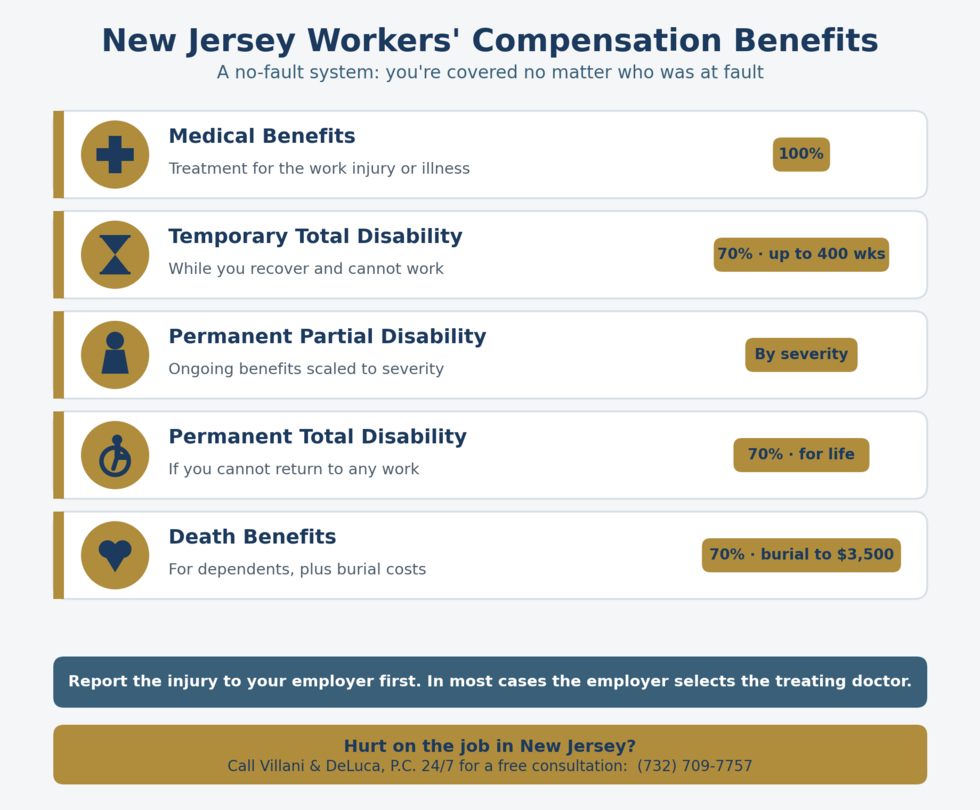
Workers' Compensation Benefits Available in New Jersey Include:
Medical Benefits (N.J.S.A. 34:15-15.2). Workers' comp pays 100% of medical bills for treatment of the work-related injury or illness, including prescriptions and hospital stays.
Temporary Total Disability (TTD). Available for injured employees who cannot work and are receiving medical care. TTD payments are generally 70% of the employee's gross average weekly wage, paid during the period of disability, not to exceed 400 weeks.
Permanent Partial Disability. Entitles you to ongoing benefits, with the weekly amount depending on the severity of the injury. These benefits begin after TTD ends.
Permanent Total Disability. If you cannot return to any type of work due to a job-related injury or illness, these benefits are generally 70% of your gross average weekly wage and can be available for life.
Death Benefits (N.J.S.A. 34:15-13). If a work-related injury or illness results in death, certain survivors have the right to death benefits, generally 70% of the deceased's weekly wage, plus coverage for burial and funeral costs up to the statutory limit.
How We Handle Your Workers' Comp Claim
We confirm your eligibility, make sure your benefits are calculated correctly from your actual wages, push back when an authorized doctor is not providing adequate care, and identify any third-party claim that could recover more than workers' comp alone.
Client Testimonial
"Was super helpful and I could not have wished for a better outcome ..very thankful I acquired their services" – Michael Ryan
"Well worth the money. Got exactly what I was looking for. Carmine knows what he's doing and talking about. Will use this firm again if needed and recommend to others to use as well." – Harrison Utter
"The office of Carmine Villiani from the front to Carmine was pleasant and professional.The outcome of my situation, better then I expected.Carmine was always available to speak with at anytime . I definitely would recommend this attorney to family or friends." – Grace Elia
Frequently Asked Questions
What are the maximum weekly benefits for a workplace injury?
As of January 1, 2026, the New Jersey Department of Labor has increased the maximum weekly benefit for temporary disability, permanent total disability, and dependency claims to $1,199. This is an increase from the 2025 rate of $1,159.
If you are unable to work due to a work injury, you are generally entitled to 70% of your average weekly wage, provided it does not exceed this new 2026 cap. The workers' compensation attorneys at Villani & DeLuca can review your pay stubs to ensure your benefits are calculated accurately under these updated state guidelines.
Does New Jersey offer specific protections for First Responders?
Yes. In January 2026, New Jersey enacted the First Responders Post-Traumatic Stress Disorder Protection Act (S2373/A2145). This landmark law prohibits employers from terminating or discriminating against paid first responders who are diagnosed with PTSD resulting from their work.
Furthermore, the Thomas P. Canzanella Act continues to provide a "rebuttable presumption" that certain cancers and cardiovascular issues in public safety workers are work-related. If you are a first responder facing a claim denial, our firm can help you leverage these 2026 protections to secure the care you deserve.
Can I choose my own doctor for a workers' comp claim?
In New Jersey, the employer (or their insurance carrier) generally has the legal right to select the treating physician for your work injury. If you seek treatment from your own doctor without prior authorization, the insurance company may not be required to pay those medical bills.
However, if the employer-authorized doctor is not providing adequate care, a workers' compensation attorney can file a Motion for Medical and Temporary Benefits to request a change in physicians. This process is often necessary for complex construction accidentsor long-term occupational illnesses.
What is a "Section 20" settlement?
A Section 20 settlement (under N.J.S.A. 34:15-20) is a lump-sum payment that essentially closes your case forever. In exchange for this one-time payment, you waive your right to future medical treatment and the right to reopen your claim later if your condition worsens.
In 2026, with medical costs rising, a Section 20 settlement should only be considered after a careful evaluation. Most of our clients instead pursue an "Order Approving Settlement," which provides a percentage of disability while leaving the door open to future medical care and permanency awardsif the injury reoccurs within two years.
How does the "Board and Lodging" update affect my benefit rate?
Effective January 12, 2026, a new law (S3772) modernized how "board and lodging" is calculated when determining an employee's average weekly wage. If your employer provided housing or meals as part of your compensation, these must now be calculated at their current market value rather than outdated fixed rates.
Contact an Experienced New Jersey Personal Injury Law Firm for Help
If you have been injured on the job, first, report the incident to your employer and get the medical treatment that you need. Then contact an attorney experienced in handling workers' compensation matters so you can understand all of your rights and obligations related to filing for workers' compensation in NJ. At Villani & DeLuca P.C., we are always available to speak with you 24 hours a day, 7 days a week. You will receive personal attention and sound legal counsel from the initial consultation throughout the entire process.
Contact the New Jersey workers' compensation lawyers of Villani & DeLuca, P.C. at (732) 709-7757to protect your rights as soon as possible. Call today for a free consultation with an experienced worker's compensation attorney. We serve clients throughout Ocean County and Monmouth County, New Jersey.
The Bottom Line
If you have been injured on the job, report the incident to your employer, get the medical treatment you need, and then contact an attorney experienced in workers' compensation so you understand your rights and obligations. At Villani & DeLuca, P.C., we are available 24/7 and serve clients throughout Ocean and Monmouth County. Call (732) 709-7757 to protect your rights as soon as possible.
About the Firm: Villani & DeLuca, P.C. represents injured workers and personal injury victims throughout Ocean and Monmouth Counties, New Jersey.
Related Articles
- Personal Injury Lawyer in NJ (overview)
- Construction Accidents in NJ
- Slip and Fall Accidents in NJ
- Wrongful Death in NJ
Trusted Resources
- New Jersey Department of Labor, Division of Workers' Compensation: https://www.nj.gov/labor/wageandhour/tools-resources/laws/workerscompensation.shtml
- New Jersey Legislature, N.J.S.A. 34:15-1 (Workers' Compensation Act): https://www.njleg.state.nj.us/laws/34/34-15-1
- Villani & DeLuca, P.C., Legal Glossary: https://www.villanideluca.com/resources/legal-glossary