

Key Points
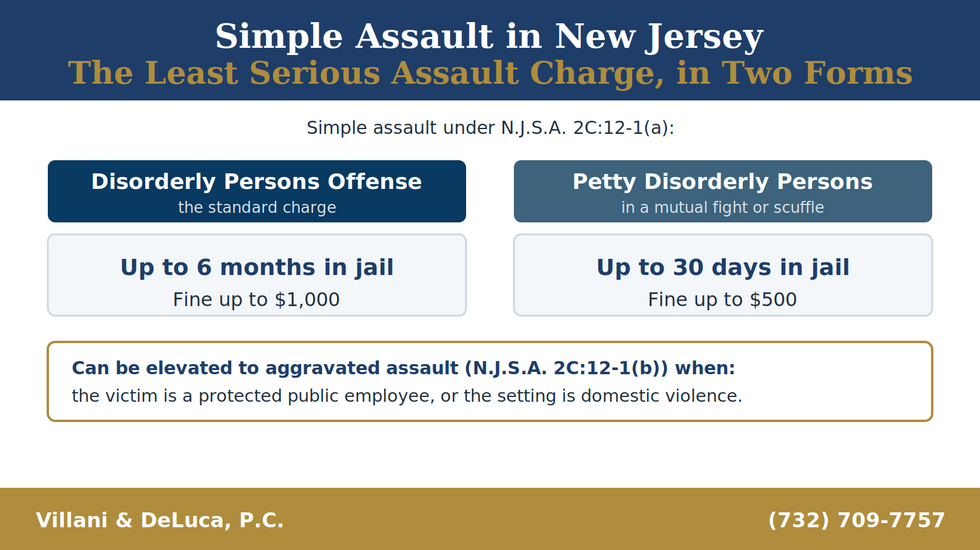
• Simple assault under N.J.S.A. 2C:12-1(a) is a disorderly persons offense or a petty disorderly persons offense when it happens in a mutual fight.
• Penalties reach up to six months in jail and a $1,000 fine for a disorderly persons offense, or up to 30 days and a $500 fine for the petty variety (N.J.S.A. 2C:43-8, 2C:43-3).
• A protected victim or a domestic setting can elevate a simple assault to aggravated assault under N.J.S.A. 2C:12-1(b).
Simple Assault NJ: Understanding the Law in New Jersey
In New Jersey, simple assault is either a disorderly person's offense or a petty disorderly persons offense, depending on whether the assault was committed in a mutual fight or scuffle. Despite being the least serious assault charge in the state, disorderly assault can still carry significant penalties depending on the situation. For example, a simple assault involving domestic violence is almost sure to result in an arrest. If you or a loved one is facing a simple assault charge in New Jersey, it's essential to contact seasoned legal counsel to help defend against potentially serious legal consequences.
What is Simple Assault?
Simple assault is defined under N.J.S.A. 2C:12-1a. A person can be convicted of simple assault if they commit one of the following acts:
-
Purposely, knowingly, or recklessly attempts to or does cause bodily injury to another person
-
Negligently causing bodily injury to another person with a deadly weapon
-
Attempts to put another person in fear of imminent serious bodily injury through the use of physical menace
Understanding a few key terms is essential to grasp the law entirely. Bodily injury is physical pain, illness, or impairment of a physical condition. Serious bodily injury is an injury that creates a substantial risk or causes serious, permanent disfigurement or protracted loss or impairment of the function of a bodily member or organ.
Physical menace is a term that describes a physical act that threatens a victim with a serious bodily injury (not just a “bodily injury”). Think of a perpetrator pulling out a gun and waving it towards a person or revealing a knife tucked in their coat pocket. These actions would put any reasonable person in fear of a serious bodily injury like a stab or gunshot wound.
Simple assaults can become more serious offenses depending on the specific circumstances of the assault. Factors that determine the seriousness of the offense include the severity of the injury caused, the perpetrator's mental state, and the victims' status. For example, a simple assault against a police officer or certain other public employees will be heightened to aggravated status automatically. Likewise, simple assaults that occur within a family unit or between spouses will be considered domestic violence cases. In domestic violence cases, police are likely to make an arrest even if only minor injuries are present in the victim. It's important to note that in New Jersey, domestic violence cases will not be dropped by the prosecution simply because a family member does not wish to press charges.
Charged with simple assault in Ocean or Monmouth County? Call Villani & DeLuca, P.C. at (732) 709-7757 for a free, confidential consultation, or contact us online. A former Municipal Prosecutor will review the police report with you.
Simple Assault vs. Aggravated Assault
The severity of the injuries caused, the victim's classification, and other specific circumstances dictate whether an assault in New Jersey will be classified as simple or aggravated. As mentioned, simple assaults committed against certain state employees, like police officers, firefighters, corrections officers, emergency response personnel, and school teachers, will automatically be classified as aggravated assault. This is true whether or not the accused was aware the victim belonged in one of these protected categories.
Another common deciding factor in determining how an assault will be classified is the severity of the injuries caused. If an assault only results in bodily injury and no other aggravating factors are present, then it will be classified as a simple assault. However, any assault that results in serious bodily injury is considered aggravated. Aggravated assaults are classified into different degrees depending on the severity of the assault. The highest charge of aggravated assault is second-degree aggravated assault. People found guilty of second-degree aggravated assault will face hefty fines of up to $150,000, up to 15 years in jail, and will be forced to serve at least 85% of their sentence under the No Early Release Act.
If you are facing simple or aggravated assault charges, we encourage you to contact our law firm for a confidential consultation to learn how we can help fight for the best possible outcome in your case.
The Disorderly person's offense of Simple Assault
To be convicted of the disorderly persons' offense, specifically classified as simple assault in New Jersey, the prosecution must prove beyond a reasonable doubt that the accused:
-
Intentionally, knowingly, or recklessly caused bodily harm to another individual
-
Negligently caused bodily harm with a deadly weapon (like a knife or a gun) or,
-
By use of threat, put another person in fear of imminent serious bodily injury.
Reducing simple assault from a disorderly person's offense to a petty disorderly person's offense
In a mutual consent fight the charge can be reduced to a petty disorderly persons offense.
Defenses in a Simple Assault Case
Although the defense does not have any burden of proof in a criminal case, there are many available defenses should the defendant wish to use them. Common defenses to simple assault include:
-
Self-Defense: Individuals have a right to defend themselves against a direct threat of bodily harm. The force must be proportionate to the perceived threat, and the individual asserting self-defense must not have instigated the confrontation.
-
Imperfect Self-Defense: If an individual genuinely believes they were under threat, even if, in hindsight, the belief seems unreasonable, they may assert imperfect self-defense
-
Defense of Others: Similar to self-defense, this defense applies when the defendant defends a third party from imminent harm. The protective force must be proportionate to the perceived threat and necessary to prevent damage to another person.
-
Mistaken Identity: This defense asserts that the perpetrator has not been accurately identified. Mistaken identity is more likely to be a successful defense if there is doubt about the perpetrator's identity or whereabouts at the time of the alleged assault.
-
Mutual Combat: If both parties willingly engage in a physical altercation, this defense might reduce penalties. It suggests shared responsibility for the altercation rather than unilateral aggression.
-
Lack of Intent: This strategy is often the best way to challenge a simple assault charge. The defendant can provide evidence that they were not in the necessary state of mind (purposely, knowingly, recklessly) required to support a simple assault conviction.
An effective defense strategy must be tailored to the specific circumstances of the assault. It is advisable to consult with a legal expert to determine the best plan for your particular case.
When can clear my record of a simple assault charge
Clearing a criminal record is known as Expungement, which is the legal process of removing any criminal conviction record from an individual's criminal history. It is a powerful tool that gives individuals who meet certain conditions a fresh start. This can be especially beneficial to individuals seeking employment or public benefits.
An individual convicted of up to five simple assaults may qualify for expungement under N.J. Stat. § 2C:52-3. To qualify, the individual must wait five years from the latest conviction, pay all related fines, and successfully complete parole or probation.
Client Testimonial
"Very knowledgeable and provides excellent service and referrals. I trust Vince to lead me down the right path, especially important when you are going through a divorce and transition. Reasonable and responsive. Definitely recommend!" – C H
"Great team and a pleasure to work with. Extremely happy I decided to move forward with Villani and Deluca. Definately reccomend this firm." – Sarah Gutman
"Carmine is the best. He is sharp and very accessible. Highly recommend for any legal matter. Furthermore, Carmine always delivers phenomenal results. He is the man for the job or legal issue. Don't waste your time with anyone else! 10 out of 10!" – – Chris Dio
Frequently Asked Questions
1. What is a simple assault charge?
Under New Jersey law (N.J.S.A. 2C:12-1a), a person is guilty of simple assault if they attempt to cause, or purposely, knowingly, or recklessly cause, bodily injury to another. This can also include cases where someone negligently causes injury with a deadly weapon or uses "physical menace" to put someone in fear of immediate serious harm. New Jersey courts continue to define "bodily injury" broadly, meaning even minor physical pain, a small cut, or a bruise is enough to justify a charge. If you are unsure of how the law applies to your specific situation, a simple assault lawyer can review the police report and help you understand the strength of the state's case.
2. What are the potential penalties for a simple assault conviction?
Simple assault is generally classified as a disorderly persons offense (the New Jersey equivalent of a misdemeanor). If convicted, you could face up to six months in the county jail and a fine of up to $1,000. Additionally, the court may order probation, community service, or mandatory anger management classes. New Jersey's "Clean Slate" laws have evolved, but an assault conviction will still create a criminal record that could impact your future employment or housing until it is eligible for expungement.
3. Can a simple assault be downgraded or dismissed?
Yes. If the incident occurred during a "fight or scuffle entered into by mutual consent," the charge may be downgraded to a petty disorderly persons offense, which carries a maximum of only 30 days in jail. Furthermore, many first-time offenders are eligible for diversionary programs like Conditional Discharge. Completing such a program leads to a total dismissal of the charges, keeping your record clean. A simple assault lawyer is essential in negotiating these downgrades with the municipal prosecutor.
4. Do I need a lawyer for a "minor" assault charge in Municipal Court?
While simple assault is heard in Municipal Court, the consequences are far from minor. A conviction can result in a permanent criminal record and even jail time. Furthermore, if you are a licensed professional or have a specific immigration status, an assault conviction can have devastating secondary consequences. An experienced criminal defense attorney can often identify procedural errors—such as a violation of your Miranda rights—that could lead to the evidence being suppressed or the case being dismissed.
5. Does a simple assault charge automatically involve domestic violence?
Not always, but it is very common. If the alleged assault is between people in a "protected relationship"—such as spouses, former partners, or housemates—the case is treated as an act of domestic violence. This may often result in a mandatory arrest and the immediate issuance of a Temporary Restraining Order (TRO). These cases are unique because you must defend against both the criminal charge in Municipal Court and the civil restraining order in Superior Court.
Seeking Legal Help
Facing criminal charges is a daunting experience, and trying to face it alone can sabotage your chances of success. At Villani & DeLuca, P.C., we understand that every criminal case has unique challenges. With our team's background as former NJ prosecutors and our commitment to aggressive representation, we're well-equipped to handle your case with the care and attention it deserves. Whether you're a first-time offender or have previous convictions, our dedicated attorneys are ready to defend your rights and achieve the most favorable outcome for your situation.
Don't let your legal situation consume your peace of mind. Take the first step towards defending your rights by contacting Villani & DeLuca, P.C. We offer a complimentary consultation to evaluate your case and determine a defense strategy. Call us now or reach out online to schedule your free consultation!
Related Articles
Learn more about assault and related charges in New Jersey:
- New Jersey Assault Lawyer
- Assault & Aggravated Assault
- Assault on a Police Officer
- Domestic Violence
Trusted Resources
- New Jersey Courts, Criminal Division, Superior Court, njcourts.gov/courts/superior/criminal
- New Jersey Division of Criminal Justice, Official Website
- Villani & DeLuca, P.C., NJ Criminal Statutes Resource Library, https://www.villanideluca.com/resources/new-jersey-statutes
- Villani & DeLuca, P.C., Simple Assault N.J.S.A. 2C:12-1(a) Breakdown, https://www.villanideluca.com/resources/new-jersey-statutes/nj-assault-laws/simple-assault-nj-2c-12-1a
- Villani & DeLuca, P.C., Legal Glossary, https://www.villanideluca.com/resources/legal-glossary