

Key Points:
• Trespassing under N.J.S.A. 2C:18-3 occurs when a person knowingly enters or remains in a place without license or privilege to be there.
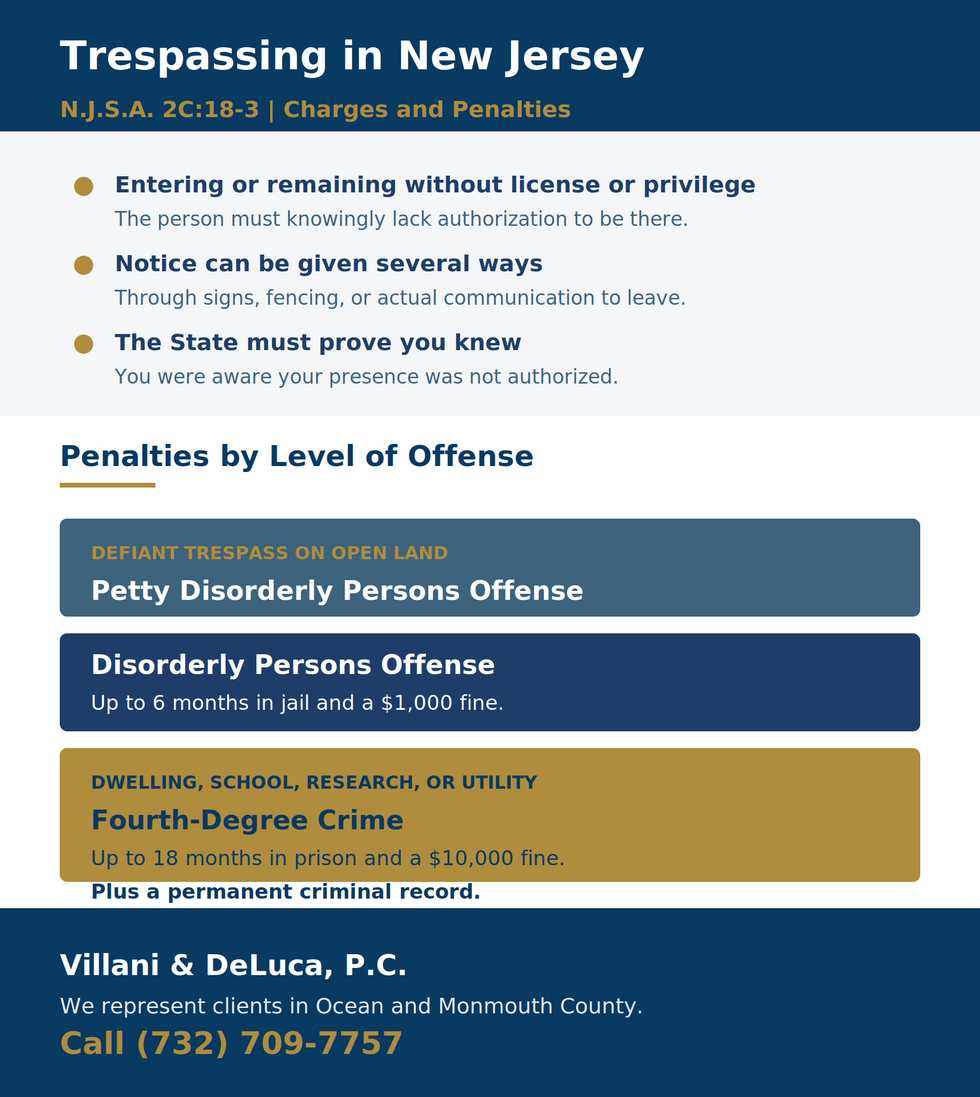
• Trespassing is typically a petty disorderly persons offense but becomes a fourth-degree crime when it occurs in a dwelling, school, research facility, or utility property.
• Notice can be given through signs, fencing, or actual communication and the State must prove you knew your presence was not authorized.
Experienced NJ Trespassing Lawyers
An individual may be charged with trespassing in New Jersey under a variety of circumstances by:
- Entering onto a neighbor's property in order to retrieve something.
- Re-entering or remaining in a bar or nightclub after having been asked by the owners or their representatives to leave the premises.
- Entering onto school property unwelcomed.
- Entering onto private property and operating an off-road vehicle on that property.
- Entering onto farmland.
- Entering onto the property of a utility company.
- Peering through a window (which is considered a form of trespassing because it invades the privacy of the people on the other side of the windows).
Committing any of these acts, and countless others not mentioned here, could result in a charge of trespassing being entered against you. If you have been charged with trespassing, you need an experienced NJ criminal defense attorney familiar with Ocean County and Monmouth County to represent you. The New Jersey statute that covers trespassing provides, in limited circumstances, for affirmative defenses to the charge of trespassing. Discussing your case with a knowledgeable attorney will help determine your rights.
Client Testimonial
"Great team and a pleasure to work with. Extremely happy I decided to move forward with Villani and Deluca. Definately reccomend this firm." – Sarah Gutman
"Was super helpful and I could not have wished for a better outcome ..very thankful I acquired their services" – Michael Ryan
"Professional, and got my issue resolved in a minimal amount of time.Thank you" – Julie Sindel
Frequently Asked Questions
1. What is the legal definition of trespassing?
Under New Jersey's trespassing laws (specifically N.J.S.A. 2C:18-3), trespassing occurs when a person enters or remains in a place while knowing they do not have the license or privilege to be there. This can apply to buildings (unlicensed entry of structures), open land (defiant trespass), or even peering into someone's window to invade their privacy. The law continues to focus on the "knowledge" of the individual—meaning the state must prove you were aware that your presence was not authorized.
2. Can I be charged with trespassing if there are no "No Trespassing" signs?
Yes. While signs are a common way to give notice, they are not always required for a trespassing charge. Notice can also be given through actual communication (someone telling you to leave) or through fencing and enclosures designed to keep people out. However, if the property was open to the public at the time of entry, a criminal defense lawyer may be able to argue that you had a reasonable belief you were allowed to be there, which is a powerful affirmative defense in New Jersey.
3. What are the different levels of trespassing charges?
New Jersey classifies trespassing based on the location of the offense. "Defiant trespass" on open land is typically a petty disorderly persons offense. However, the charge is upgraded to a fourth-degree crime (a felony-level offense) if the trespassing occurs in a dwelling, a school, a research facility, or on utility company property. Following the legal updates, the presence of a firearm during the act can also significantly upgrade the severity of the charge and the potential for mandatory prison time.
4. What are the potential penalties for a trespassing conviction?
The penalties vary by the degree of the offense:
-
Petty Disorderly Persons Offense: Up to 30 days in jail and a $500 fine.
-
Disorderly Persons Offense: Up to 6 months in jail and a $1,000 fine.
-
Fourth-Degree Crime: Up to 18 months in prison and a $10,000 fine. Beyond jail and fines, a conviction results in a permanent criminal record. Repeat offenders of defiant trespass may also face mandatory community service and increased periods of incarceration under newer "quality of life" sentencing guidelines.
5. How is trespassing different from burglary?
The main difference is intent. A trespassing charge simply alleges that you were somewhere you weren't supposed to be. Burglary is a more serious second- or third-degree crime because it alleges you entered a structure with the specific intent to commit another crime inside, such as theft or assault. If the prosecution cannot prove that secondary intent, a skilled lawyer for trespassing may be able to have a burglary charge downgraded to simple trespassing.
Call An Experienced NJ Trespassing Lawyer
If you have been charged with trespassing in New Jersey, contact one of Villani & DeLuca's criminal defense attorneys at (732) 709-7757 for a free consultation. An experienced Villani & DeLuca, P.C. attorney will consider the facts of your case in light of the law, and devise an effective defense strategy. We represent clients throughout Ocean and Monmouth County New Jersey.
Related Articles
Learn more about trespassing charges in New Jersey in our articles:
Trusted Resources
- New Jersey Courts, Municipal Courts - Directory, https://www.njcourts.gov/courts/municipal
- New Jersey Division of Criminal Justice, Official Website, https://www.njoag.gov/about/divisions-and-offices/division-of-criminal-justice-home/
- New Jersey Legislature, N.J.S.A. 2C:18-3 (Trespassing), https://www.njleg.state.nj.us/laws/2c/2c-18-3
- New Jersey Legislature, N.J.S.A. 2C:43-8 (Sentencing for Disorderly Persons Offenses), https://www.njleg.state.nj.us/laws/2c/2c-43-8
- Villani & DeLuca, P.C., NJ Criminal Statutes Resource Library, https://www.villanideluca.com/resources/new-jersey-statutes
- Villani & DeLuca, P.C., Legal Glossary, https://www.villanideluca.com/resources/legal-glossary