
Key Point:
• A wholesale liquor license (Class B) is required to distribute alcohol to retailers, not to sell directly to the public
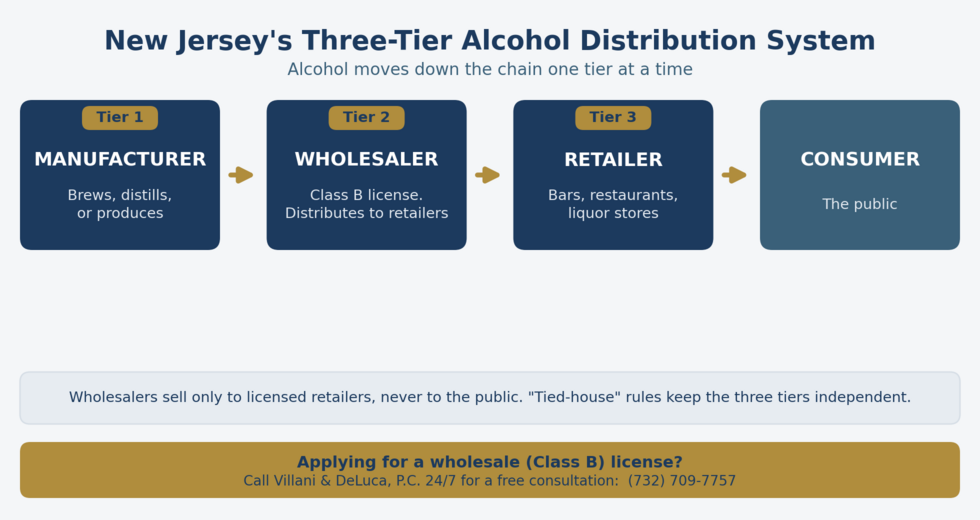
• NJ runs on a three-tier alcohol distribution system: manufacturers sell to wholesalers, wholesalers sell to retailers, retailers sell to consumers
• A Class B liquor license is issued by the state, with its own application, warehouse, and background requirements
• A NJ wholesale liquor license attorney can help you apply, meet compliance standards, and avoid the errors that stall approvals
In New Jersey, the manufacture, sales, and distribution of alcoholic beverages are regulated by the State's Division of Alcoholic Beverage Control. In addition to setting statutes pertaining to the commerce of alcoholic beverages, the Division of ABC enforces and investigates violations of the state and local ABC laws. Licensing guidelines are also set by the Division of ABC, which offers three main categories: manufacturer, retail and wholesale liquor licenses.
Class B or wholesale liquor licenses are required for the selling and distribution of alcoholic beverages to retail outlets and wholesalers. Each license grants specific privileges, such as permitting the licensee to sell to out-of-state retailers or to sell chilled malt beverages in kegs and barrels. The State Beverage Distributor's License is the most limited, since no more than 72 can be issued for the entire State of New Jersey. Any deviation from the guidelines set forth under a license can be viewed as an ABC violation, which the State takes very seriously. The Division of ABC considers it “a privilege to operate a business in the liquor industry and that this privilege may be forfeited for violations of the alcoholic beverage law.”
Download: Alcoholic Beverage Control Handbook for Retail Licensees
Understanding NJ's Alcohol Distribution System
In order to be in full compliance of the ABC guidelines, it is imperative to understand New Jersey's complex system of alcohol control laws. With rare exceptions, New Jersey operates under a three-tier alcohol distribution system, in which alcoholic beverages are sold from the manufacturer to the wholesaler, who then sells to the retailer, who may then only sell directly to customers. One such exception exists for Atlantic City casinos, which must purchase alcoholic beverages directly from the wholesaler. In general, Atlantic City casinos operate under different rules from other liquor licensed establishments because their alcohol control laws are set forth by the Casino Control Commission and the Division of Gaming Enforcement. Exceptions from state and local ABC laws also exist for federal enclaves, such as military bases.
Municipal Alcoholic Beverage Control Boards
New Jersey also allows each municipality to pass ordinances to control alcoholic beverage sales within its own borders. Thus, a municipality can set specific requirements on State regulations, such as limiting the hours of alcohol sales, and nature and condition under which a licensed premise may operate. Municipalities with 15,000 or more residents may also appoint their own Alcoholic Beverage Control Board to oversee ABC regulations and process license applications for premises within their own borders. It is essential that applicants check both the state and municipal laws before applying for a wholesale liquor license.
Shipping Alcohol to New Jersey Households
One frequently discussed the issue among alcoholic beverage wholesalers is the direct shipping of wine to individual customers. In 2004, New Jersey passed a law that prohibited both in-state and out-of-state wineries from shipping directly to customers. This statute was declared unconstitutional by the Third Circuit Court of Appeals in 2010 since it violated the terms of the U.S. Constitution's Interstate Commerce Clause. Further action was taken in 2012 when Governor Christie officially signed into law the bill that allowed in-state and out-of-state wineries to ship wine directly to customers in New Jersey. This is a rare exception to the state's three-tier alcohol distribution system, in which a winery is normally required to sell to a retailer, who then sells to the customer. However, wineries cannot ship to anyone under the age of 21, nor can they ship more than 12 cases per year to a single customer. In addition, only wineries that produce less than 250,000 gallons per year are permitted to ship directly to New Jersey customers. The 250,000-gallon rule does not affect New Jersey wineries, which all produce less than that amount, but it does rule out 90% of all wineries outside of New Jersey. Proponents of the bill are concerned about the constitutionality of this rule since a similar limitation in Massachusetts was struck down by the United States Supreme Court in 2008.
Directing shipping of alcoholic beverages has and continues to apply only to wineries, although beer and hard liquor can be shipped from a wholesaler to a licensed retailer. Otherwise, beer and hard liquor must be transported to the seller, which requires obtaining a Class D, or transportation license. A transportation license applies to manufacturers and wholesalers only; it does not apply to retail licensed businesses that deliver directly to the customer. Although rare, New Jersey liquor stores can deliver alcoholic beverages to a customer's home or car. The delivery must be made in a car or van, and take place during the hours when alcohol sales are permitted by the municipality. Deliveries can only be made to customers 21 years of age or older, who have paid for the alcoholic beverages in advance. There is no licensing requirement at all specifically for this type of delivery, as long as the delivery is made by a retail liquor licensed establishment.
Download: Alcoholic Beverage Control Handbook for Retail Licensees
Client Testimonial
"Carmine is the best. He is sharp and very accessible. Highly recommend for any legal matter. Furthermore, Carmine always delivers phenomenal results. He is the man for the job or legal issue. Don't waste your time with anyone else! 10 out of 10!" – Chris Dio
"Carmine is a great lawyer and my case was resolved in a minimal amount of time. Even during a pandemic, he responded quickly to any questions and concerns I had. I highly recommend him and his firm. Thank you so much Carmine!" – Karina Testa
"Well worth the money. Got exactly what I was looking for. Carmine knows what he's doing and talking about. Will use this firm again if needed and recommend to others to use as well." – Harrison Utter
Frequently Asked Questions
1. What is the role of a wholesale liquor business in New Jersey?
New Jersey operates under a "three-tier" system for alcohol distribution. This system separates the industry into three distinct levels: manufacturers (Tier 1), wholesalers (Tier 2), and retailers (Tier 3). A wholesale liquor entity acts as the essential middleman, purchasing products from manufacturers or importers and selling them to licensed retailers, such as bars, restaurants, and liquor stores. This structure is designed to prevent monopolies and ensure an orderly market.
2. What are the different types of wholesale licenses available?
There are several classes of wholesale licenses issued by the New Jersey Division of Alcoholic Beverage Control (ABC), depending on what you intend to distribute:
-
Plenary Wholesale License: Allows for the distribution of all types of alcoholic beverages (beer, wine, and spirits).
-
Limited Wholesale License: Restricts the holder to distributing brewed malt beverages (beer) and naturally fermented wines.
-
Wine Wholesale License: Specifically for the distribution of wine and wine-based products. Choosing the right license depends on your business model and the specific products you plan to represent.
3. How is a wholesale license different from a retail license?
The primary difference is the customer base. While a retail license allows you to sell to the general public, a wholesale license strictly limits your sales to other licensees. In New Jersey, you generally cannot hold an interest in both a wholesale business and a retail business simultaneously due to "tied-house" restrictions, which are meant to keep the tiers of the industry independent.
4. I want to start a distribution business; how to get a wholesale license?
Learning how to get a wholesale license involves a rigorous state-level application process. Unlike retail licenses, which are often handled by local municipalities, wholesale licenses are issued directly by the State Director of the ABC. The process includes:
-
Submit a detailed 12-page application.
-
Undergoing a thorough background check and fingerprinting.
-
Providing a full financial disclosure to prove the "source of funds" for the business.
-
Securing a physical warehouse location that meets specific state security and storage requirements.
5. What is the "Notice of Intention" requirement?
Before a wholesale license can be granted, an applicant must publish a "Notice of Intention" in local newspapers. This allows the public or other industry members to file a formal objection if they believe the applicant does not meet the "good moral character" requirements or if the location is unsuitable. If an objection is filed, the ABC may hold a hearing to determine if the license should still be issued.
Contact an ABC Lawyer in New Jersey
The complexity of New Jersey's alcoholic beverage control laws become obvious to any business owner who attempts to apply for a liquor license. With constant changes in both the state and municipal statutes, most owners find it difficult to stay in full compliance with New Jersey's ABC laws. If you are in the process of applying for a wholesale liquor license, please speak to the experienced ABC lawyers of Villani & DeLuca. A liquor license application is full of legal technicalities and complicated requirements, which you may not understand without help from a knowledgeable attorney.
We invite you to schedule a consultation with Jeffrey A. Warsh, Esq., former staff attorney for the NJ Division of Alcoholic Beverage Control. Mr. Warsh is a current member of the Alcoholic Beverage Control Advisory Counsel and has been representing clients in both the private and public sector for over 20 years. Whether you have questions about what type of license your business needs, or require legal representation for an ABC disciplinary hearing, Villani & DeLuca ABC lawyers have the experience to help you resolve your legal issues.
Related Articles
Learn more about liquor licensing in New Jersey:
- Buying a Retail Liquor License in NJ
- Selling a Retail Liquor License in NJ
- Liquor License Enforcement in NJ
- Liquor Manufacturing License Attorneys
- Understanding Wholesale Liquor Licenses
Trusted Resources
- NJ Division of Alcoholic Beverage Control (ABC), Official Website, https://www.nj.gov/oag/abc/
- NJ ABC Handbook for Retail Licensees, https://www.nj.gov/oag/abc/
- NJ Legislature, Title 33 Intoxicating Liquors N.J.S.A. 33:1-12.14, https://www.njleg.state.nj.us/
- NJ Division of Taxation, Alcoholic Beverage Retail License Clearance, https://www.nj.gov/treasury/taxation/
- Villani & DeLuca, P.C., Legal Glossary, https://www.villanideluca.com/resources/legal-glossary