
Key Points
- A breath test refusal is a separate charge from DWI. Under N.J.S.A. 39:4-50.4a, refusing a lawful breath test carries its own penalties, including license loss and an ignition interlock requirement, on top of any DWI charge.
- New Jersey's implied consent law applies to every driver. Under N.J.S.A. 39:4-50.2, driving on New Jersey roads means you have already consented to a breath test when an officer has reasonable grounds to request one.
- The State must prove four elements to convict. Probable cause, a lawful arrest, the Attorney General's Standard Statement read in a language you understand, and an actual refusal, each required under N.J.S.A. 39:4-50.4a.
With the Right Lawyer, Your NJ Breath Test Refusal Case Can Be Successful
Charged with a DWI/DUI or a breath test refusal? If so, you should contact a New Jersey Lawyer to protect your rights. The NJ attorneys at Villani & DeLuca are there for you and can be reached 24 hours a day, 7 days a week. Give them a call today at (732) 709-7757
Our Process is Straightforward
Step 1 – Schedule Your Free Consultation
To find out more about how we can build a case for your breath test refusal charge we'll schedule a time to meet with you. If you are unable to meet in person, we can schedule a phone call. Our NJ attorneys are experienced in breath test refusal cases. With their knowledge in law and an understanding of your situation, your chance of having a successful case is improved. Let us help you with your NJ Breath Test Refusal case, the quicker you start the process and call 732-709-7757 for your free consultation the more we can help.
Step 2 – Create a Plan for Your Defense
Breath test refusal cases can be complicated. Together we can help build a successful case from the start. Trying to handle your breath test refusal case on your own or hiring the wrong New Jersey lawyer can result in an unsuccessful case, potentially leaving you with no choice but to plead guilty. Our NJ attorneys can guide you to success.
Step 3 – Have an Experience Attorney Like Carmine Villani on Your Side
NJ DWI Lawyer

Mr. Villani is a founding partner of Villani & DeLuca, P.C. and has experience in both the prosecution and defense of DWI, DUI and breath test refusal charges in New Jersey. Mr. Villani is one of a small number of NJ Breath Test Refusal Lawyers trained both on the Alcotest and the Breathalyzer in New Jersey. He has received the similar training to that of law enforcement officers in the areas of Drug Recognition Evaluation (DRE) and Standardized Field Sobriety Testing (SFST). As an experienced New Jersey Lawyer who represents people facing DWI/DUI and breath test refusal charges in municipal court, Mr. Villani is a member of the National College for DWI Defense. In July of 2014, Mr. Villani was a presenter at the first New Jersey DWI Institute, offered by New Jersey Institute for Continuing Legal Education, a full day advanced seminar on NJ DWI Law.
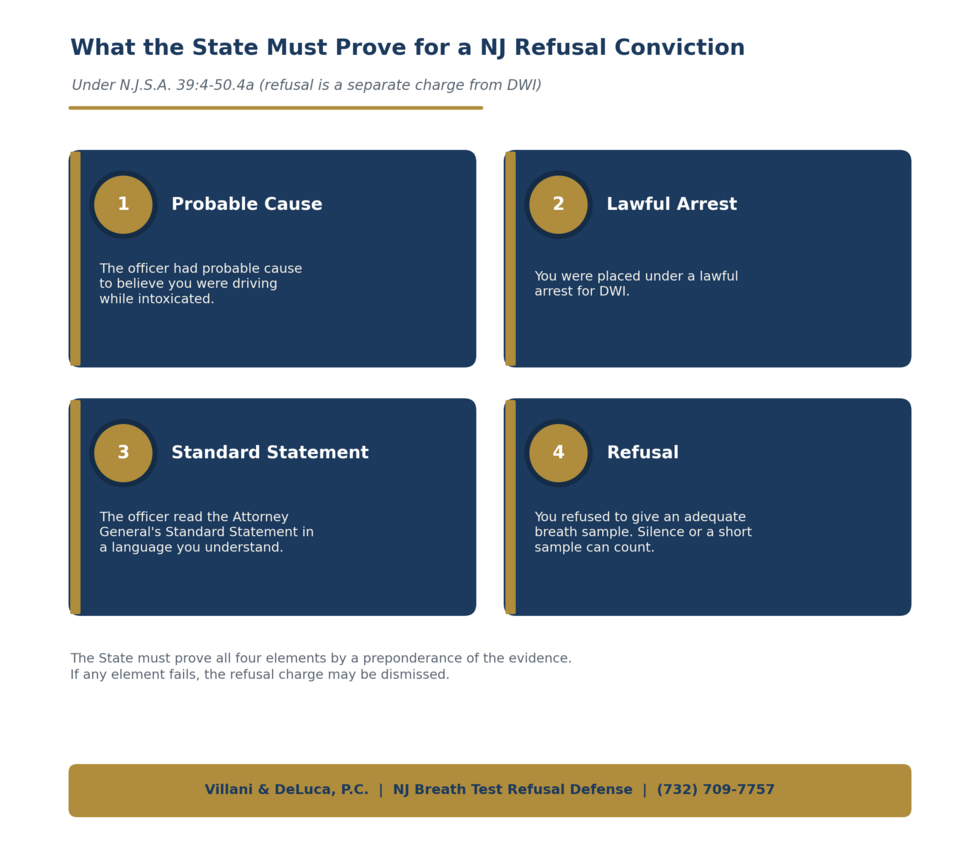
A refusal charge stands or falls on four specific elements. The chart below shows what the State must prove, and where a defense can be built.
Client Testimonial
"Mr. Villani really helped me out. He knew his stuff and was very confident about what he was doing. Great guy." – Erica Aborlleile
"Carmine is a great lawyer with an honest and caring approach that helped guide me through the process. I highly recommend him, you will not be disappointed with the results. Thanks Carmine!" – Chris Fedroff
"I would highly recommend him for all your legal needs" – Ken Murphy
Frequently Asked Questions
1. What is "implied consent," and how does it affect me?
In New Jersey, the law (N.J.S.A. 39:4-50.2) states that simply by driving on public or quasi-public roads, you have already given your "implied consent" to submit to a breath test if a police officer has reasonable grounds to believe you are intoxicated. This means that providing a breath sample is not a choice you make at the time of the stop; it is a legal obligation you accepted when you received your driver's license.
2. What happens if you refuse a breath test in New Jersey?
Refusal is not limited to saying the word "no." New Jersey courts recognize several actions as a refusal, including:
-
Silence: Not responding to the officer's request.
-
Conditional Consent: Saying you will only take the test if you can speak to a lawyer first (you do not have the right to an attorney for the breath test).
-
Inadequate Samples: Purposely failing to provide enough air to get a valid reading.
-
Stalling: Delaying the test by asking repeated questions or making excuses.
3. What legally qualifies as a "refusal"?
A refusal charge is separate from a DWI charge. To secure a conviction, the prosecutor must prove four specific elements by a preponderance of the evidence:
-
The officer had probable cause to believe you were operating a vehicle while intoxicated.
-
You were placed under a lawful arrest.
-
The officer read the Standard Statement (advising you of the consequences of refusal) in a language you understand.
-
You refused to provide the sample (this includes remaining silent or providing a "short sample").
4. Are the breath testing machines always accurate?
While the state relies on these devices, their reliability can be challenged. As of early 2026, the New Jersey Supreme Court lifted a long-standing stay on cases involving the Alcotest 9510, the state's newest testing device. While the court has allowed these cases to move forward, individuals still retain the right to challenge the specific calibration, maintenance, and operation of the machine used in their arrest. If the machine was not handled according to strict Attorney General protocols, the results—or the refusal charge itself—may be thrown out.
5. Can a refusal charge be defended in court?
Yes. A DWI defense attorneycan look for procedural errors that may invalidate the charge. For example:
-
Did the officer have "reasonable suspicion" to pull you over initially?
-
Did the officer have "probable cause" to arrest you for DWI?
-
Did the officer read the "Standard Statement" explaining the consequences of refusing a breath test in a language you understand? If any of these steps were skipped or handled improperly, the court may dismiss the refusal charge.
If any of these steps were skipped or handled improperly, the court may dismiss the refusal charge.
Facing a Breath Test Refusal Charge in New Jersey? Act Now.
A refusal charge does not have to define what happens next. Because the State has to prove all four elements by a preponderance of the evidence, a single procedural misstep by the officer can open the door to a strong defense. The sooner you act, the more room there is to build one. Carmine R. Villani, founding partner of Villani & DeLuca, P.C., is one of a small number of New Jersey attorneys trained on both the Alcotest and the Breathalyzer, and he has handled these cases from both the prosecution and defense side. If you have been charged with a breath test refusal or a DWI anywhere in Ocean or Monmouth County, do not try to work through it alone. Call (732) 709-7757 today for a free consultation. Our attorneys answer 24 hours a day, 7 days a week, and the sooner you call, the more we can do to protect your license and your rights.
Related Articles
Learn more about New Jersey DWI and breath test refusal defense:
- DWI & DUI Lawyer in NJ (overview)
- First Offense DWI in NJ
- Second Offense DWI in NJ
- Third or Subsequent DWI in NJ
- Alcotest® Trained NJ DWI Attorney
- DUI & DWI Checkpoints in NJ
Trusted Resources
- New Jersey Courts, Municipal Division, https://www.njcourts.gov/courts/municipal
- New Jersey Motor Vehicle Commission, https://www.nj.gov/mvc/
- Villani & DeLuca, P.C., N.J.S.A. 39:4-50.4a Refusal to Submit to Breathalyzer, https://www.villanideluca.com/resources/new-jersey-statutes/nj-drunk-driving-laws/refusal-to-submit-to-breathalyzer-nj-39-4-50-4a
- Villani & DeLuca, P.C., N.J.S.A. 39:4-50.2 Consent to Breath Test, https://www.villanideluca.com/resources/new-jersey-statutes/nj-drunk-driving-laws/consent-to-breathalyzer-nj-39-4-50-2
- Villani & DeLuca, P.C., N.J.S.A. 39:4-50 Driving While Intoxicated, https://www.villanideluca.com/resources/new-jersey-statutes/nj-drunk-driving-laws/intoxicated-nj-39-4-50
- Villani & DeLuca, P.C., NJ Legal Glossary, https://www.villanideluca.com/resources/legal-glossary