

Key Points:
• Shoplifting under N.J.S.A. 2C:20-11 includes taking merchandise without paying, altering price tags, under-ringing items, or concealing goods with intent to deprive the merchant of full retail value.
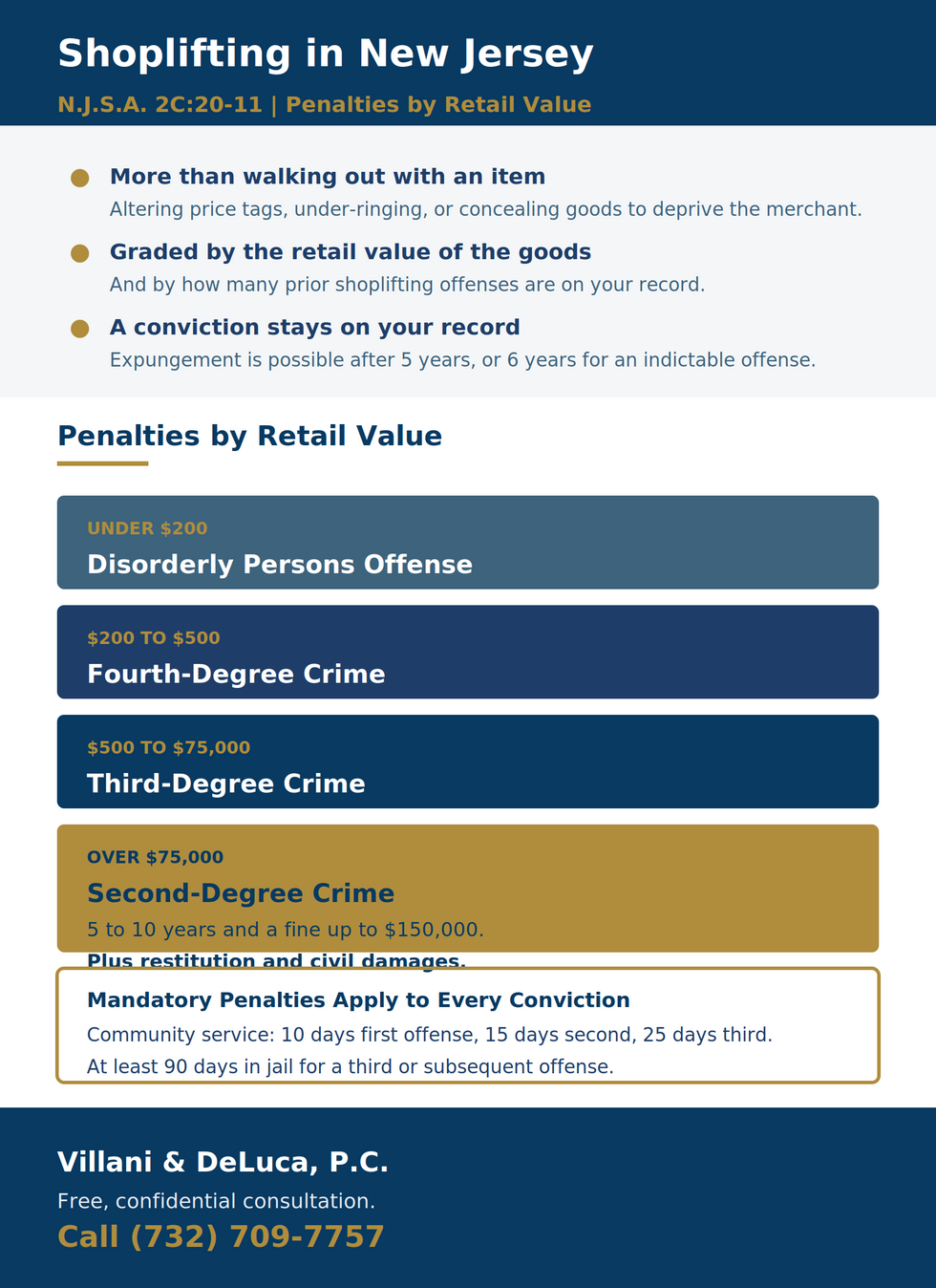
• Shoplifting is graded by value: under $200 is a disorderly persons offense (up to 6 months and a $1,000 fine); $200-$500 is fourth-degree (up to 18 months); $500-$75,000 is third-degree (3-5 years); and over $75,000 is second-degree (5-10 years).
• Mandatory penalties include community service (10 days for the first offense, 15 for the second, and 25 for the third) and mandatory jail of at least 90 days for a third or subsequent offense.
Charged with Shoplifting in New Jersey? Protect Your Rights With a Strong Defense
Getting arrested for shoplifting in New Jersey can be a daunting experience where you find yourself grappling with a range of emotions and uncertainties. What are the immediate and long-term consequences? How might a shoplifting charge affect your future?
It's essential to recognize that shoplifting is taken seriously in New Jersey, with potentially severe penalties. However, it's also crucial to remember that being charged is not the same as being convicted. You have the right to defend yourself, and an experienced lawyer can help. Knowledge is power in this challenging time; being informed with a clear understanding of New Jersey's shoplifting laws is your first step toward a strong defense.
Shoplifting Laws in New Jersey
What happens if you shoplift in New Jersey? Can you go to jail for shoplifting in the Garden State? What kind of sentence can you expect for this type of charge?
New Jersey law defines shoplifting as a crime under N.J.S.A. 2C:20-11:
You can be convicted of shoplifting if you knowingly take possession, transport, or transfer any merchandise without paying the full retail price. Shoplifting also applies if you alter product labels or price tags or “under-ring” your items when checking out.
The severity of the charge and the penalties you face will depend on the retail value of the stolen items as well as the number of shoplifting offenses you already have on your record.
The following shoplifting charges are considered indictable offenses in New Jersey and will be handled at the County Superior Court level:
-
2nd-Degree Shoplifting: The most severe form of shoplifting is a second-degree crime if the total value of the merchandise exceeds $75,000. In New Jersey, a second-degree crime conviction carries a penalty of 5-10 years in prison and/or a fine up to $150,000, in addition to any restitution or civil damages you may be required to pay.
-
3rd Degree Shoplifting: If the merchandise totals more than $500 but less than $75,000, the penalty could be 3-5 years of imprisonment and/or a fine of up to $15,000.
4th Degree Shoplifting: For offenses with a total merchandise value of more than $200 but less than $500, you could face up to 18 months in prison and/or a $10,000 fine.
If your shoplifting charges are non-indictable, they will be handled in the Municipal Court of the town where the alleged theft occurred, as they are considered disorderly persons offenses and have less severe consequences:
-
Disorderly Persons Offense: If the total retail value of the shoplifted items is less than $200, you could be charged with a disorderly persons-level shoplifting offense. This lesser charge can result in up to 6 months in jail and a $1,000 fine.
New Jersey courts will also impose additional mandatory penalties, such as community service. A first-offense conviction for disorderly person's shoplifting includes a minimum of 10 days of community service; for a second offense, you will be required to complete at least 15 days of community service. If you're facing your third or subsequent shoplifting offense, you may face a mandatory minimum of 90 days of imprisonment and be required to perform a maximum of 25 days of community service.
Does Shoplifting Stay on Your Record in New Jersey?
Yes. A shoplifting conviction can stay on your New Jersey criminal record permanently. The only way to get a shoplifting conviction removed from your record in New Jersey is to take action and file for expungement after a minimum of five years has passed for a disorderly person shoplifting conviction, or six years have passed for an indictable shoplifting conviction.
An experienced defense attorney can help you get your records expunged when the time comes, but the best opportunity to defend yourself is before the court rules and convicts you. That means talking to a lawyer and getting started on your case as soon as possible.
What are Possible Defenses for Shoplifting?
The strongest defense against a shoplifting charge depends on the unique circumstances of each case. The only way to know what strategy might work for your specific situation is to talk to a New Jersey defense attorney about your legal options.
Depending on the facts of your case, your attorney may argue one or more of the following:
-
Evidence Issues: The evidence against you is insufficient, incorrect, or has been mishandled in a way that makes it inadmissible. For example, questioning the accuracy of surveillance footage or eyewitness testimony, or establishing that the value of the items you allegedly stole is much lower than charged.
-
Lack of Intent: Whatever “taking” you did was unintentional or accidental. For example, you accidentally left a store with an item because you got distracted, or your child took an item without understanding the implications.
-
Mistaken Identity or False Accusation: You were incorrectly identified or wrongly accused of being the perpetrator of the theft. To support this, you can present an alibi that places you elsewhere at the time of the alleged offense or highlight inconsistencies in witness descriptions that don't match your appearance.
-
Improper Police Procedures: There was a violation of your rights during the arrest or investigation. For example, the police can't show probable cause for your arrest, or the arresting officers failed to read your Miranda rights at the appropriate time.
-
Duress or Coercion: You were forced to commit the act by someone else under threat or duress. You acted because you feared harm to yourself or others.
In addition, your attorney may be able to negotiate lesser charges, for example, by getting you a plea deal or reducing your charges from an indictable shoplifting offense down to a disorderly person's offense. Your lawyer may be able to negotiate a plea to a different charge, as plea bargaining is generally permitted in these types of cases. This may be an option if you're a first-time offender with no prior criminal record or there's some evidence against you. Still, your situation warrants leniency due to extenuating circumstances.
A first-time offender may be eligible for a diversionary program, such as conditional dismissal for a disorderly persons-level charge or Pretrial Intervention (PTI) for an indictable charge.
These general strategies may not apply to every situation, but a qualified defense lawyer can help you determine the best options for you based on the specifics of your case. Your attorney can evaluate the evidence, guide you through the legal process, and build your defense.
Third offenses are very serious and can result in mandatory jail. Can You Get a Shoplifting Charge Dismissed in New Jersey?
While it is possible to get a shoplifting charge dismissed in New Jersey, the outcome of your case depends on various factors such as the evidence against you, your criminal history, and the circumstances of the alleged offense
Your options for dismissal might include the following:
-
Participating in a pre-trial intervention program, especially for first-time offenders
-
Factually demonstrating your innocence beyond a reasonable doubt
-
Your attorney is establishing weaknesses in the prosecution's case
A knowledgeable defense attorney can guide you through the legal process and advocate on your behalf. Facing a shoplifting charge in New Jersey can undoubtedly be a stressful and challenging experience. The most important thing you can do to protect your record and your future is to find an experienced defense lawyer who can look out for your best interests.
Client Testimonial
"If you are looking for a lawyer to represent you, look no further, you just found him- Carmine Villani from the firm Villani and DeLuca. While on vacation in New Jersey, I got into trouble, and I had no one to refer me to a good lawyer. So, I had to take it upon myself to find one. I called several firms before I called Villani and DeLuca, and I didn't feel at ease with any of them. After I read Carmine's reviews, I called his office. Ruby Goldberg, his paralegal answered the phone and she was so nice. She reassured me that Carmine will do his very best to protect me and did. After I spoke to her, she put a call out to Carmine and within 10 minutes, he called me as he was driving in his car . After I hystericaly explained my situation to him, he told me to relax . He gave me feedback on my situation, I thought to myself, - this is the lawyer I want - he knows the law! Also, Ruby is always so friendly and she will always keep you updated . Carmine has your best interest and is there for you. Although I live in New York, I always felt like I was in good hands, because I knew he was going to do whatever it takes to protect me, and he did. As I wrote in the first sentence, No need to look for a lawyer, you just found him!" – Marylou Cilurzo
"Great team and a pleasure to work with. Extremely happy I decided to move forward with Villani and Deluca. Definately reccomend this firm." – Sarah Gutman
"IWas super helpful and I could not have wished for a better outcome ..very thankful I acquired their services" – Michael Ryan
Frequently Asked Questions
1. What actions fall under shoplifting laws in New Jersey?
-
Under shoplifting laws (N.J.S.A. 2C:20-11), the offense isn't limited to simply walking out of a store with an item. It also includes concealing unpurchased merchandise, altering price tags, transferring items into different containers, or even "under-ringing" items at a self-checkout. As of 2026, New Jersey courts have increasingly focused on digital evidence from advanced retail surveillance systems to prove the intent to deprive the merchant of the full retail value of the goods.
2. What are the mandatory penalties for a shoplifting conviction?
New Jersey is unique because it imposes mandatory community service for every shoplifting conviction. For a first offense, you face at least 10 days of community service; a second offense requires 15 days, and a third offense requires at least 25 days. Furthermore, any person convicted of a third or subsequent shoplifting offense faces a mandatory minimum of 90 days in jail. In 2026, these mandatory minimums remain strictly enforced, which is why hiring a shoplifting lawyer to fight the initial conviction is so critical.
3. Can I be charged with shoplifting if I never left the store?
Yes. The law allows for a "presumption of shoplifting" if you are found to have concealed unpurchased merchandise while still inside the store. If the items are hidden in a pocket, bag, or under clothing, the prosecution can argue that you intended to steal. A shoplifting lawyer can often defend these cases by demonstrating a lack of intent—for example, showing that the concealment was accidental or that you had the funds and intent to pay before being stopped by loss prevention.
4. Will a shoplifting charge appear on my criminal record?
Yes. A conviction for shoplifting—even for a minor item—will result in a permanent criminal record that can be seen by employers, landlords, and licensing boards. However, under the 2026 "Clean Slate" guidelines, many individuals may be eligible for an expungement to clear their record after a specific period of time has passed without further legal issues.
5. What is a "civil demand" letter?
After an arrest, many people receive a letter from a law firm representing the retailer (like Walmart or Target) demanding payment of several hundred dollars as a "civil penalty." This is separate from the criminal case. Paying the civil demand does not mean your criminal charges will be dropped. Before paying any civil fines, it is best to consult with a shoplifting lawyer to ensure your payments aren't misconstrued as an admission of guilt in your criminal proceeding.
Contact Villani & DeLuca, P.C.
If you are facing shoplifting charges in New Jersey, the time to act is now. A conviction can have lasting consequences on your criminal record, employment opportunities, and future. At Villani & DeLuca, P.C., our experienced criminal defense attorneys understand the complexities of New Jersey's shoplifting laws and are prepared to build a strong defense on your behalf.
We offer a free, confidential consultation or call us at (732) 709-7757 to discuss your case, review the evidence, and explain your legal options. Whether you are a first-time offender seeking a diversionary program or facing more serious charges, we are here to protect your rights.
Get a Free Consultation Today.
Related Articles
Learn more about shoplifting and theft charges in New Jersey:
Trusted Resources
- New Jersey Courts, Municipal Courts - Directory, https://www.njcourts.gov/courts/municipal
- New Jersey Courts, Criminal Division - Superior Court, https://www.njcourts.gov/courts/superior/criminal
- New Jersey Division of Criminal Justice, Official Website, https://www.njoag.gov/about/divisions-and-offices/division-of-criminal-justice-home/
- Villani & DeLuca, P.C., NJ Criminal Statutes Resource Library, https://www.villanideluca.com/resources/new-jersey-statutes
- Villani & DeLuca, P.C., Shoplifting N.J.S.A. 2C:20-11 Breakdown, https://www.villanideluca.com/resources/new-jersey-statutes/theft-laws-nj/shoplifting-nj-2c-20-11
- Villani & DeLuca, P.C., Legal Glossary, https://www.villanideluca.com/resources/legal-glossary