

Key Point:
• New Jersey's no-fault divorce is filed on irreconcilable differences under N.J.S.A. 2A:34-2, with no need to prove wrongdoing.
• You must show a six-month breakdown of the marriage, no reasonable prospect of reconciliation, and one year of New Jersey residency.
• No-fault does not mean uncontested; custody, support, alimony, and equitable distribution must still be resolved.
No-Fault Divorce in New Jersey: A Simpler Way to Move Forward
Divorce is difficult for any family, but the legal process does not have to add to the stress. Many couples in New Jersey file for a no-fault divorce, which lets them end the marriage without blaming either spouse. When both parties are ready to move on and can agree on the major terms, a no-fault divorce is often the most straightforward path. At Villani & DeLuca, P.C., we have helped clients in Monmouth County, Ocean County, and throughout New Jersey through this process with clarity and confidence.
What “No-Fault” Really Means
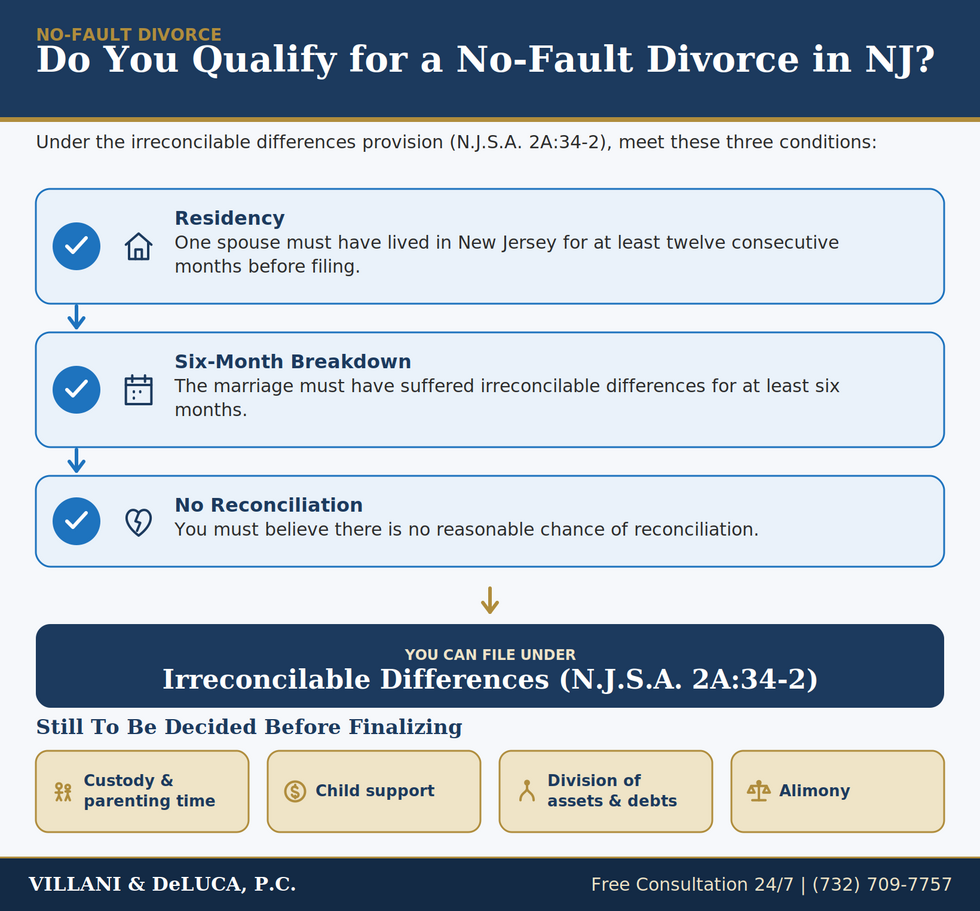
New Jersey law recognizes both fault-based and no-fault divorces. Under the irreconcilable differences provision (N.J.S.A. 2A:34-2), you can file for divorce simply because your marriage has broken down — without having to prove adultery, cruelty, or other misconduct.
To qualify, a few basic conditions must be met:
-
One spouse must have lived in New Jersey for at least twelve consecutive months before filing.
-
You must be able to show that the marriage has suffered irreconcilable differences for at least six months.
-
You must believe there's no reasonable chance of reconciliation.
That's it. The court doesn't require details about what went wrong, only an honest statement that the marriage cannot be repaired.
It's worth noting that “no-fault” does not always mean “uncontested.” If you and your spouse disagree about issues like custody, property, or alimony, those matters still need to be resolved before the divorce can be finalized.
Why Many Couples Choose the No-Fault Route
For most people, the main appeal of a no-fault divorce is simplicity. It keeps the focus on moving forward rather than assigning blame. This usually means:
-
Less conflict. Without accusations, tensions tend to stay lower, making negotiations more productive.
-
More privacy. Because there's no need to prove wrongdoing, sensitive personal issues are less likely to end up in the public record.
-
Lower costs and faster results. Fewer disputes often translate into shorter timelines and lower legal fees.
-
A healthier path for families. When children are involved, a less adversarial process helps preserve stability and cooperation between parents.
For many families, this approach makes it easier to reach fair agreements and start the next chapter of their lives on better terms.
What Still Needs to Be Decided
Even in a no-fault divorce, the court must address several key issues before a judgment is entered. These include:
-
Custody and parenting time, ensuring the best interests of the children remain at the center of every decision.
-
Child support, calculated using New Jersey's child support guidelines to maintain financial stability for the children.
-
Division of assets and debts, handled under the principle of equitable distribution, meaning property is divided fairly, not necessarily equally.
-
Alimony, when one spouse may need financial support to maintain a reasonable standard of living after the divorce.
If you and your spouse can reach an agreement on these issues, the court will generally approve your settlement and finalize the divorce without unnecessary delay.
How We Handle Your No-Fault Divorce
Even when both spouses agree, a divorce is a major legal and financial event. We handle the paperwork, protect your rights, and make sure your settlement is complete and enforceable, so nothing important is left unresolved.
Client Testimonial
Monmouth: "Vince is extremely knowledgeable, friendly and provides practical and realistic advice. His counsel assisted me in determining my options and my path moving forward. Based on his sound guidance, there were no unnecessary legal fees. I would strongly recommend seeking advice and representation from Vince. He did an outstanding job and I am very grateful." – D.D.
"Carmine Villani was very knowledgeable. I would highly recommend him." – Karen Roche
"Carmine and his staff are the best around! Very professional and friendly, but most of all they make you feel comfortable in handling your legal issues. I would highly reccomend using Villani & Deluca for any legal matter big or small!" – Emily Woszczak
Frequently Asked Questions
1. What exactly does "Irreconcilable Differences" mean?
In New Jersey, a no-fault divorce is officially filed under the grounds of "Irreconcilable Differences" (N.J.S.A. 2A:34-2). If you are wondering what a no-fault divorce is, it simply means you do not have to prove a specific argument or failure. Legally, it means that your marriage has been broken for at least six months, there is no reasonable prospect of reconciliation, and you believe the marriage should end.
Because no-fault divorce laws don't require "proving" a spouse did something wrong, it is often the most efficient way to settle. The divorce lawyers at Villani & DeLuca can help you file under these grounds to keep your private life out of the public record.
2. Do we have to live in separate houses to file for a no-fault divorce?
No. While there is a separate ground for divorce based on an 18-month separation, most no-fault divorces in 2026 are filed while the spouses still reside in the same home. You can establish "irreconcilable differences" even if you are sharing a roof, provided you have lived as separate individuals for at least six months.
If you're unsure which timeline applies to your situation, Villani & DeLuca can advise you on the most strategic way to establish your filing date.
3. How does a no-fault filing affect child custody and safety?
Even in a no-fault divorce, child custody is handled with a focus on the "Best Interests of the Child." Under the January 2026 updates to N.J.S.A. 9:2-4, New Jersey courts have shifted to a framework where child safety is a threshold issue. This means that even if neither spouse is "at fault" for the marriage ending, the court must still evaluate any history of abuse or safety risks before determining parenting time.
4. Will I lose out on alimony or assets if I don't prove my spouse's "fault"?
Generally, no. New Jersey follows the principle of Equitable Distribution, which divides property based on fairness and financial contribution, not moral conduct. Similarly, alimony is based on financial need and ability to pay. Unless your spouse's behavior led to "economic misconduct"—such as wasting marital funds on an affair or gambling—a no-fault filing provides the same financial protections as a fault-based one, often with significantly lower legal costs.
5. What are the residency requirements for a no-fault divorce in New Jersey?
To file for a no-fault divorce, at least one spouse must have been a bona fide resident of New Jersey for at least 12 consecutive months before the complaint is filed. This residency establishes the court's "jurisdiction" (the legal power to hear your case).
How an Experienced Divorce Attorney Can Help
Even when both spouses are on the same page, a divorce is still a major legal and financial event. Having the right attorney ensures that every detail, from the paperwork to the final settlement, is handled properly and that your rights remain protected.
The divorce lawyers at Villani & DeLuca, P.C. have been representing clients across the Jersey Shore for decades. We understand the emotional and practical challenges that come with ending a marriage, and we're here to help you navigate the process with clarity, compassion, and discretion.
If you're considering a no-fault divorce in New Jersey, call Villani & DeLuca, P.C. at (732) 709-7757 or contact us online to schedule a free consultation. We're available around the clock to answer your questions and help you take the next step toward a more secure future.
Related Articles
Trusted Resources
- New Jersey Courts, Self-Help (Divorce): https://www.njcourts.gov/self-help/divorce
- New Jersey Legislature, N.J.S.A. 2A:34-2 (Grounds for Divorce): https://www.njleg.state.nj.us/laws/2a/2a-34-2
- New Jersey Legislature, N.J.S.A. 9:2-4 (Child Custody Best Interests): https://www.njleg.state.nj.us/laws/9/9-2-4
- Villani & DeLuca, P.C., Legal Glossary: https://www.villanideluca.com/resources/legal-glossary