

Key Point:
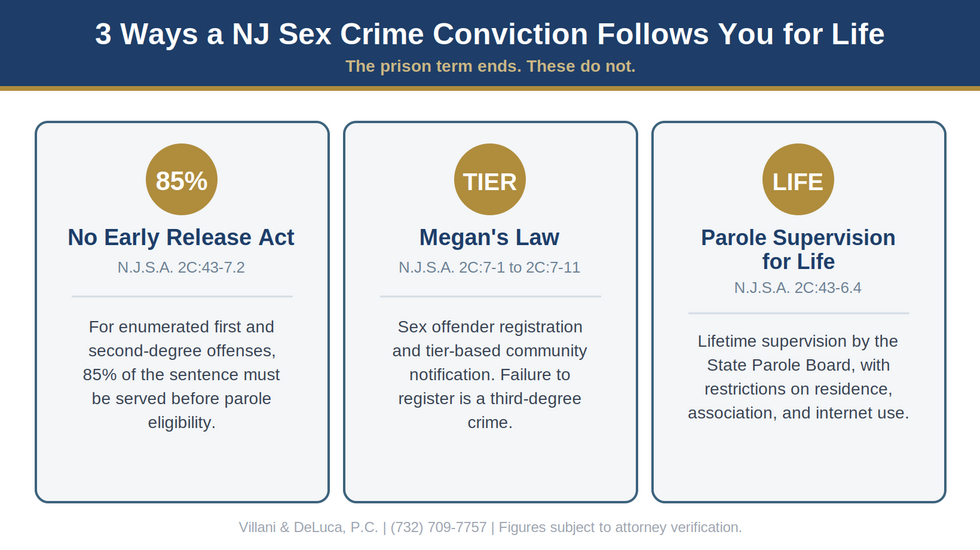
• Sex crime convictions in New Jersey for first and second-degree offenses fall under the No Early Release Act (N.J.S.A. 2C:43-7.2), requiring 85% of the sentence be served before parole
• Megan's Law (N.J.S.A. 2C:7-1 through 2C:7-11) requires sex offender registration and tier-based community notification, with failure to register charged as a third-degree crime
• Parole Supervision for Life (N.J.S.A. 2C:43-6.4) applies to many sex offenses and means lifetime supervision with restrictions on residence, association, and internet use
Sex crimes in New Jersey are some of the most serious offenses under the law. These charges can carry severe penalties, including lengthy prison sentences, mandatory registration, and lasting impacts on your personal and professional life.
If you are facing allegations of a sex crime, you need an experienced criminal defense attorney who understands the complexities of New Jersey law and can protect your rights throughout the legal process. Villani & DeLuca, P.C. has decades of experience defending individuals accused of sex crimes, and we are here to guide you through every step.
Understanding Sex Crimes in New Jersey
Sex crimes cover a broad range of offenses, each with unique legal consequences. These include sexual assault, internet crimes, child pornography (CSAM), and issues related to Megan's Law.
Even if the alleged act seems minor, a conviction can have lifelong consequences, including mandatory registration as a sex offender, difficulties finding employment, and loss of certain civil rights. The New Jersey legal system treats these offenses seriously, and the defense strategies must be tailored to the specific type of allegation you are facing.
Sexual Assault
Sexual assault in New Jersey includes offenses under N.J.S.A. 2C:14-2, ranging from unwanted sexual contact to acts involving penetration through force, coercion, or exploitation of a vulnerable person. Aggravated sexual assault, a first-degree crime, applies when the victim is under thirteen, when a weapon is used, or when serious bodily injury occurs. Second-degree sexual assault applies in situations involving physical force, lack of consent, or victims between thirteen and fifteen years old, where the accused is at least four years older.
Convictions can lead to 10 to 20 years in prison for first-degree charges and 5 to 10 years for second-degree charges. Sentences often fall under the No Early Release Act, requiring 85 percent of the term to be served before parole. Defense strategies typically focus on consent, mistaken identity, improper collection of evidence, or violations of constitutional rights.
Internet Crimes
Internet-based sex offenses often involve charges under N.J.S.A. 2C:24-4, 2C:14-9, or 2C:14-3, including online solicitation, explicit communication with someone believed to be a minor, and possession or exchange of illegal sexual materials. Many charges stem from online sting operations or digital monitoring tools used by law enforcement agencies. Offenses such as luring or enticing a minor online can be charged as second-degree crimes, punishable by up to ten years in prison.
Digital evidence plays a significant role, including search histories, deleted files, IP addresses, and metadata collected from phones or computers. Problems with search warrants, device imaging, or undercover communication logs can create strong defense arguments. A skilled attorney will analyze how the digital evidence was gathered, whether protocols were followed, and whether any statements were obtained unlawfully.
Child Pornography (CSAM)
CSAM offenses in New Jersey fall under N.J.S.A. 2C:24-4(b) and include possession, distribution, or production of any image or video depicting a minor in a sexual act. Possession is typically a third-degree crime, whereas distribution or manufacturing is a second-degree crime, increasing the potential for prison exposure. Each file can be charged separately, which can multiply charges and significantly increase sentencing risks.
Convictions often require mandatory parole supervision for life and immediate registration under Megan's Law. Investigations commonly rely on monitoring peer-to-peer file sharing, undercover downloads, or forensic analysis of hard drives and cloud storage. A defense attorney can challenge file-tracking software, disputed downloads, shared device access, or mistaken identity.
Megan's Law
Megan's Law, outlined in N.J.S.A. 2C:7-1 through 2C:7-11, requires registration for offenses such as aggravated sexual assault, certain sexual assaults involving minors, luring, and child endangerment. Registrants must report addresses, employment, schooling, vehicles, and any changes within 24 hours. Tier classification hearings determine the level of community notification, ranging from no public disclosure to broad community notification.
Failure to register or update information is a third-degree crime, punishable by up to five years in prison. In limited cases, individuals may petition for removal after 15 years without offense, provided they are not classified as repetitive or compulsive offenders. An attorney can help prepare for tier hearings, manage compliance issues, and pursue removal when legally eligible.
Penalties and Consequences
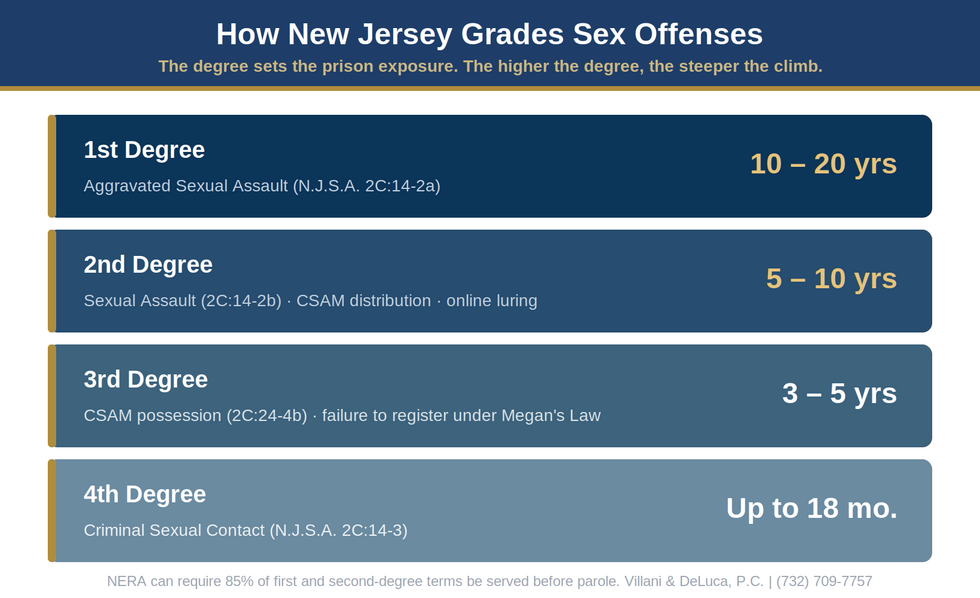
Penalties for sex crimes in New Jersey vary widely based on the degree of the offense, aggravating factors, and the age of the alleged victim. First- and second-degree convictions can lead to five to twenty years in state prison and often fall under the No Early Release Act, which requires serving eighty-five percent of the sentence before parole eligibility. Additional consequences may include Megan's Law registration, Parole Supervision for Life, mandatory counseling, and restrictions on internet use for certain offenses.
The consequences extend far beyond the courtroom and can have a lasting impact on multiple areas of life. A conviction may affect employment opportunities, housing access, professional licensing, and family-related matters such as custody or visitation. Even allegations, without a conviction, can create reputational harm and personal stress due to the seriousness with which these cases are treated in New Jersey.
Defense Strategies and Legal Representation
A strong defense requires a detailed understanding of the specific charges, applicable statutes, and the evidence the state intends to use. At Villani & DeLuca, P.C., every case begins with a thorough review of digital records, forensic reports, police procedures, and witness statements to determine whether the investigation followed proper legal standards. Problems with search warrants, device imaging, undercover communications, or forensic software often become critical issues in sex-crime cases.
Defense strategies often challenge the accuracy or admissibility of physical, digital, or testimonial evidence. This can include disputing intent, presenting proof of consent when allowed by law, or showing that devices or accounts may have been accessed by someone else. For individuals subject to Megan's Law or Parole Supervision for Life, legal representation may also involve handling classification hearings, compliance requirements, and evaluating future eligibility for removal from the registry.
Contact Villani & DeLuca, P.C.
Facing sex crime allegations in New Jersey is one of the most serious legal situations you can encounter, with long-term consequences for your freedom, reputation, and future opportunities. Villani & DeLuca, P.C. provides experienced legal representation, detailed case analysis, and strategic defense tailored to the complexities of New Jersey sex crime laws. Call us today at (732) 709-7757 to schedule a free consultation with a knowledgeable New Jersey criminal defense attorney.
Client Testimonial
"Well worth the money. Got exactly what I was looking for. Carmine knows what he's doing and talking about. Will use this firm again if needed and recommend to others to use as well." – Harrison Utter
"Villani and his firm were extremely knowledgeable and professional handling my case. I'm extremely satisfied with the outcomes. God bless you and your firm for your dedicated work.." – Bernard Perutti
"Was super helpful and I could not have wished for a better outcome ..very thankful I acquired their services" – Michael Ryan
Frequently Asked Questions
1. What actions are classified as "sex crimes" in New Jersey?
In New Jersey, the term covers a broad spectrum of illegal conduct ranging from non-consensual physical contact to the possession of prohibited digital materials. Common charges include Aggravated Sexual Assault, Sexual Assault, Criminal Sexual Contact, and Endangering the Welfare of a Child. Because New Jersey law is strict, even "contact" that does not involve a completed act can be prosecuted as a serious crime if it is deemed to be for sexual gratification or involves a minor.
2. What is the difference between Sexual Assault and Criminal Sexual Contact?
The primary difference lies in the nature of the act and the severity of the charge. Sexual Assault (N.J.S.A. 2C:14-2) generally involves "penetration" and is typically classified as a second-degree or first-degree crime. Criminal Sexual Contact (N.J.S.A. 2C:14-3) involves "intentional touching" of intimate parts, either directly or through clothing, without consent. While Sexual Contact is often a fourth-degree crime, it still carries a criminal record and may trigger mandatory registration requirements.
3. What is Parole Supervision for Life (PSL)?
Parole Supervision for Life is a mandatory sentencing requirement for many sex-offense convictions in New Jersey. Unlike standard parole, which ends when your sentence is over, PSL means you remain under the supervision of the New Jersey State Parole Board for the rest of your life. This includes restrictions on where you can live, who you can associate with, and your use of the internet. Violating even a minor condition of PSL can result in a return to prison, making it one of the most difficult aspects of a conviction to manage.
4. Can a person be charged if the other individual initially gave consent?
Yes. Under New Jersey law, consent can be withdrawn at any time. Furthermore, the law recognizes certain situations where a person is legally incapable of giving consent, regardless of what they say. This includes individuals who are under the legal age of consent, those who are physically helpless or mentally incapacitated, or situations where there is a significant power imbalance (such as a teacher and a student). Proving or disproving consent is a central pillar of most defense strategies used by a sex crimes lawyer.
5. How can an attorney help if I am being investigated?
If you are under investigation, everything you say to law enforcement can be used to build a case against you. A sex crimes lawyer serves as your shield, ensuring your constitutional rights are protected during questioning. An attorney can also conduct an independent investigation—hiring private investigators or digital forensic experts—to uncover evidence that contradicts the accuser's story or demonstrates a lack of criminal intent. Early intervention is often the key to preventing a formal charge from being filed or securing a downgrade in the severity of the offense.
Trusted Resources
New Jersey Courts, Criminal Division - Superior Court, https://www.njcourts.gov/courts/superior/criminal
New Jersey Division of Criminal Justice, Official Website, https://www.njoag.gov/about/divisions-and-offices/division-of-criminal-justice-home/
Villani & DeLuca, P.C., NJ Criminal Statutes Resource Library, https://www.villanideluca.com/resources/new-jersey-statutes
Villani & DeLuca, P.C., Sexual Assault N.J.S.A. 2C:14-2 Breakdown, https://www.villanideluca.com/resources/new-jersey-statutes/nj-assault-laws/sexual-assault-nj-2c-14-2
Villani & DeLuca, P.C., Legal Glossary, https://www.villanideluca.com/resources/legal-glossary