
Key Point:
• To buy a liquor license in NJ, most bars, restaurants, and liquor stores purchase an existing one rather than applying for a new license
• Few new licenses exist because the state caps them by population, so a liquor license for sale in NJ is usually bought from a current holder
• A restaurant liquor license or bar liquor license is a Class C retail license, with the purchase price as the biggest and most variable cost
• Buying a retail liquor license involves a person-to-person transfer, a background check, and several months of processing
If you are thinking about retiring, selling your restaurant or bar, stepping away from the hospitality industry, or simply cashing out an investment you've held for years, selling your license can make financial sense. But the process is not like selling equipment or inventory. A liquor license sale is completed through a formal transfer that must be reviewed and approved by both your local issuing authority and the New Jersey Division of Alcoholic Beverage Control (ABC). A retail liquor license attorney can guide you through the transfer requirements and protect your interests as the seller.
Download: Alcoholic Beverage Control Handbook for Retail Licensees
Person-to-Person and Place-to-Place License Transfers
When you “sell” a retail liquor license in New Jersey, you are actually completing a license transfer. Depending on the deal, it may be a person-to-person transfer (the owner changes), a place-to-place transfer (the licensed location changes), or both if the buyer is changing ownership and moving the license. While the buyer usually handles the filing, the transfer cannot move forward without the seller's clear consent and cooperation.
Sellers are required to sign a consent to transfer, provide good-standing documentation showing the license is active and free of unresolved violations or unpaid municipal charges, and assist with public notice requirements so the published legal notices accurately describe the license. Buyers also generally must obtain tax clearance from the NJ Division of Taxation, which may require information from the seller to confirm there are no state tax liens tied to the license. A retail liquor license attorney can help ensure the paperwork is complete, consistent, and ready for submission to avoid delays.
How Do I Prepare My License for Sale?
Most sellers do not run into trouble because the deal is “bad.” They run into trouble because the license is not prepared. Small issues - missing paperwork, renewal gaps, unresolved municipal issues - can slow a transaction that everyone expected to close quickly.
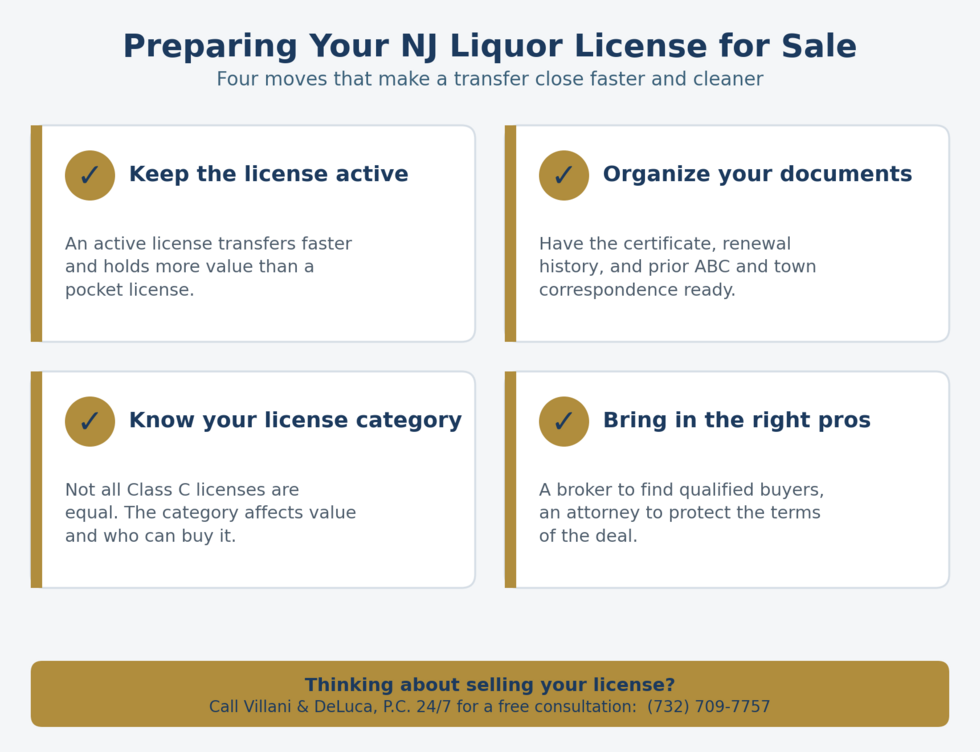
There are a few practical steps sellers can take to make the sale cleaner and more appealing to serious buyers:
Keep the license active. An active license is easier to transfer and usually more valuable. Inactive “pocket” licenses can create timing and compliance complications, especially with recent legislative attention to inactivity.
Organize your documents early. Buyers and attorneys will ask for the license certificate, renewal history, and any prior correspondence with the municipality or ABC. Having it ready builds confidence and prevents last-minute scrambling.
Know your license category. Not all Class C licenses are equal. Some are far more marketable than others. The category can affect value and who the likely buyers will be.
Bring in the right professionals. A broker may help find qualified buyers, but legal counsel helps protect the terms of the transaction, the transfer application, and your exposure as the seller. A retail liquor license attorney can also spot issues that commonly derail approvals and address them early.
Keep it simple: reduce friction. The fewer surprises in review, the faster the approval, and the cleaner the closing.
The Cost of Selling a NJ Liquor License
Even though buyers often cover most government filing fees, sellers should still understand the costs and deal terms that can affect what you actually net at closing. Transfers typically include a $200 state application fee payable to the Division of ABC (often paid by the buyer, but it should be clearly assigned in the purchase agreement), along with municipal transfer charges that are commonly 10% of the annual license fee or 20% if the transaction requires both a person-to-person and a place-to-place transfer. Sellers may also incur legal and brokerage costs, including attorney fees for contract review and negotiation and, if a broker is involved, a commission usually due at closing. Working with a retail liquor license attorney helps ensure contingencies and payment terms protect the seller if approvals take longer than expected. Finally, the sale may create tax consequences, such as capital gains exposure, so it is smart to consult a tax advisor before signing. In many transactions, the sale price is only part of the story. The deal structure, timing, approval obligations, and who pays which fees often determine whether the transfer closes smoothly or drags on for months.
Types of NJ Class C Retail Liquor Licenses
Retail liquor licenses are typically “Class C” licenses issued by the municipality where the licensed business operates. The category of your license affects who can buy it, how it can be used, and what the market may pay.
Under N.J.S.A. 33:1-12, Class C retail licenses include:
-
Club Licenses (Not sold) (31)
-
Plenary Retail Consumption License with Broad Package Privilege (32)
-
Plenary Retail Consumption License (33)
-
Seasonal Retail Consumption License (34 or 35)
-
Hotel/Motel License (36)
-
Plenary Retail Consumption License (theater exception) (37)
-
Limited Retail Distribution License (no longer issued; only renewed or transferred) (43)
-
Plenary Retail Distribution License (44)
If you are unsure which license type you hold, that is something we can clarify quickly by reviewing the license certificate and municipal records with a retail liquor license attorney.
Download: Alcoholic Beverage Control Handbook for Retail Licensees
Client Testimonial
"Well worth the money. Got exactly what I was looking for. Carmine knows what he's doing and talking about. Will use this firm again if needed and recommend to others to use as well." – Harrison Utter
"Mr. Villani really helped me out. He knew his stuff and was very confident about what he was doing. Great guy" – Erica Aborlleile
"Great team and a pleasure to work with. Extremely happy I decided to move forward with Villani and Deluca. Definately reccomend this firm.."– Sarah Gutman
Frequently Asked Questions
1. How do I sell a retail liquor license in New Jersey?
You sell it through a formal transfer application approved by the local issuing authority and the NJ Division of ABC. The buyer files most paperwork, but the seller must provide consent and supporting records.
2. What is the difference between a person-to-person and place-to-place transfer?
Person-to-person changes ownership of the license. Place-to-place moves the licensed premises. Some sales require both.
3. Do I need to keep my license active before selling?
Keeping the license current and in good standing can reduce delays and make the transfer process smoother. Inactivity can create complications depending on timing and local/ABC requirements.
4. What fees are involved in a liquor license transfer?
Transfers typically involve a state application fee, municipal transfer charges, and professional fees if attorneys or brokers are involved. The purchase agreement should clearly state who pays what.
5. How long does it take to transfer a liquor license in NJ?
Timing depends on the municipality, completeness of the application, tax clearance, background investigation, and whether there are objections or compliance issues. Some transfers move quickly; others take longer if documents are missing or approvals are delayed.
Call a NJ Liquor License ABC Lawyer
Selling a liquor license is one of those transactions that looks straightforward until it isn't. The approval process involves strict rules, municipal procedures, public notice requirements, tax clearance, and ABC oversight - and one misstep can delay a closing or complicate the value of the deal.
The attorneys at Villani & DeLuca, P.C. help clients through liquor license sales and transfers across New Jersey. Whether you are preparing to sell, already under contract, dealing with compliance concerns, or simply want to understand your options, we can help you approach the transaction with a plan and protect your interests from the start. If you need a retail liquor license attorney, our team is ready to help.
Related Articles
Learn more about liquor licensing in New Jersey:
- NJ Liquor License Rules and Requirements
- Buying a Retail Liquor License in NJ
- Liquor License Enforcement in NJ
- Liquor Manufacturing License Attorneys
- Understanding Wholesale Liquor Licenses
Trusted Resources
- NJ Division of Alcoholic Beverage Control (ABC), Official Website, https://www.nj.gov/oag/abc/
- NJ Division of Taxation, Tax Clearance for License Transfers, https://www.nj.gov/treasury/taxation/
- NJ ABC Handbook for Retail Licensees, https://www.nj.gov/oag/abc/
- NJ Legislature, Title 33 Intoxicating Liquors N.J.S.A. 33:1-12, https://www.njleg.state.nj.us/
- Villani & DeLuca, P.C., Legal Glossary, https://www.villanideluca.com/resources/legal-glossary