

Key Points:
• Megan's Law (N.J.S.A. 2C:7-1 through 2C:7-11) requires people convicted of certain sex offenses to register with local law enforcement, for a term of years or for life.
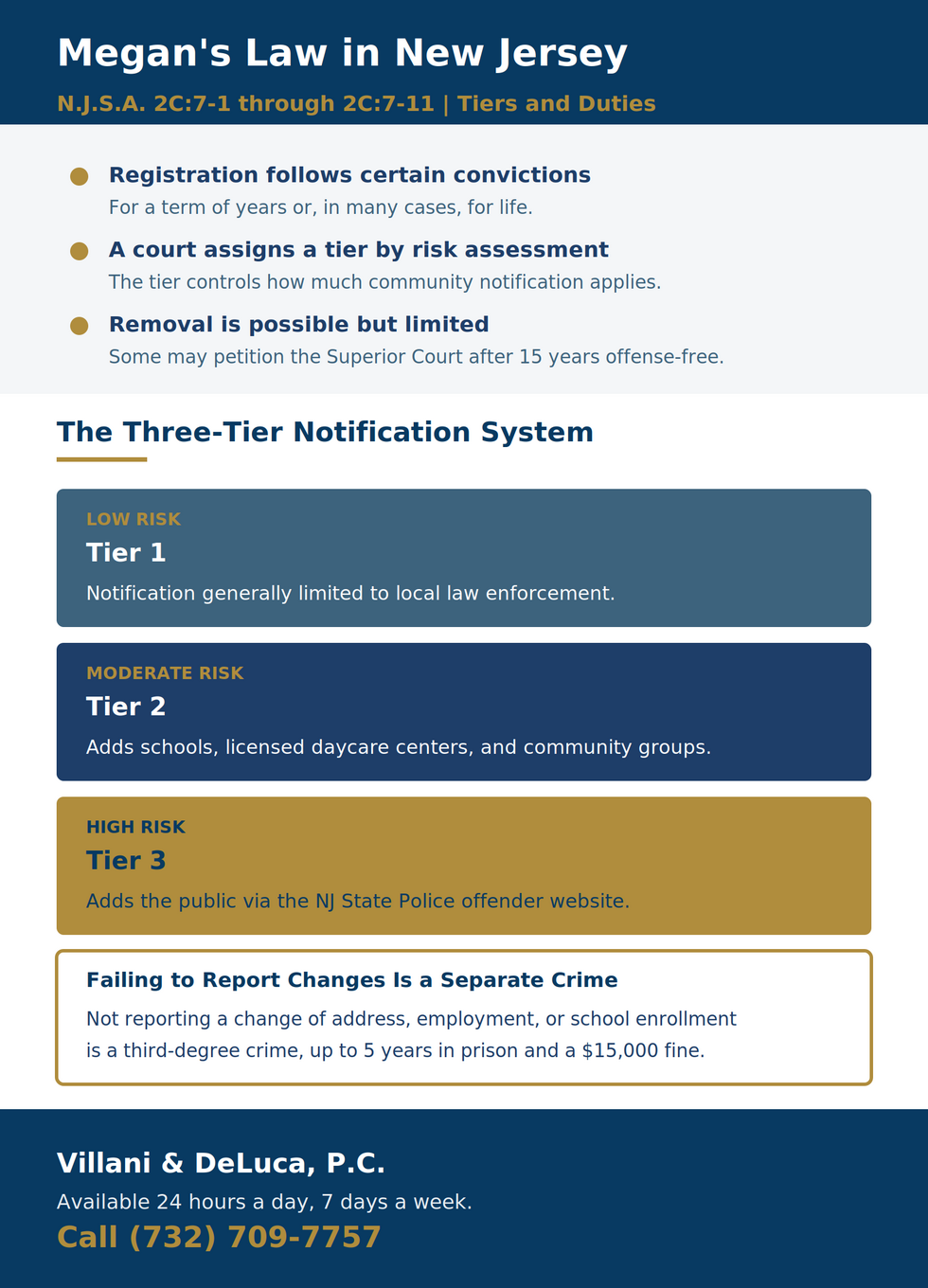
• A court sets a tier based on a risk assessment, which controls how much community notification applies, from law enforcement only up to broad public notification.
• Failing to report a change of address, employment, or school enrollment is a third-degree crime carrying up to 5 years in prison and a fine up to $15,000.
Being subject to Megan's Law in New Jersey can profoundly affect every aspect of your daily life. Individuals convicted of certain sex offenses may be required to register as sex offenders, with their personal information made available to law enforcement and, in many cases, to the public. These registration requirements can last for years or even a lifetime and may impact housing, employment, and reputation.
If you or someone you care about is facing sex crime charges that could lead to Megan's Law registration in Monmouth County, Ocean County, or anywhere in New Jersey, it is critical to have an experienced defense attorney guiding you through this complex legal process. The legal team at Villani & DeLuca, P.C. has extensive knowledge of Megan's Law and is prepared to help protect your rights at every stage.
What Is Megan's Law?
Megan's Law refers to a set of state and federal laws that require certain individuals convicted of specified sex offenses to register with local law enforcement as sex offenders. The law is named after Megan Kanka, a child from New Jersey who was tragically killed by a neighbor with prior sex offense convictions. In response, the state enacted laws to increase community awareness and tracking of convicted sex offenders.
In New Jersey, Megan's Law registration involves providing personal information to law enforcement, which may be made publicly available to communities. The goal of the law is to enhance public safety by informing communities about the presence of individuals convicted of certain sex offenses.
Who Must Register Under Megan's Law?
Not all criminal convictions lead to sex offender registration. Under New Jersey law, individuals convicted of specific sex offenses such as sexual assault, aggravated sexual contact, child endangerment involving sexual conduct, and other listed offenses are typically required to register.
The registration requirement is based on the underlying offense and is determined by statute. Whether a conviction triggers Megan's Law registration depends on the offense of conviction, the court's judgment, and applicable provisions of the New Jersey Megan's Law statute. Individuals convicted of offenses listed in the statute at the time of sentencing are generally subject to registration unless a court orders otherwise in limited circumstances.
What Information Is Included in the Registry?
When an individual is required to register under Megan's Law, certain personal details must be provided to law enforcement. Typical registration information includes:
-
Full legal name
-
Home address and any subsequent changes of address
-
Date of birth and physical descriptors
-
Photograph
-
Criminal conviction information
Law enforcement maintains this registry and, in many cases, shares certain information with the public through an online searchable database. This enables residents to view information about registered offenders who live, work, or attend school in nearby areas.
Duration and Updates: How Long Must Registration Continue?
The length of time a person remains on the Megan's Law registry varies based on the offense and other statutory criteria. Some offenses result in lifetime registration, while others may carry a term of years. Factors affecting duration include the severity of the offense, the sentence imposed, and whether a conviction occurred before or after changes to the law.
Individuals subject to Megan's Law also must update their registration when personal information changes. This can include changes in address, employment, school enrollment, or other designated circumstances. New Jersey law imposes specific timelines for reporting these changes to law enforcement.
Public Access to Megan's Law Information
Megan's Law in New Jersey includes provisions allowing the public to access certain registry information. This information is available through a public registry maintained by law enforcement that can be searched online. Access is generally focused on community safety and awareness, though only limited and relevant details are disclosed to the public.
It is important to understand that the public registry is distinct from law enforcement's internal records. The public may search the registry by geographic location or other limited criteria to see which registered offenders live or work in a particular area.
How Villani & DeLuca, P.C. Can Help
Facing Megan's Law registration in New Jersey can be overwhelming and carry serious long-term consequences for your privacy, mobility, and future opportunities. Villani & DeLuca, P.C. provides experienced legal guidance and personalized defense strategies to protect your rights at every stage of the process.
Call us today at (732) 709-7757 to schedule a free consultation with one of our skilled New Jersey criminal defense attorneys.
Client Testimonial
"I would highly recommend him for all your legal needs." – Ken Murphy
"Villani was awesome could not ask for a better Out come in my case will definitely use him again if ever need be 5 ⭐️‘s" – Joshua Posey
"The staff is great, professional, responsive and always super helpful. Mr. Carmine is great at his job. Even through a pandemic things were hassle free. He kept everything super simple and stress free. Even when I had questions and just emailed him and he literally responded back immediately. I would recommend to anyone that needs a lawyer. He is the BEST." – Jayson Le
Frequently Asked Questions
1. What is Megan's Law, and who is required to register?
Megan's Law is a set of statutes that require individuals convicted of certain sex offenses to register their personal information with local law enforcement. In New Jersey, this requirement applies to both adults and juveniles adjudicated delinquent for specific offenses. The goal is to allow law enforcement to monitor the whereabouts of certain offenders. If you are convicted of a qualifying offense, registration is generally mandatory and, in many cases, is a lifelong requirement.
2. How does the "Tier" system work in New Jersey?
New Jersey uses a three-tier system to determine the level of community notification required for a registrant. A "Tier" is assigned based on a risk assessment (often using the Registrant Risk Assessment Scale or RRAS):
-
Tier 1 (Low Risk): Notification is generally limited to local law enforcement.
-
Tier 2 (Moderate Risk): Notification may include schools, licensed daycare centers, and community organizations in addition to law enforcement.
-
Tier 3 (High Risk): Notification can include the general public via the New Jersey State Police sex offender website.
3. What information is shared with the public under Megan's Law NJ?
For individuals placed in Tier 2 or Tier 3, certain information is made available to the public. This typically includes the person's name, a photograph, a physical description, the offense they were convicted of, and their general location (such as a home address or block). Recent legal updates have reinforced that the public registry's purpose is public safety, not punishment, though the social consequences of being listed can be significant.
4. Can I ever be removed from the Megan's Law registry?
Yes, but the process is strict. Under New Jersey law, many registrants can petition the Superior Court to be removed from the registry if they have not committed an offense for 15 years following their conviction or release from custody, whichever is later. However, this "15-year rule" does not apply to everyone. Certain serious offenses, such as aggravated sexual assault or those involving repetitive/compulsive behavior, may result in a lifetime registration requirement with no possibility of removal.
5. What happens if I move or change jobs while registered?
Registration is an ongoing obligation. If you move to a new residence, change your employment status, or enroll in a school/university, you must notify the local police department in the jurisdiction where you currently reside within a specific timeframe (usually 48 hours to 10 days, depending on the circumstances). Failure to notify authorities of these changes is a third-degree crime in New Jersey and can result in significant prison time.
Trusted Resources
- New Jersey Courts, Criminal Division, Superior Court, https://www.njcourts.gov/courts/superior/criminal
- New Jersey Division of Criminal Justice, Official Website, https://www.njoag.gov/about/divisions-and-offices/division-of-criminal-justice-home/
- New Jersey Courts, Report on the Implementation of Megan's Law, https://www.njcourts.gov/sites/default/files/courts/criminal/meganslaw-2024.pdf
- Villani & DeLuca, P.C., Legal Glossary, https://www.villanideluca.com/resources/legal-glossary