We at Villani Deluca understand that going through a separation is a tough process. As the parent of your child, apart from your own needs, you must also resolve issues relating to your child's future. With so many family law firms out there, getting legal counsel well-versed in family law is important. This is why our New Jersey-based law firm has a robust family law team, comprised of some of the most experienced family law attorneys and child custody lawyers in New Jersey, to help you get through the custody litigation process.
In this article, we will talk about the different processes available to decide custody disputes, the different types of child custody, and other things to look out for in a New Jersey child custody case.
Negotiation or Mediation Process
The common things to look out for regarding child custody include:
- Child support
- Parenting time
- Visitation schedule
A good way to settle these custody issues is through negotiation or mediation. These alternative dispute resolution methods are a simple means to resolve a custody dispute amicably. They can be taken up before the case goes to court, or even after the case has gone to court.
Negotiation is when you and the other parent will discuss what they want with each other. Essentially, the divorcing couple is making a bargain, hoping to reach a compromise. This can be done by the parents themselves, or in the presence of their respective New Jersey child custody lawyers. You are able to discuss matters relating to custody or parenting time with the other parent and talk things out.
Mediation is when both parents undergo the same discussion in the presence of a mediator, who will attempt to keep the discussion on track and make suggestions to resolve child custody conflicts. In New Jersey, the court may order parents to attend mandatory mediation. The mediators for court ordered mediation are often experienced in mediating cases involving child custody disputes, although they are not allowed to provide any legal opinion.
During mediation, it is more likely that the issues of creating a parenting plan, child support and other issues relating to a child custody agreement can be worked out with less conflict. Compared to a lengthy and drawn-out custody battle, negotiation and mediation processes are cheaper and quicker. Most importantly, these processes are built on the spirit of cooperation and being non-confrontational. You are less likely to entirely ruin your relationship with the other parent if you can avoid litigation.
Regardless, there are situations where negotiation and mediation are not suitable, such as when one parent has issues of substance abuse or physical abuse. In such cases, or if other processes have come to a dead-end, going to court should be the last resort.
Our child custody lawyers will advise you as to the options available, so you can take the best possible next step.
Litigation Process
If a custody battle happens, our experienced child custody attorneys will be available to advocate for your desired child custody arrangements. It is important to understand that the New Jersey court will place its focus on which custody arrangement will be in the child's best interests. This takes into account a range of factors set out in New Jersey law and affirmed by the Supreme Court, including but not limited to:
- Parents' agreement to cooperate in matters relating to the child's life;
- Parents' willingness to accept custody and any history where a parent refuses to allow parenting time;
- The child's relationship with parents and siblings;
- The history of domestic violence, if any;
- The child's safety and the safety of one parent from physical abuse by the other parent;
- The child's wishes, if he or she is of sufficient age to make an intelligent decision;
- The child's needs;
- The stability of where the child resides;
- The quality and continuity of the child's education;
- The fitness of the parents, i.e. a parent's conduct;
- The extent and quality of time spent with the child prior to or subsequent to the separation;
Our child custody lawyers will carefully analyze the above factors and advocate for you accordingly.
If you are the father of your child, you can be assured that the New Jersey child custody law treats both parents equally. While the common perception is otherwise, a child custody case is not always immediately favorable to the mother. Again, New Jersey courts will make their decisions based on the child's best interests.
Every single child custody attorney in our firm will make the appropriate arguments on your behalf based on the above factors, so you can receive the right custody arrangement you want and an arrangement that is in the best interests of your child.
Physical Custody and Legal Custody
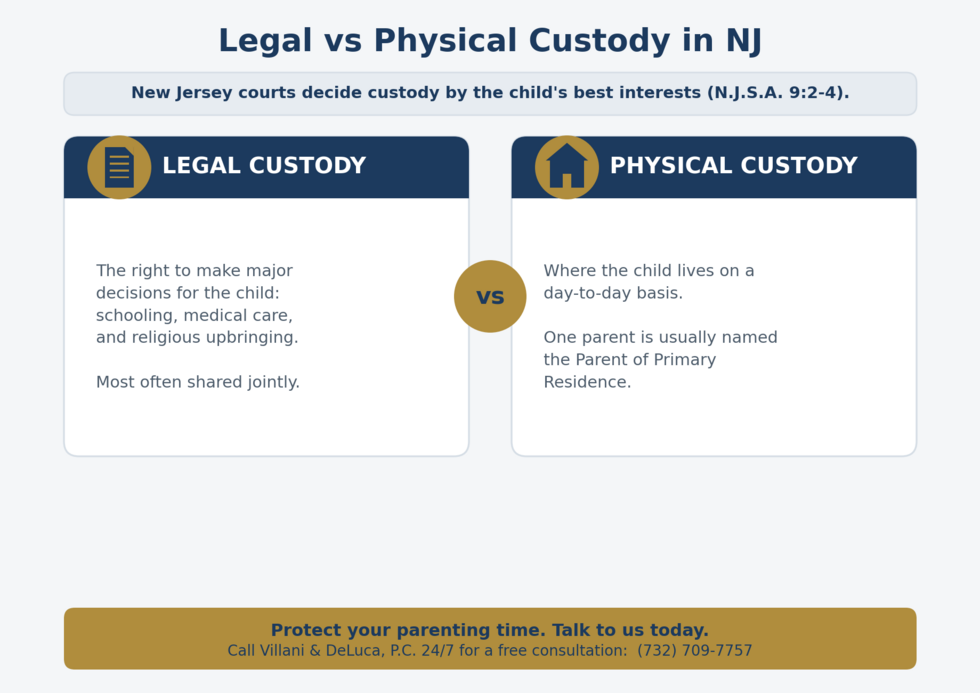
Physical custody refers to receiving residential custody, where you will be the one the child lives with the majority of the time. In child custody agreements, the parent housing the child is the custodial parent, while the parent not housing the child is the noncustodial parent. The noncustodial parent is generally entitled to scheduled visitation as part of the visitation agreement.
In a rare custody case, the new jersey court may decide on a split custody arrangement. Split custody may occur in situations where the parents have more than one child. The court may decide that one parent and the other parent will both be custodial parents, and they will each take care of a different child.
Legal custody refers to receiving the authority to make decisions involving your child's best interests, including health and education. Having joint legal custody or sole custody will have a large bearing on your child's life, as the child's welfare depends on the decisions made.
While there may be occasions where sole physical custody of the child is granted, New Jersey child custody cases often result in joint legal custody. This type of arrangement gives both parents an equal say in the parenting plan of their child. This is especially so when there is a minor child involved, typically joint custody, where both parents have a say, is considered more suitable to further the child's best interests.
Our child custody attorneys will advocate for the parental rights you want, whether you prefer having joint custody or sole custody, and legal custody rights or physical custody rights.
Issues arising from custody orders and further modifications
Even after the court has made a decision regarding child custody, there may be disagreements in the process of carrying out custody arrangements. One parent may disagree with a decision made by the other parent. The custodial parent may make a choice that the noncustodial parent strongly objects to. As time passes, the needs and wants of the child will change and may warrant changes to the custody arrangement.
The New Jersey court may make modifications accordingly to the legal custody, physical custody, sole custody or joint custody arrangement. If both parents can reach an agreement, the court will allow it. If a disagreement arises, the litigation process will begin again. However, any changes made regarding existing child custody will still focus on the best interests of the child.
There may be situations where the custodial parent intends to move to another state. The parent wishing to relocate should get in touch with a child custody lawyer, as New Jersey laws have restrictions on such a move. A relocation will reduce or entirely deny the parenting time of the noncustodial parent. New Jersey law may deem such a proposed move not to be in the best interests of the child. The court will allow it if both parents can come to an agreement.
There may also be unfortunate instances where a parent is failing to carry out the agreed child custody arrangements. A parent with physical custody may be wrongfully denying parenting time to the other. One parent with joint legal custody may also be making decisions without consulting the other, such as making plans for the child's education by himself. An enforcement order will be needed from the court to settle these child custody issues and, to ensure the child's best interests are met.
Our family law attorneys will seek enforcement or modifications for these arrangements from the New Jersey court.
Discuss your situation with an experienced New Jersey child custody lawyer today
Are you in the process of seeking professional legal counsel regarding child custody issues? Have other law firms failed to answer your questions? Our law firm offers a free consultation, and you are welcome to speak to our New Jersey child custody lawyers today. We promise to provide sound support for parents like you, and our New Jersey child custody lawyers pride themselves on maintaining a close lawyer-client relationship. Contact us today to speak to an experienced attorney now.
Client Testimonial
"Worth the money. Carmine Villani was so helpful throughout the court process. He answered any questions I had about my case, helping to keep me calm when I got stressed. The outcome was terrific and Mr. Villani was the most professional lawyer in the court that day. I couldn't have asked for better representation." - Heather Popielarczyk
"I just wanted to send you an email to say thank you for yesterday you are truly a pleasure to work with. You without a doubt made a 13 month long drawn out battle with my ex-husband a bit easier, if only you were the mediator that was assigned to us in the first place this may have been over a lot sooner.Again Thank you! " – R.H.
"Carmine Villani was very knowledgeable. I would highly recommend him." – Karen Roche
Frequently Asked Questions
Can a parent who does not have custody have access to the child's records?
Both parents will have access to the child's records, even if the child lives with only one parent. These records include information about the child's medical, dental and educational care. If you do not want the other parent to see these records, you may ask the court for a hearing to limit the other parent's access. A judge will limit access if s/he decides that it would be in the best interest of your child, or if the other parent is using access to the records to harm you.
I am the child's relative (aunt/grandparent/cousin/etc). Can I get custody of the child?
Probably not. A court determines who should have custody based on what a judge thinks is in the best interest of the child. There is a very strong presumption that living with one or both parents is in the best interest of the child. Therefore, generally, a court will not award custody to another relative unless the court finds that both parents are “unfit” to take good care of the child. However, a relative may be able to get temporary custody of the child if neither parent is able to take care of the child at that time and neither parent objects.
If a custody order is already in place, how can I get it changed?
To change a custody or visitation order that is already in place, you need to petition the court. Generally, for the court to grant you a change in custody or visitation, you need to show that there has been a significant change in circumstances since your last hearing.
To file a motion for (ask for) a change in custody or visitation, you must fill out certain forms and return them to the court. The court clerk may be able to answer some questions you have about the paper work. However, the packet and court workers cannot tell you whether you should bring your case to court or what will happen if you do.
What Happens If We Reach A Custody Agreement?
In New Jersey, if the Court grants you sole physical custody of your child, then your child lives with you and not with the other parent. Joint physical custody is where your child lives with both you and the other parent, splitting her/his time between both homes. When there is joint physical custody arrangement, both parents share the rights of making day-to-day decisions about your child and the responsibilities of caring for your child. In order for joint physical custody to be a viable option the parties must have the ability to communicate well with one another (have a good relationship with one another) as well as reside in close proximity to one another. In a joint physical custodial arrangement both parents will be responsible for the feeding of the child, bathing the child, arranging medical care for the child, participating in your child's education and putting the child to bed at night. Because parents with joint physical custody usually have joint legal custody as well, it also means that both parents share the right to make major decisions about your child. Here are some examples of joint physical custody:
- Your child spends 3 days a week with you, and 4 days a week with the other parent.
- Your child spends one week, month or year with you and then the next week, month or year with the other parent.
- If you have physical custody and the other parent has visitation rights (parenting time), then this is not joint physical custody. This is true even if the other parent has a large amount of visitation time.
What are the steps for filing for custody?
It depends on the particulars of your situation. To find out what the process will be like for you, please consult a lawyer in your area. Generally, if the parents are married, one or both of the parents usually files for custody as part of a divorce action. If the parents are already divorced, the parent who does not have custody can ask for a change in custody in the county where the divorce was issued. If the parents were never married, either parent can file for custody in the county in which the child has been living for at least six months.
In which state do I file for custody?
It depends. Only one state's court will have jurisdiction, or the power to hear your case. Custody jurisdiction is state law. However, most states have adopted a law called the Uniform Child Custody Jurisdiction and Enforcement Act (UCCJEA). New Jersey has recently adopted the UCCJEA. Under the UCCJEA, you can only file for custody in the “home state” of the child. The “home state” is typically the state where your child has lived with a parent or a person acting as a parent for at least six consecutive months. If your child is less than 6 months old, then your child's home state is the state where s/he has lived since birth. Leaving the state for a short period of time, such as going on vacation, does not change your child's home state. If you and your child recently moved to a new state, generally you cannot file for custody in that new state until you have lived there for at least six months. Until then, you or the other parent can start a custody action in the state where your child has most recently lived for at least 6 months. Please be advised that there are exceptions to this rule.
What are some of the advantages and disadvantages of obtaining a custody order?
Some people decide not to get a custody order because they do not want to get the courts involved. They may have an informal agreement that works well for them or may think going to court will provoke the other parent. Getting a custody order can provide you with:
- The legal right to make decisions about your child.
- The legal right to have your child live with you.
- If you decide not to obtain a custody order, then legally, you and the other parent both have equal rights to make decisions about your child and live with your child. The only way to legally change this arrangement is to file for custody.
What if the collaborative law process fails to reach a settlement?
In the event the parties are unable to arrive at a settlement through the Collaborative Law Process, the lawyers withdraw from the case and the parties are free to retain trial attorneys to pursue their matter in court. The result is that the parties will have the best representation for each phase of the proceeding, and possibly save time spent in a subsequent, costlier trial.
Is there any difference between custody and parenting time?
Custody can include the right to make decisions about your child (legal custody) and the right to have your child live with you (physical custody). A parent who does not have physical custody may be entitled to significant parenting time. This means that even though the child lives primarily with one parent, the child still gets to spend time with the other parent. In New Jersey, this is sometimes also called “parenting time.” You may also share legal custody of your child with the parent who has parenting time. In this case, your child lives with one parent and spends time with the other parent, but both parents have the right to make important decisions about your child. To read more about “parenting time” and the laws governing it in New Jersey, you can view the New Jersey Judiciary guide online here: http://www.judiciary.state.nj.us/family/paretime.pdf
If a court denies a request for custody, do they have to explain why?
Yes. Anytime the court makes a custody determination that both parents do not agree on, the court must specifically explain why “on the record.” Usually, the judge explains the reasons orally, in the courtroom. The denial of custody should be documented in an “order” but the reasons for the decision are rarely explained there. If you would like the judge's explanation and you cannot be in court to hear it, you may order a transcript of the oral decision from the court for a cost.
Can I get financial support for my children and myself?
Yes. But the court makes separate decisions when awarding support for you and your children, so it is possible that you may only be able to get support for your children, and not for yourself.
Support for your child: Generally, the court will determine how much money the other parent will pay to support your child. The court almost always utilizes set guidelines that are contained in a child support obligation worksheet to determine how much support you will receive.
If you would like to see all of the factors that go into determining support, you can visit the NJ Courts Website. The guidelines the court uses involve a very complex formula, but basically the court looks at both parents' incomes, your child's needs and how much time your child spends with each parent. The more time your child spends with you, the more support you will usually receive.
To get a rough idea of how much support you may receive, you can visit this website: www.alllaw.com/calculators/childsupport/new_jersey/. You should know that this website only estimates the amount of support you may receive. The actual amount of support you receive depends on how much the judge actually decides to give you.
You can also read more information about child support at http://www.njchildsupport.org.
Support for you: This is also referred to as alimony. If you are getting separated or divorced, a court can award you temporary or permanent alimony. In deciding whether to award you alimony, a judge will look at statutorily mandated factors. A few of the factors a judge is required to consider are:
- Your need for payment/ the other parties' ability to pay
- The duration of your marriage
- The age, physical and emotional health of you and the other party
- The standard of living you enjoyed in your marriage and how likely it is that you will be able to maintain a similar standard of living
- How much both parties can earn for a living, and how much education you both have
A judge cannot give you alimony if you were not married to the other parent or if your divorce has already been finalized.
If a custody order is already in place, how can I get it changed?
To change a custody or visitation order that is already in place, you need to petition the court. Generally, for the court to grant you a change in custody or visitation, you need to show that there has been a significant change in circumstances since your last hearing.
To file a motion for (ask for) a change in custody or visitation, you must fill out certain forms and return them to the court. The court clerk may be able to answer some questions you have about the paper work. However, the packet and court workers cannot tell you whether you should bring your case to court or what will happen if you do.
If there is a custody order in place, can I take my kids out of the state?
It depends. Generally, you cannot take your kids out of the state, even for a short period of time, without the other parent's permission, unless the court order specifically says you can. If your court order does not address this issue, then the other parent is not allowed to leave the state with your child, unless you give him/her permission. If the other parent takes the kids out of state without your permission or the permission of a judge, you may be able to file for contempt of the custody order.
If I think that the other parent may abduct my child, is there anything I can do?
You should immediately contact a lawyer who can help you try to prevent abduction. A court may take steps to prevent the other parent from abducting your child. If you think that the other parent may flee the state with the purpose of kidnapping your child, then there are several things you can do:
- File a criminal complaint against the other parent (if the other parent is in the process of fleeing the jurisdiction in violation of a court order or with the purpose of kidnapping your child)
- Attempt to get an emergency Temporary Restraining Order from Family court.
- If you think that the other parent may try to take your child out of the country, you could ask the court to seize your child's passport so s/he cannot leave the country.
Can I get temporary emergency custody?
Should the circumstances so warrant, you may be able to obtain temporary custody on an emergency basis by way of filing an Order to Show Cause application with the court. In order to obtain such relief, you must demonstrate to the court that the child will face substantial immediate and irreparable harm if the transfer is not granted. Courts may be inclined to grant an emergent custody transfer in the event that the child is in danger, i.e. one of the parents is a drug addict, there has been a threat to abduct the child, the child has suffered from some type of abuse and/or neglect.
How will a judge make a decision about custody?
When deciding who will be awarded custody, a judge will try to make an arrangement that he/she thinks is in the best interest of your child. Generally, the court will try to make sure that both parents share the rights and responsibilities of parenting. This means that the court is inclined to let both parents play an active role in taking care of the child and making decisions about the child's life. The court will base its decision on many factors. In accordance with N.J.S.A. 9:2-4, some of the things a judge will consider are:
- Both parents' ability to agree, talk with one another and cooperate about issues relating to the child.
- Whether you and the other parent want custody.
- If either parent has refused to let the other parent see the child. However, a judge will not take this into consideration if you prove that you denied access because you or your child were being abused.
- Your child's relationship with both parents and any siblings. The court tries to make sure children will have an ongoing relationship with their brothers and sisters.
- How many other children you have and how old they are.
- The history of domestic violence, if there is one.
- The safety of your child and of either parent from physical abuse by the other parent.
- Which parent your child would rather live with, if s/he is old enough to make an intelligent decision.
- What your child's needs are.
- How stable both parents' homes are.
- The quality and continuity of your child's education-in other words, whether your child would have to change schools, and how good of an education s/he will receive.
- The general fitness of both parents.
- Generally speaking, the court looks at the character, habits, and physical and mental condition of both parents to see whether it thinks you are “fit”.
- Usually, the court will consider how far the distance is between both parents' homes and whether either parent plans to move out of state.
- How much time and the quality of the time that both parents spent with the child, before or after you split up.
- Both parents' employment responsibilities.
- If either parent did not participate in the Parent's Education Program (See What is the Parent's Education Program?).
If I have moved away from the house where the father and children currently live, will this hurt my chances of gaining custody?
It might be a good idea to consult a domestic violence advocate or attorney before leaving the home where your spouse and children currently live. In some cases, leaving the home could harm your chances of obtaining custody. This is especially true if you leave, but your children stay with your abuser.
Do I need a child custody lawyer?
While it is not mandatory, it may be best to get a child custody lawyer, to make sure that your rights are protected. If you are unable to get a lawyer, you may be able to file for custody on your own. You can visit your local courthouse, which may have copies of some of the paperwork that you will need. You should know that court workers cannot tell you whether you should bring your case to court or what will happen if you do. Even if you plan on representing yourself, it may be helpful for you to have a lawyer review your forms before you file them.
What options are there for legal custody?
If the Court grants you sole legal custody, then you are the only parent who is able to make major decisions for your child. The courts are hesitant to grant sole custody and usually only do so in extreme circumstances (i.e. one parent is incarcerated or has a drug addiction etc.) If the Court grants you joint legal custody of your child, it means that you share the right to make major decisions about your child with the other parent. This is true even though only one parent has physical custody (your child lives with only one parent). With joint legal custody, both parents have a say in major issues like where your child goes to school, whether he/she will have surgery and what kind of religious training he/she receives.
Can a parent who committed domestic violence obtain parenting time?
Yes, it is possible that a parent who committed violence will be awarded parenting time. An isolated act of domestic violence does not automatically take away a parent's right to parenting time. Often whether a parent who has committed domestic violence will obtain parenting time depends on how severe the domestic violence was and whether it was directed toward you or your child. A judge will generally only deny a parent parenting time if he/she feels it is in the best interest of the child. In some cases, a judge may give a parent the right to supervised parenting time-where the parent and child can spend time together with another person present.
What is custody?
Custody is the legal responsibility for the care and control of your child (under 18). The court may give custody of your child to one or both parents. There are 2 types of custody: legal and physical. Typically the parties to a divorce will eventually share legal custody with the spouse being designated as the parent of the primary residence. (i.e. where the child resides the majority of the time). Legal custody is the right to make major decisions about your child. Some types of decisions included in the right of legal custody are: where your child goes to school, whether your child gets surgery and what kind of religious training your child receives. Physical custody refers to who your child lives with on a day-to-day basis.
Who can get custody?
At least one of the child's parents is entitled to custody, unless there is clear and compelling evidence that both parents are “unfit.” In the rare case that the parents are no longer living or are considered “unfit”, the judge can award custody to another person or to an agency such as the Department of Human Resources, depending on what the judge believes to be in the best interest of the child.