

Key Points:
• Under N.J.S.A. 2C:24-4, possessing, distributing, or manufacturing child sexual abuse material (CSAM) is a serious criminal offense, and New Jersey does not distinguish between viewing and sharing.
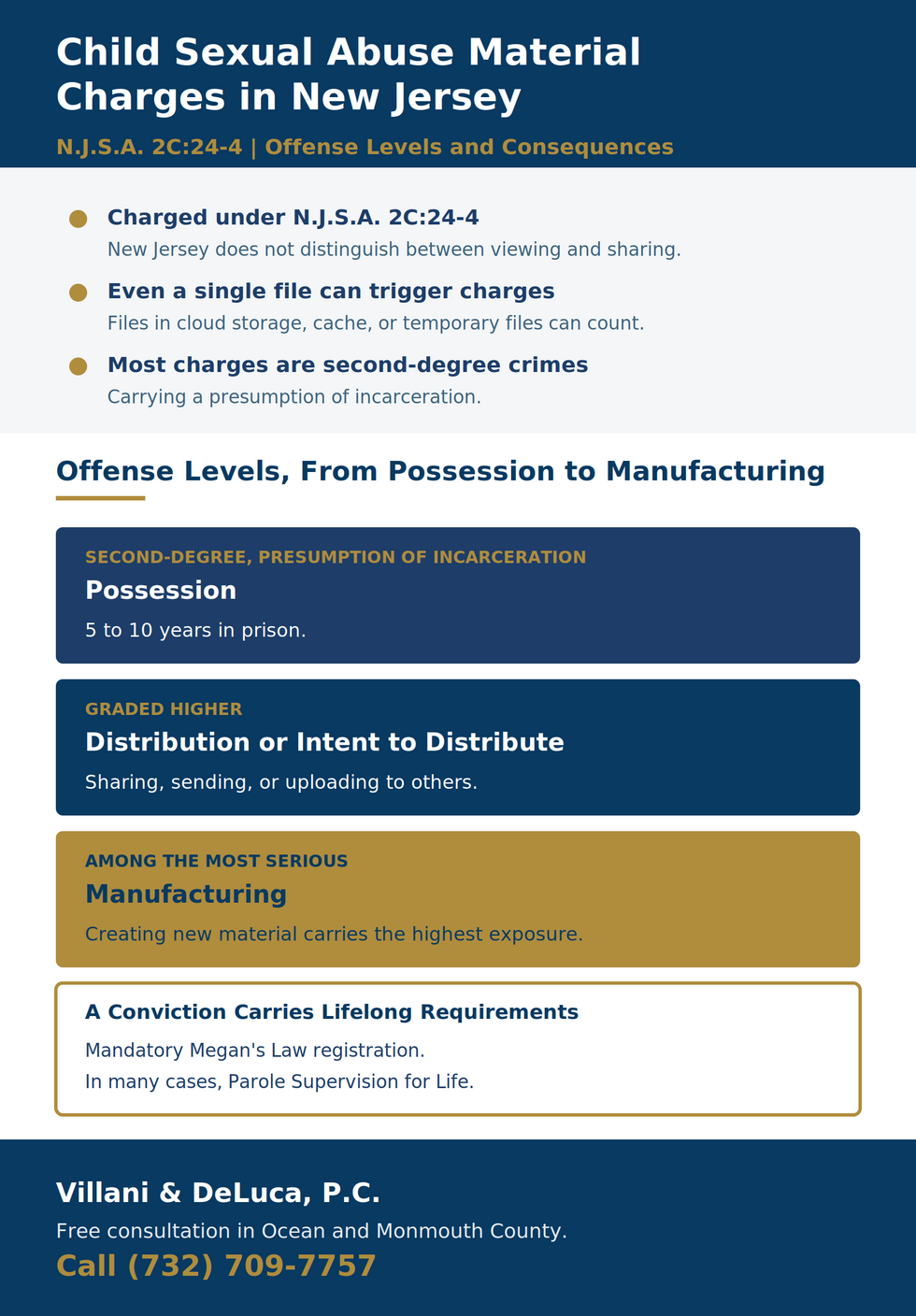
• Most CSAM charges are second-degree crimes carrying a presumption of incarceration, with distribution and manufacturing graded higher.
• A conviction generally triggers mandatory Megan's Law registration and, in many cases, Parole Supervision for Life.
Being investigated or charged with a child pornography offense in New Jersey is a life-altering experience. State prosecutors and law enforcement treat Child Sexual Abuse Material (CSAM) cases with the utmost seriousness, and even a single image can result in criminal charges that carry prison time, mandatory sex offender registration, and long-term restrictions on your freedom and future.
If you or someone you care about is facing CSAM-related charges in Monmouth County, Ocean County, or anywhere in New Jersey, it is essential to have a knowledgeable and experienced defense attorney guiding you through the legal process. The legal team at Villani & DeLuca, P.C. understands the complexity and sensitivity of these cases and is prepared to protect your rights at every stage.
Understanding CSAM Under New Jersey Law
In New Jersey, possessing, distributing, or creating CSAM is a serious criminal offense. The state does not distinguish between viewing and sharing CSAM; both activities can lead to charges. Prosecutors frequently pursue multiple related charges, such as possession of CSAM, distribution with intent to distribute, and manufacturing CSAM, depending on the conduct involved.
Law enforcement agencies in New Jersey, such as county prosecutor Cyber Crimes Units and the Internet Crimes Against Children (ICAC) Task Force, actively investigate CSAM cases. These units work with public and federal partners to trace electronic activity and secure digital evidence. In recent years, arrests and prosecutions for CSAM-related offenses in New Jersey have increased significantly as authorities expand resources for online child protection.
Common Types of CSAM-Related Offenses
1. Possession of CSAM
Possession means having images or videos depicting child sexual abuse on any device or account. This can include computers, phones, cloud storage, or shared drives. Charges may range in severity based on the type and quantity of material.
2. Distribution of CSAM
Distribution refers to sharing, sending, uploading, or transmitting CSAM to others. Even limited electronic sharing with another person can result in distribution charges.
3. Possession With Intent to Distribute
When prosecutors believe a person intended to share or trade CSAM based on the volume of material, communications, or other evidence, they may elevate charges to include “intent to distribute.”
4. Manufacturing CSAM
Manufacturing involves creating new CSAM, whether through recording or producing sexually explicit content involving minors. This is among the most serious offenses and carries significant potential penalties.
Why CSAM Laws Are Strict
New Jersey and federal authorities take CSAM offenses seriously because every image or video represents the documented abuse of a real child. The creation and circulation of these materials perpetuate victimization, trauma, and exploitation. CSAM crimes are prosecuted not only to punish offenders but also to deter exploitation and protect children.
It is important to understand that even possessing digital images that individuals did not create themselves can still lead to criminal charges. Once such material is found on a device, law enforcement typically treats it as evidence of wrongdoing.
Potential Consequences of CSAM Charges
Convictions for CSAM-related offenses in New Jersey can carry severe consequences, which may include:
-
State Prison Terms: Depending on the offense level, prison sentences can be several years long.
-
Sex Offender Registration: Convicted individuals often must register as sex offenders, with long‑term obligations.
-
Fines and Restitution: Courts may impose monetary fines or restitution orders.
-
Long‑Term Supervision: Parole or supervised release requirements may extend for years beyond incarceration.
Penalties tend to increase with aggravated factors such as the volume of material, evidence of distribution, or prior criminal history.
How Investigations Typically Unfold
CSAM cases often begin with a CyberTipline report to authorities or tips from digital platforms about suspicious content. Law enforcement may obtain a search warrant based on probable cause and then conduct digital forensics on seized devices. Electronic communications, account activity, and metadata can play a significant role in building a case.
Investigators use their findings to support arrest warrants and prosecutorial charges. Cases are then processed through New Jersey courts, where charges can evolve based on ongoing discovery and legal strategy.
Contact Villani & DeLuca, P.C.
Facing CSAM charges in New Jersey can be overwhelming and carry serious long-term consequences for your freedom, record, and future opportunities. Villani & DeLuca, P.C. provides experienced legal guidance and personalized defense strategies to protect your rights at every stage of the process.
Call us today at (732) 709-7757 to schedule a free consultation with one of our skilled New Jersey criminal defense attorneys.
Client Testimonial
"Villani and his firm were extremely knowledgeable and professional handling my case. I'm extremely satisfied with the outcomes. God bless you and your firm for your dedicated work." – Bernard Perutt
"Vince and his staff were very professional. Listened to the needs of the client. Great results." – Glen Vandeventer
"Well worth the money. Got exactly what I was looking for. Carmine knows what he's doing and talking about. Will use this firm again if needed and recommend to others to use as well." – Harrison Utter
Frequently Asked Questions
1. What does the law consider "possession" of prohibited digital materials?
In the digital age, "possession" is defined broadly under New Jersey statute N.J.S.A. 2C:24-4. It does not just mean physical ownership of a hard drive or a printed photo. Legally, having a file in your email inbox, saved in a cloud storage account, or even temporarily stored in a computer's "cache" or "temporary files" can be enough to trigger a charge. Because the technology used to track these files is highly advanced, individuals often need an Internet crime attorney to review the technical data and "chain of custody" of the evidence.
2. Is there a difference between viewing a file and distributing it?
Yes, though both are severe crimes. New Jersey law distinguishes between "possession" and "distribution" (or "possession with intent to distribute"). Distribution can include sending a file via message, uploading it to a website, or even using "peer-to-peer" (P2P) file-sharing software where your computer automatically shares parts of a file with others while you are downloading it. Distribution charges are typically classified as higher-degree crimes with much harsher mandatory prison sentences.
3. What are the potential penalties for a conviction in New Jersey?
Most charges involving prohibited materials of minors are classified as second-degree crimes. In New Jersey, a second-degree conviction carries a "presumption of incarceration," meaning the court is legally required to sentence the defendant to between 5 and 10 years in state prison. Additionally, these convictions often fall under the No Early Release Act (NERA) or other mandatory minimum statutes, meaning you must serve a significant portion of the sentence before being eligible for parole.
4. Will I have to register as a sex offender for a digital crime?
In most cases, yes. A conviction for possessing or distributing prohibited materials involving minors generally triggers mandatory registration under Megan's Law. This requires you to register your home address, employment, and vehicle information with local police for life. Furthermore, you may be placed on Parole Supervision for Life (PSL), which subjects your internet usage and daily activities to strict monitoring by a parole officer even after you have completed your prison sentence.
5. How does "Cyber Harassment" relate to these types of charges?
While often separate, cyber harassment nj laws can overlap with cases involving digital materials. If an individual uses electronic devices to send lewd or threatening materials to a specific person with the intent to harm or annoy them, they may face cyber harassment charges. These are often fourth-degree crimes, but if they involve the exploitation of a minor or are part of a larger pattern of internet-based crime, the legal complications multiply quickly.
Trusted Resources
- New Jersey Courts, Criminal Division, Superior Court, https://www.njcourts.gov/courts/superior/criminal
- New Jersey Division of Criminal Justice, Official Website, https://www.njoag.gov/about/divisions-and-offices/division-of-criminal-justice-home/
- New Jersey Internet Crimes Against Children (ICAC) Task Force, https://www.njoag.gov/about/divisions-and-offices/division-of-criminal-justice-home/nj-internet-crimes-against-children-task-force/
- Villani & DeLuca, P.C., Legal Glossary, https://www.villanideluca.com/resources/legal-glossary