

Key Points:
• Under N.J.S.A. 2C:33-4.1, cyber-harassment is generally a fourth-degree crime, rising to third degree if the actor is 21 or older and poses as a minor to harass a minor.
• Computer criminal activity under N.J.S.A. 2C:20-25 ranges from a third-degree to a second-degree crime based on the conduct and the value of the data or property involved.
• Internet offenses involving minors under N.J.S.A. 2C:24-4 carry the most severe exposure and can require Megan's Law registration.
Sexual assault is a serious criminal offense in New Jersey that carries significant legal consequences and long-term effects on a person's life. Understanding the state's laws, what constitutes sexual assault, and how cases are handled is critical for anyone facing these difficult situations. Being informed can help you take the proper steps to protect your rights and understand the legal process.
At Villani & DeLuca, P.C., our criminal defense attorneys assist clients throughout Ocean County, Monmouth County, and surrounding areas with sexual assault matters. Knowing the types of sexual assault charges, how cases progress, and potential outcomes can give you clarity during an overwhelming time.
Understanding Sexual Assault Under NJ Law (2C:14-2)
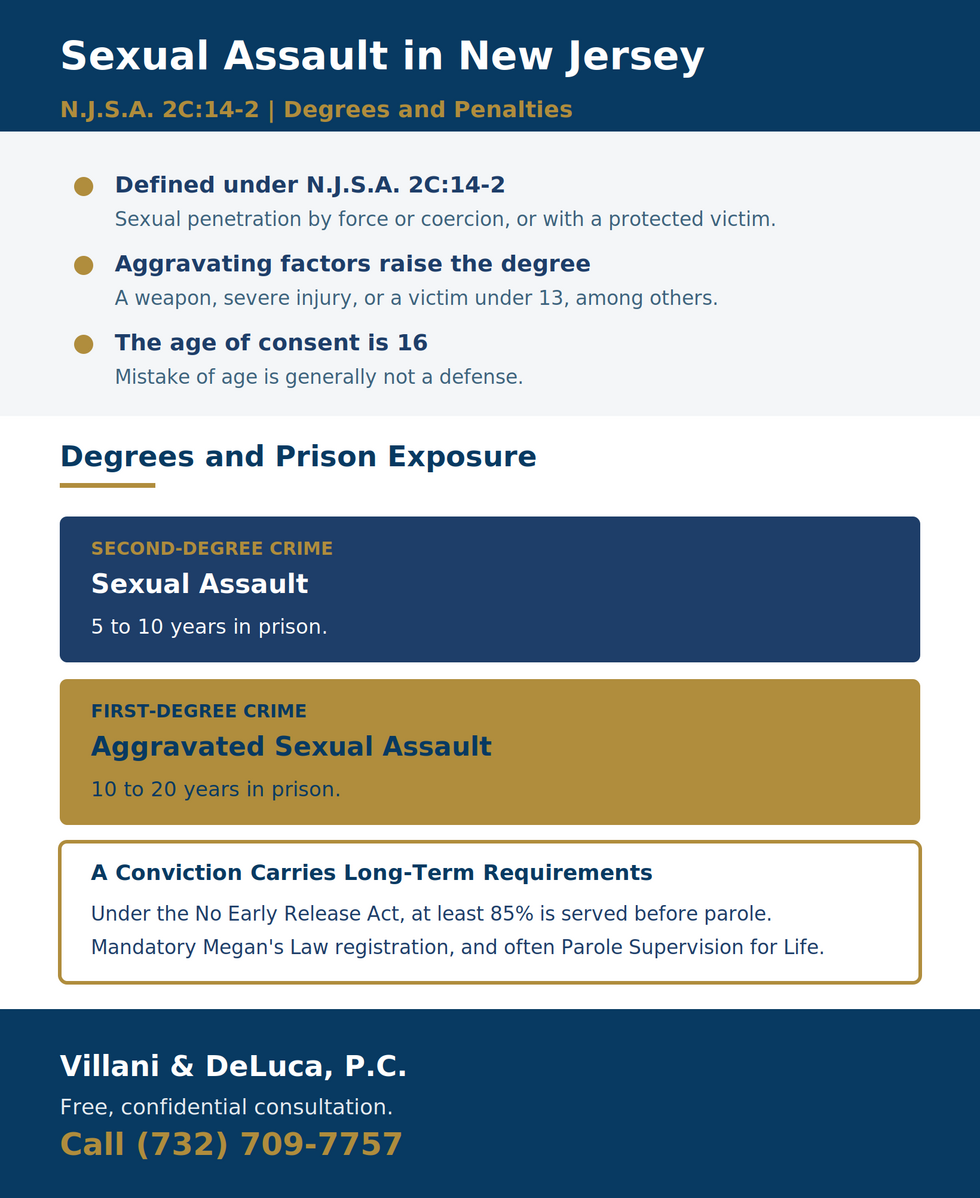
New Jersey defines sexual assault and aggravated sexual assault under N.J.S.A. 2C:14-2. The law sets clear standards for what constitutes these offenses:
Aggravated Sexual Assault (First-Degree Crime)
An individual can be charged with aggravated sexual assault if they commit sexual penetration under any of the following circumstances:
-
The victim is under 13 years old.
-
The victim is 13 to 15 years old, and the actor is related by blood or affinity, has supervisory authority, or acts in loco parentis (as a guardian or household parent).
-
The act occurs during another serious crime, such as robbery, kidnapping, homicide, aggravated assault, burglary, arson, or criminal escape.
-
The actor threatens or uses a weapon or object perceived as a weapon.
-
Others aid the actor and use physical force or coercion.
-
The actor's conduct causes severe personal injury.
-
The victim is physically helpless, mentally incapacitated, or unable to consent due to a mental disease or defect.
Sexual Assault (Second-Degree Crime)
Sexual assault charges under NJ law include:
-
Sexual contact with a victim under 13 when the actor is at least four years older.
-
Sexual penetration using force or coercion, even if severe injury is not sustained.
-
Victims on probation, parole, or detention, where the actor has supervisory authority.
-
Victims 16 to 17 years old, if the actor is related, has supervisory power, or acts in loco parentis.
-
Victims 13 to 15 years old, if the actor is at least four years older.
Penalties vary depending on the severity of the offense, the victim's age, and prior criminal history. First-degree convictions carry the most severe consequences, including long prison terms, while second-degree convictions still carry significant prison time, fines, and potential long-term restrictions.
Who Can Be Charged With Sexual Assault?
Anyone in New Jersey can face sexual assault charges if they violate the statute. This includes:
-
Individuals who engage in sexual contact or penetration without consent.
-
Adults involved in sexual activity with minors.
-
Individuals in positions of authority or trust who exploit their role.
Prior convictions and other factors may increase the severity of penalties and affect legal rights.
Defending Against Sexual Assault Charges
Sexual assault cases can be complex, and defenses vary depending on the circumstances. Common defense strategies may include:
-
Consent: Demonstrating that sexual activity was consensual.
-
Misidentification: Proving that the accused was not involved in the alleged act.
-
Procedural issues: Challenging illegal searches, evidence collection, or violations of rights.
Experienced attorneys can evaluate the evidence, develop a strategy, and provide guidance to navigate this challenging legal area.
How Villani & DeLuca, P.C. Can Help
At Villani & DeLuca, P.C., our team has over 20 years of experience handling sexual assault and other criminal defense matters throughout Ocean and Monmouth Counties, New Jersey. We include former municipal prosecutors and seasoned trial attorneys who know how to interpret New Jersey statutes, including 2C:14-2.
Whether facing a first-degree or second-degree charge, our attorneys provide guidance, advocacy, and support to help clients make informed decisions and protect their rights under New Jersey law.
Protect Your Rights Today
If you are facing sexual assault charges or have questions about potential violations, it is vital to understand your rights and the legal process. Being informed can help you take the necessary steps to protect your future and ensure your case is handled appropriately.
Villani & DeLuca, P.C. offers free consultations, in person or over the phone, to review your situation and explain your options. Call us today at (732) 709-7757 to speak with an experienced criminal defense attorney and take the first step toward protecting your rights.
Client Testimonial
"Villani was awesome could not ask for a better Out come in my case will definitely use him again if ever need be 5 ⭐️‘s" – Joshua Posey
"Carmine is the best. He is sharp and very accessible. Highly recommend for any legal matter. Furthermore, Carmine always delivers phenomenal results. He is the man for the job or legal issue. Don't waste your time with anyone else! 10 out of 10!" – Chris Dio
"I use Mr. Hoffman for all my family matters. He is great!!!! I recommend him and his firm highly!!!!" – Myriah Stanley
Frequently Asked Questions
1. What is the legal definition of sexual assault in New Jersey?
Under New Jersey statute N.J.S.A. 2C:14-2, sexual assault is defined as an act of sexual penetration with another person using force or coercion. It also applies if the victim is physically helpless, mentally incapacitated, or below the legal age of consent. It is important to note that "penetration" is defined broadly in the law and does not require a completed act or a specific duration to constitute a crime. Because the consequences are so severe, individuals facing these allegations often seek out sexual assault lawyers to protect their rights early in the process.
2. Are there different degrees or types of sexual assault?
Yes. New Jersey law categorizes these offenses into several "degrees" based on the circumstances of the incident. Aggravated Sexual Assault is a crime of the first degree and involves additional "aggravating" factors, such as the use of a weapon, the infliction of severe physical injury, or the victim being under the age of 13. Standard Sexual Assault is typically a second-degree crime. Other types of sexual assault charges may involve "Criminal Sexual Contact," which involves intentional touching rather than penetration but is still a serious criminal offense.
3. What is the "age of consent" in New Jersey?
In New Jersey, the legal age of consent is 16 years old. However, the law is more complex than a single number. If an actor is in a position of authority (such as a teacher, coach, or guardian) or if there is a significant age gap between the parties (typically four or more years when the victim is between 13 and 15), charges can still be filed even if the minor appeared to consent. New Jersey law strictly protects minors, meaning "mistake of age" is generally not a valid legal defense.
4. What are the mandatory penalties for a conviction?
A conviction for a first-degree sex crime carries a prison sentence of 10 to 20 years, while a second-degree conviction carries 5 to 10 years. Under the No Early Release Act (NERA), individuals convicted of these crimes must serve at least 85% of their sentence before becoming eligible for parole. Furthermore, a conviction results in mandatory registration under Megan's Law and often requires Parole Supervision for Life (PSL), which imposes strict residency and internet usage restrictions long after prison time is served.
5. How is "consent" evaluated in a court of law?
Consent must be a freely given, affirmative "yes" through words or clear actions. Under New Jersey law, consent cannot be given if a person is intoxicated to the point of being "mentally incapacitated" or "physically helpless" (such as being asleep or unconscious). If the prosecution can prove that the defendant knew or should have known the other person was unable to consent due to substances or other factors, a lack of physical resistance from the victim does not mean the act was legal.
Trusted Resources
- New Jersey Courts, Criminal Division, Superior Court, https://www.njcourts.gov/courts/superior/criminal
- New Jersey Division of Criminal Justice, Official Website, https://www.njoag.gov/about/divisions-and-offices/division-of-criminal-justice-home/
- Villani & DeLuca, P.C., Sexual Assault N.J.S.A. 2C:14-2, https://www.villanideluca.com/resources/new-jersey-statutes/nj-assault-laws/sexual-assault-nj-2c-14-2
- Villani & DeLuca, P.C., Legal Glossary, https://www.villanideluca.com/resources/legal-glossary