

Key Point:
• New Jersey has no formal "legal separation" status; couples use a private separation agreement to define rights while living apart.
• A no-fault divorce based on separation requires living in different residences for at least 18 consecutive months under N.J.S.A. 2A:34-2.
• A "Divorce from Bed and Board" (limited divorce) lets a couple remain married while resolving support and property, and can be converted to a full divorce.
Separation Divorce in New Jersey: Living Apart Without Ending the Marriage
Many couples reach a point in their marriage where they need space and time apart but aren't ready to end the relationship completely. In these situations, a separation divorce or more accurately, a period of separation supported by a written agreement can serve as a practical alternative to filing for divorce right away.
While some states offer a formal process for legal separation, New Jersey does not. Instead, couples can live separately under a separation agreement that outlines their rights and responsibilities while they're apart. This arrangement can help reduce conflict, protect financial interests, and lay the groundwork for reconciliation or, if necessary, a later divorce filing.
At Villani & DeLuca, P.C., our family law attorneys have helped countless clients in Monmouth County, Ocean County, and throughout New Jersey navigate separation and divorce. Whether you're exploring a trial separation or preparing for a longer-term arrangement, we can guide you through the process and protect what matters most.
What a Separation Divorce Means in New Jersey
Because New Jersey does not have a formal statute for legal separation, couples who want to live apart can enter into a private separation agreement. This document functions much like a temporary marital settlement agreement, setting clear expectations for both spouses during the separation period.
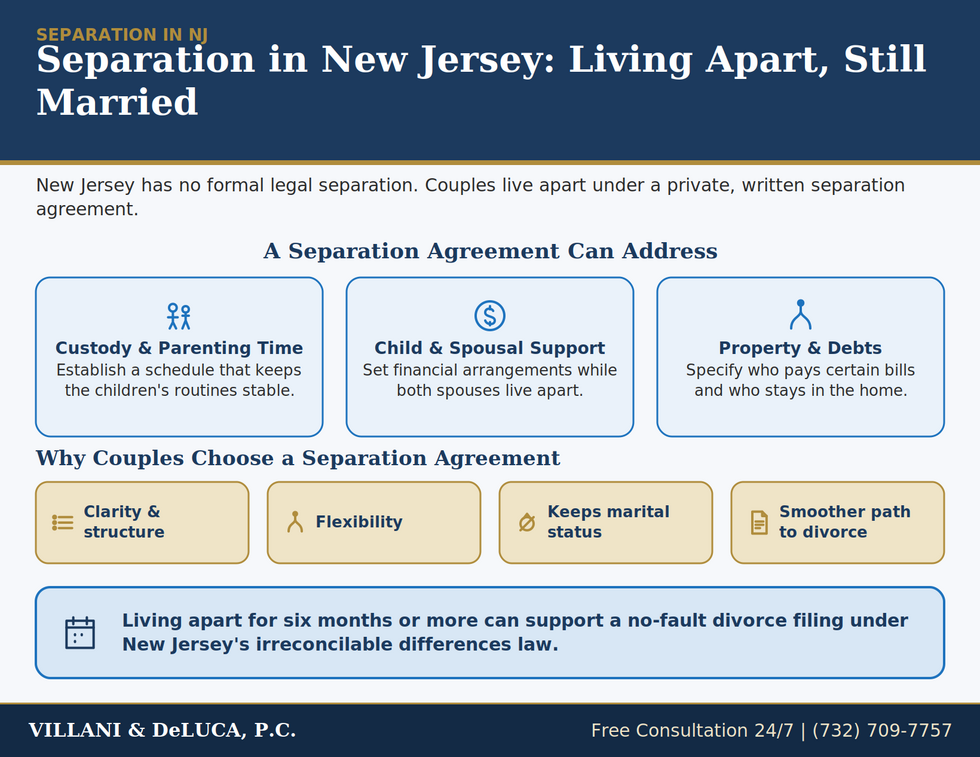
A well-drafted separation agreement can address:
-
Child custody and parenting time. Parents can establish a schedule that keeps the children's routines stable and consistent.
-
Child support and spousal support. Financial arrangements ensure that both spouses and any children continue to be supported while living apart.
-
Division of property and debts. Agreements can specify who will pay certain bills, who stays in the home, and how marital expenses are managed.
Though separation does not legally dissolve the marriage, it can serve as an important step toward clarity whether that means eventual reconciliation or preparing for divorce down the line.
Why Some Couples Choose Separation Instead of Divorce
There are many personal, financial, and practical reasons why spouses may choose to separate rather than immediately file for divorce. Common motivations include:
-
Religious or moral beliefs. Some couples prefer to remain legally married due to faith-based or personal convictions but still need the space to live independently.
-
Opportunity for reconciliation. A period of separation can help couples reassess their relationship and decide if repair is possible before making divorce final.
-
Financial or insurance benefits. Remaining legally married may preserve certain tax advantages or health insurance coverage that would be lost after divorce.
-
Stability for children. Parents sometimes separate to reduce upheaval for their children while still addressing parenting time and financial support.
A separation agreement offers structure and protection during this period of uncertainty, allowing couples to take thoughtful, deliberate steps forward.
How Separation Can Influence a Future Divorce
A trial separation or formal separation agreement can have lasting effects if the couple later decides to divorce. Some of the key ways it can impact the process include:
-
Evidence of irreconcilable differences. Living apart for six months or more can support a no-fault divorce filing under New Jersey's irreconcilable differences law.
-
Custody and parenting time. Temporary arrangements often become the basis for permanent custody orders if they've proven workable.
-
Property and finances. Maintaining separate accounts and responsibilities during separation can simplify equitable distribution later.
-
Alimony considerations. Courts may look at how each spouse managed financially during separation when deciding future support obligations.
In short, a separation can serve as both a cooling-off period and a trial run for the terms that might govern a later divorce.
Benefits of a Separation Agreement
For couples unsure about their next step, a separation agreement offers flexibility and peace of mind. Among the benefits:
-
Clarity and structure. Each spouse knows what's expected, reducing arguments about money, parenting time, and household issues.
-
Flexibility. Agreements can be customized to the couple's needs without court intervention.
-
Preservation of marital status. Couples remain legally married, which is useful for insurance, taxes, or religious reasons while still living separately.
-
Smoother transition to divorce. If reconciliation doesn't occur, the agreement can streamline the divorce process by resolving major issues in advance.
-
How We Handle Separation Agreements
We draft a clear, enforceable separation agreement covering support, parenting time, and expenses, so you are protected during the separation and positioned well if the marriage later ends in divorce.
Client Testimonial
Monmouth: "I am writing this review of Vince DeLuca to help anyone who may be considering hiring him as a collaborative divorce attorney. I hired him in that role back in 2010 when collaborative divorce was still relatively uncommon in NJ, yet he already had a great deal of experience at that point. The main point I want to convey is that I am very glad I hired Vince, and I highly recommend him. The reasons for that are trust, his capacity to put my son's needs first, and his ability to understand and support me in some unusual situations. Trust is very important to me in all relationships, but given the importance of this divorce for my son and me, it was a top priority. After a quick look at the Villani DeLuca website, I worried that they might be too assertive or corporate for me. But I was wrong, and I am glad I took the time to meet Vince. After his help with a successful divorce, I have had three other occasions to contact him for guidance, and each time my trust in him has grown. One of the main reasons I trust him is his capacity to think first of the needs of the child. He has worked as a mediator and has children of his own. As a result, there were times when he guided me to back off or adjust my requests, and other times when he encouraged me to ask for more to maintain an appropriate balance for our son. This was really critical for me, because I wanted to make sure that whatever actions I took were in the long-term best interest of our child. Each time I contacted Vince, I felt like I had an unusual situation he had likely never encountered before. In most cases, he confirmed that it was new for him. Yet despite those challenges, he proved that he could easily adapt his vast experience to my specific situations. He never judged me, and I always felt genuine caring from him, especially for my son and also for my ex. For these reasons and more, I highly recommend Vince DeLuca as a collaborative divorce attorney. Best of luck to you on your current challenges. I highly recommend Vincent DeLuca as a collaborative divorce attorney. I hired him back in 2010 for a collaborative divorce, and his involvement helped make it a success. He was already skilled in that area of law at the time, despite it being new to many people in NJ. In a collaborative divorce, both lawyers become part of the team, yet in private, they still offer guidance to their clients. So I wanted a lawyer who was both a team player and a straight shooter. If I was asking for too much, I wanted him to tell me, and if I was not holding a fair line, I also wanted to know. Throughout the process, he offered that kind of honest guidance, and he helped keep our son's needs front and center. He also has skills as a mediator, and it was clear to me that he truly wanted what was best for our son. Vince is also capable of being assertive and seeing through tactics and posturing. I certainly did not want a typical divorce battle, but I want to be clear that if I had faced one, I would also trust that Vince could help protect me from those pitfalls. In many ways, he offers a great blend of all of those skills. He is caring, experienced, creative, and tactful. Above all, he earned my trust at a high level. I ended up contacting him three other times and referring a handful of friends to him. I wish you luck on your current challenges and recommend that you consider a consultation with Vince to see if he is a good fit for your needs."– Erica Aborlleile
"Mr. Villani really helped me out. He knew his stuff and was very confident about what he was doing. Great guy" – C.D.
"Carmine is a great lawyer and my case was resolved in a minimal amount of time. Even during a pandemic, he responded quickly to any questions and concerns I had. I highly recommend him and his firm. Thank you so much Carmine!" – Karina Testa
Frequently Asked Questions
1. Does New Jersey recognize a status of "legal separation"?
Strictly speaking, New Jersey does not have a formal court status called "legal separation" in the same way some other states do. However, couples can achieve a similar result through a legal separation agreement, often referred to as a Consent Order or a Separation Agreement. This document allows you to live apart while formally deciding on issues like support and asset division. As of 2026, these agreements are highly encouraged by the courts as a way to provide stability and clear boundaries before a final divorce is filed.
2. How is a "separation divorce" different from a standard divorce?
A divorce separation usually refers to a "no-fault" divorce based on living separately and apart. In New Jersey, if a couple has lived in different habitations for at least 18 consecutive months and there is no reasonable prospect of reconciliation, they can file for divorce on these grounds. While this was the traditional route for many, 2026 legal practices show that most couples now prefer filing for "irreconcilable differences," which only requires a six-month breakdown of the marriage and does not strictly require living in separate residences.
3. Can I still live in the same house while we are separated?
Yes. In New Jersey, you do not necessarily have to move out to be considered "separated" for a divorce based on irreconcilable differences. However, if you are seeking a divorce or separation based on the 18-month separation statute, the law generally requires "different habitations." If you are residing under the same roof but leading separate lives, a legal separation agreement can help define the financial and domestic responsibilities of each party during this transitional period.
4. What is a "Divorce from Bed and Board," and when is it used?
A "Divorce from Bed and Board" (technically a limited divorce) is a legal arrangement in New Jersey that is similar to what other states call a legal separation. This arrangement allows a couple to remain legally married while living in separate residences and negotiating issues such as alimony, child support, and asset division. It is often used by couples who are not ready for a complete divorce or those who need to remain legally married for specific benefits. For example, it allows a spouse to continue receiving health insurance coverage under the other spouse's plan, which is usually terminated in a final judgment of divorce. Additionally, it can be vacated if the couple chooses to reconcile or converted into a full divorce if they decide to end the marriage permanently.
5. Is a written agreement necessary if we agree on everything?
While you are not required to have a written document to live apart, it is highly recommended. Without a formal separation divorce agreement, you may remain financially liable for your spouse's new debts, and there are no enforceable rules regarding parenting time or support. In 2026, New Jersey courts have seen an increase in "post-separation" litigation where verbal agreements failed. Having a lawyer draft a formal agreement protects your assets and provides peace of mind.
Work with an Experienced New Jersey Separation Divorce Attorney
If you're considering a separation or unsure whether divorce is the right next step, it's important to understand how each option affects your rights and finances. An experienced attorney can help you draft a fair, enforceable separation agreement that protects you now and in the future.
At Villani & DeLuca, P.C., we've been helping New Jersey families navigate separation and divorce for decades. We understand the emotional and financial complexities these decisions bring and will work closely with you to find the best path forward whether that's reconciliation or a permanent resolution through divorce.
Call (732) 709-7757 today for a free consultation. Our attorneys are available 24/7 to answer your questions and help you move forward with confidence and peace of mind.
The Bottom Line
If you are considering separation or unsure whether divorce is the right next step, an experienced attorney can help you draft a fair, enforceable agreement that protects you now and later. Villani & DeLuca has helped New Jersey families with separation and divorce for decades. Call for a free consultation.
About the Author: Vincent C. DeLuca, Esq., NJ Supreme Court Certified Matrimonial Attorney, is a partner at Villani & DeLuca, P.C. He handles separation agreements, collaborative divorce, custody, and support matters for families throughout Ocean and Monmouth Counties.
Related Articles
- Divorce in New Jersey
- No-Fault Divorce in NJ
- Marital Settlement Agreements in NJ
- Divorce Mediation in NJ
Trusted Resources
- New Jersey Courts, Self-Help (Divorce): https://www.njcourts.gov/self-help/divorce
- New Jersey Legislature, N.J.S.A. 2A:34-2 (Grounds for Divorce): https://www.njleg.state.nj.us/laws/2a/2a-34-2
- Villani & DeLuca, P.C., Legal Glossary: https://www.villanideluca.com/resources/legal-glossary