

Key Point:
• New Jersey recognizes several fault grounds under N.J.S.A. 2A:34-2: adultery, extreme cruelty, desertion, addiction, imprisonment, and institutionalization.
• Fault grounds require credible, corroborated evidence and tend to be longer and costlier than a no-fault filing.
• Fault rarely changes property division or custody unless it involves economic misconduct or affects a parent's fitness.
Fault-Based Divorce in New Jersey: When Misconduct Matters
While many couples in New Jersey choose a no-fault divorce, there are still situations where one spouse decides to file on fault-based grounds. In these cases, the spouse seeking the divorce must prove that the other engaged in misconduct that directly led to the breakdown of the marriage.
Pursuing a fault-based divorce can make the process longer and more contentious, but in certain situations, it may have strategic or emotional benefits, especially when issues like alimony, custody, or property division could be affected.
If you're considering this route in Monmouth County, Ocean County, or anywhere in New Jersey, the attorneys at Villani & DeLuca, P.C. can help you understand your options and build a case that protects your interests.
Grounds for a Fault-Based Divorce in New Jersey
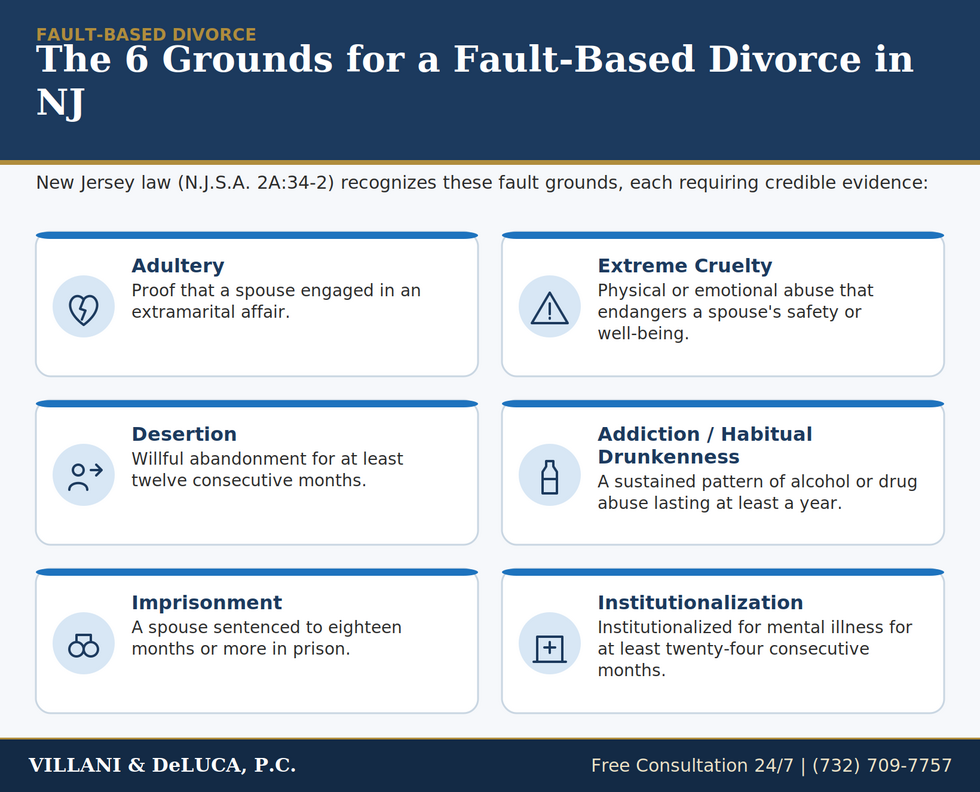
New Jersey law (N.J.S.A. 2A:34-2) recognizes several specific grounds for filing a fault-based divorce. Each requires credible evidence to support the claim:
-
Adultery: Proof that a spouse engaged in an extramarital affair. While adultery doesn't automatically affect property or custody decisions, it can influence alimony or settlement negotiations in certain cases.
-
Extreme Cruelty: Physical or emotional abuse that endangers a spouse's safety or well-being. Testimony, medical records, or witness statements often play an important role in proving cruelty.
-
Desertion: One spouse has willfully abandoned the other for at least twelve consecutive months without justification. This can include leaving the marital home or refusing intimacy during that time.
-
Addiction or Habitual Drunkenness: A sustained pattern of alcohol or drug abuse lasting at least a year after the marriage began. Evidence might include rehab records, police reports, or testimony.
-
Imprisonment: If a spouse has been sentenced to eighteen months or more in prison, the other may seek a divorce on this basis. However, resuming cohabitation after release can nullify this ground.
-
Institutionalization for Mental Illness: When a spouse has been institutionalized for mental illness for at least twenty-four consecutive months, supported by medical documentation or hospital records.
Why Some Spouses Choose a Fault-Based Divorce
While most divorces in New Jersey proceed on no-fault grounds, there are situations where establishing fault serves a purpose.
-
Damages: Demonstrating misconduct can influence the court's decisions on alimony, property division, or attorney's fees, especially in high-asset cases or where one spouse's actions caused significant harm.
-
Custody and Parenting Time: In cases involving abuse, addiction, or other harmful behavior, a fault finding can impact custody and parenting decisions by showing that one parent poses a risk to the child's well-being.
-
Personal Closure: For some, proving fault is about more than legal strategy. It's about accountability and having the record reflect what truly ended the marriage along with finding a sense of resolution in doing so.
The Challenges of Proving Fault
Filing for divorce on fault grounds is rarely simple. It requires more time, evidence, and emotional energy than a typical no-fault filing.
-
More Time and Expense: Proving misconduct often means additional hearings, discovery, and testimony. That can increase both the duration and the cost of the case.
-
Emotional Strain: Sensitive personal details, from infidelity to abuse, must often be discussed in open court. This can heighten conflict between spouses and make the process more difficult.
-
Higher Burden of Proof: The spouse making the allegations must present credible, corroborated evidence. Without documentation or witness testimony, it may be hard to convince the court of the allegations.
For many people, these challenges outweigh the potential benefits. But when substantial financial interests or child-related concerns are at stake, pursuing a fault-based divorce can sometimes be the right decision.
How We Handle Fault-Based Divorce Cases
We help you decide whether fault serves your goals, gather and present the corroborated evidence the court requires, and, where the misconduct is economic, work with financial experts to identify dissipation of assets.
Client Testimonial
Monmouth: "I would like to specifically commend Vincent DeLuca, Esq. on his tremendous efforts in mediating this matter. Mr. DeLuca was able to assist the parties virtually and facilitate the within the agreement, as well as lay a foundation to remediate further issues regarding the parties' daughter. I on behalf of both parties thank him for his efforts." – A.M.
"The office of Carmine Villiani from the front to Carmine was pleasant and professional.The outcome of my situation, better then I expected.Carmine was always available to speak with at anytime . I definitely would recommend this attorney to family or friends." – Grace Elia
"I just wanted to send you an email to say thank you for yesterday you are truly a pleasure to work with. You without a doubt made a 13 month long drawn out battle with my ex-husband a bit easier, if only you were the mediator that was assigned to us in the first place this may have been over a lot sooner.Again Thank you!" – R.H.
Frequently Asked Questions
1. What are the legal grounds for a fault-based divorce in New Jersey?
While many couples choose "Irreconcilable Differences," New Jersey law (N.J.S.A. 2A:34-2) still allows for fault-based divorce under specific circumstances. These include extreme cruelty (physical or mental), adultery, willful desertion for at least 12 months, habitual drunkenness, voluntary addiction to narcotics, and institutionalization for mental illness.
If you believe your situation warrants a fault-based filing, the divorce lawyers at Villani & DeLuca can help you determine which ground best protects your interests and explain the potential advantages of fault based divorce.
2. Does filing for "Extreme Cruelty" provide a faster divorce?
Actually, filing for extreme cruelty is often a matter of legal strategy rather than speed. Under New Jersey law, you can file for divorce based on extreme cruelty as soon as three months after the last act of cruelty occurred. This is a shorter "waiting period" than the six months required for a no-fault divorce. However, because you must provide specific proof of the conduct, these cases can sometimes become more litigated than a standard filing.
3. How does "fault" affect the division of marital property?
New Jersey is an Equitable Distribution state. Generally, "marital fault" (like infidelity or desertion) does not impact how assets are split. However, one of the financial advantages of fault-based divorce involves cases of "economic fault." If a spouse's conduct led to the intentional depletion of marital funds—such as spending money on an addiction or a paramour—the court may award the other spouse a larger share of the remaining assets to compensate for the loss.
The team at Villani & DeLuca works with financial experts to identify instances of asset dissipation to ensure you receive a fair settlement.
4. Will a fault-based filing influence child custody decisions?
In 2026, New Jersey courts continued to follow the "Best Interests of the Child" standard under N.J.S.A. 9:2-4. A parent's "fault" in the marriage only impacts child custody if that conduct directly affects their fitness as a parent. For example, while adultery rarely impacts custody, grounds like habitual drunkenness, drug addiction, or extreme cruelty (domestic violence) are taken very seriously by judges when determining a safe parenting schedule.
5. Can I change my mind and switch to a "no-fault" divorce after filing?
Yes. It is common for a spouse to initially file on fault-based grounds but later reach a settlement through a Marital Settlement Agreement. In these cases, the parties often agree to amend the complaint to "Irreconcilable Differences" to finalize the divorce more amicably. This can save time and reduce the emotional strain on the family.
If you are currently in a high-conflict situation, contact Villani & DeLuca to discuss the most effective legal path for your specific circumstances.
Talk with an Experienced New Jersey Divorce Attorney
Deciding whether to file for divorce on fault grounds is a serious choice that depends on the facts of your case. An experienced attorney can explain how each option may impact your finances, your children, and your future.
The family law attorneys at Villani & DeLuca, P.C. have decades of experience representing clients in complex divorce cases across Monmouth County, Ocean County, and throughout New Jersey. We approach every case with honesty, discretion, and a focus on achieving the best possible outcome.
If you're considering a fault-based divorce, call (732) 709-7757 or reach out online to schedule a free consultation. We're available 24/7 to help you move forward with clarity and confidence.
The Bottom Line
Deciding whether to file on fault grounds is a serious choice that depends on the facts of your case, and an experienced attorney can explain how each option affects your finances, your children, and your future. The family law attorneys at Villani & DeLuca have decades of experience with complex divorce cases across Monmouth and Ocean County. Call for a free consultation.
About the Author: Vincent C. DeLuca, Esq., NJ Supreme Court Certified Matrimonial Attorney, is a partner at Villani & DeLuca, P.C. He handles fault-based and no-fault divorce, custody, and support matters for families throughout Ocean and Monmouth Counties.
Related Articles
Trusted Resources
- New Jersey Courts, Self-Help (Divorce): https://www.njcourts.gov/self-help/divorce
- New Jersey Legislature, N.J.S.A. 2A:34-2 (Grounds for Divorce): https://www.njleg.state.nj.us/laws/2a/2a-34-2
- New Jersey Legislature, N.J.S.A. 9:2-4 (Child Custody Best Interests): https://www.njleg.state.nj.us/laws/9/9-2-4
- Villani & DeLuca, P.C., Legal Glossary: https://www.villanideluca.com/resources/legal-glossary