

Key Point:
• New Jersey alimony is decided under N.J.S.A. 2A:34-23(b), which lists 14 factors the court must weigh. There is no formula and no calculator.
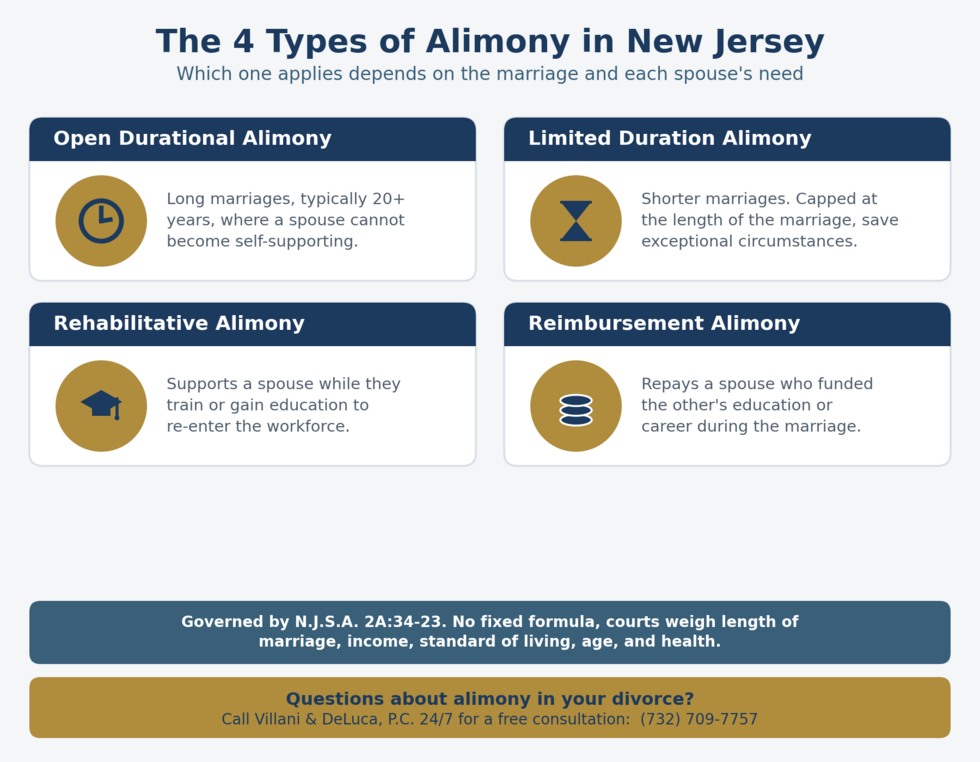
• New Jersey recognizes four types of alimony: open durational, limited duration, rehabilitative, and reimbursement. Permanent alimony was ended by the 2014 reform.
• Alimony can be modified or terminated on a substantial change in circumstances under the Lepis v. Lepis standard, and cohabitation by the recipient is grounds for suspension or termination under N.J.S.A. 2A:34-23(n).
When two people marry or enter a civil union, they usually pool everything. Separating those finances fairly, years later, is one of the harder parts of a divorce.
Alimony is where that separation gets personal. One person is worried about paying for two households on one income. The other is worried about the standard of living they gave up a career to help build. Both of those concerns are legitimate, and New Jersey law takes both seriously.
The family law attorneys at Villani & DeLuca, P.C. will help you analyze your case under New Jersey's alimony laws, working from the actual facts of your marriage: how long you were married, what each of you earns, what each of you needs. Reach out for a free consultation at (732) 709-7757, or contact us online. We are located at 703 Richmond Avenue (Route 35) in Point Pleasant Beach.
How We Handle Alimony Matters
Alimony turns on the numbers and on how well those numbers are documented. We work through the statutory factors under N.J.S.A. 2A:34-23(b), build out need and ability to pay, and bring in experts where the picture is complicated. Whether you are seeking support, resisting an award you think is wrong, or asking to change an existing order, we prepare the record the court will actually rely on.
Client Testimonial
"I wanted to tell you again how grateful I am for everything you did for me and my children today. You gave me SUCH peace of mind. You can't put a price on that. I am truly so thankful that I can finally begin to see light at the end of the tunnel. Vincent, thank you for being such a gentleman & fair minded during this process! You are amazing at what you do." - K.G.
"Mr. Villani really helped me out. He knew his stuff and was very confident about what he was doing. Great guy" – Erica Aborlleile
"The office of Carmine Villiani from the front to Carmine was pleasant and professional.The outcome of my situation, better then I expected.Carmine was always available to speak with at anytime . I definitely would recommend this attorney to family or friends." – Grace Elia
Frequently Asked Questions
What is Alimony?
Alimony, also called spousal support, is money one spouse pays the other during or after a divorce. A court can order it while the case is pending and after the judgment. The idea behind it is straightforward: a divorce should not leave the spouse with fewer resources unable to maintain anything like the life the marriage built. Permanent alimony no longer exists in New Jersey; it was replaced by open durational alimony. For marriages shorter than 20 years, the total duration of alimony generally cannot exceed the length of the marriage, except in exceptional circumstances.
How is Alimony determined in New Jersey?
N.J.S.A. 2A:34-23(b) lists 14 factors the court weighs, including the actual need and ability of the parties to pay, the length of the marriage, the age and physical and emotional health of both spouses, the standard of living established during the marriage, each party's earning capacity and employability, how long the spouse seeking support has been out of the job market, parental responsibilities, the time and expense needed to get education or training, each party's financial and non-financial contributions to the marriage, the equitable distribution ordered, investment income, tax consequences, and any pendente lite support already paid. The statute also says no factor is automatically more important than another unless the court explains why, and the judge has to make written findings. Where child support is also at issue, the court may set that first.
How long does a spouse have to pay alimony in New Jersey?
The length of the marriage does most of the work. For marriages and civil unions under 20 years, alimony generally cannot last longer than the marriage did, unless the court finds exceptional circumstances. The statute lists eight of those, including a large age gap, a chronic illness, one spouse having given up a career for the other, and one spouse having received a disproportionate share of the marital assets. Whether the court orders limited duration alimony, meaning a set term where the recipient can become employable, or open durational alimony, where they cannot, depends on the facts of your marriage.
How can I avoid alimony in New Jersey?
Once alimony is ordered, it must be paid as ordered, but either party can move to modify or terminate it. The long-standing standard comes from Lepis v. Lepis, 83 N.J. 139 (1980), which requires a substantial and continuing change in circumstances. For orders and agreements after September 10, 2014, three situations also have their own statutory rules on top of Lepis: retirement under N.J.S.A. 2A:34-23(j), which creates a rebuttable presumption that alimony ends at full retirement age of 67; cohabitation under subsection (n); and involuntary loss of income under subsections (k) through (m), which requires a 90-day waiting period before an application can even be filed. Parties can also agree in writing to change the amount, but a later modification still requires a motion showing a substantial and unanticipated change.
How long does a spouse have to pay alimony in New Jersey?
The length of the marriage does most of the work. For marriages and civil unions under 20 years, alimony generally cannot last longer than the marriage did, unless the court finds exceptional circumstances. The statute lists eight of those, including a large age gap, a chronic illness, one spouse having given up a career for the other, and one spouse having received a disproportionate share of the marital assets. Whether the court orders limited duration alimony, meaning a set term where the recipient can become employable, or open durational alimony, where they cannot, depends on the facts of your marriage.
How can alimony be modified or ended in New Jersey?
Once alimony is ordered, it must be paid as ordered, but either party can move to modify or terminate it. The long-standing standard comes from Lepis v. Lepis, 83 N.J. 139 (1980), which requires a substantial and continuing change in circumstances. For orders and agreements after September 10, 2014, three situations also have their own statutory rules on top of Lepis: retirement under N.J.S.A. 2A:34-23(j), which creates a rebuttable presumption that alimony ends at full retirement age of 67; cohabitation under subsection (n); and involuntary loss of income under subsections (k) through (m), which requires a 90-day waiting period before an application can even be filed. Parties can also agree in writing to change the amount, but a later modification still requires a motion showing a substantial and unanticipated change.
Does cohabitation automatically end alimony in New Jersey?
No, but it is strong grounds for suspension or termination. Under N.J.S.A. 2A:34-23(n), cohabitation means "a mutually supportive, intimate personal relationship in which a couple has undertaken duties and privileges that are commonly associated with marriage or civil union but does not necessarily maintain a single common household." The court weighs seven factors: intertwined finances, shared responsibility for living expenses, recognition of the relationship in the couple's social and family circle, living together and the frequency and duration of contact, sharing household chores, whether the recipient has an enforceable promise of support from the new partner, and any other relevant evidence. The statute says directly that a court may not find an absence of cohabitation solely because the couple does not live together full time. Dating alone is not cohabitation.
Can a criminal conviction affect alimony?
Yes, in a narrow set of cases. Under N.J.S.A. 2A:34-23(i), a person convicted of murder, manslaughter, criminal homicide, or aggravated assault under N.J.S.A. 2C:12-1(b) may not receive alimony if the crime caused death or serious bodily injury to a family member of a divorcing party and was committed after the marriage or civil union began. A person convicted of attempt or conspiracy to commit murder may not receive alimony from the intended victim. The statute also preserves the court's general authority to deny alimony for other bad acts.
What if my ex-spouse hides income or assets to reduce alimony?
Concealing income or assets is fraud on the court. Full financial disclosure is required, and that includes non-traditional assets: cryptocurrency, closely held business interests, deferred compensation, and retirement accounts. If a spouse fails to disclose, the court can impute income, set aside the order, or award counsel fees and sanctions. If you suspect something is missing, an experienced attorney can bring in forensic accountants and pursue formal discovery before any number gets locked in.
How much does a divorce lawyer cost in New Jersey?
It varies with the case. Hourly rates for New Jersey divorce lawyers generally run from $250 to $500+ depending on experience and complexity, and most attorneys require a retainer. Other costs include the $300 filing fee for the complaint, a $25 Parents' Education Program registration fee per parent where custody, parenting time, or child support is at issue, and expert fees where asset valuation or a custody evaluation is needed. Where the parties agree on terms or use a mediator, costs drop substantially.
Get a Free Consultation Today. Our attorneys are available 24/7 at (732) 709-7757, or contact our firm online.
The Bottom Line
Alimony has a lasting effect on your finances, whether you are the paying or receiving spouse. Villani & DeLuca's alimony attorneys are ready to protect your interests, in and out of court, and to help you set, modify, or enforce a spousal support order. Contact us anytime for a free consultation.
About the Author: Vincent C. DeLuca, Esq., NJ Supreme Court Certified Matrimonial Attorney, is a partner at Villani & DeLuca, P.C. He handles alimony, divorce, custody, and mediation matters for families throughout Ocean and Monmouth Counties.
Related Articles:
How Alimony is Calculated in New Jersey
Effect of Retirement on Alimony Payments in NJ
Alimony and Taxation in NJ Divorce Actions
The Basics of Modifiable and Non-Modifiable Alimony
NJ Divorce Lawyer: Understanding How Alimony in NJ is Determined
NJ Family Law Attorney Explains Reimbursement Alimony
Enforcing Alimony Payments in NJ
Can Alimony Be Reversed in NJ?
NJ Statute: 2A:34-23b. Alimony factors.
NJ Statute: 2A:34-23. Alimony, maintenance.
Trusted Resources
-
New Jersey Courts, Family Division (Superior Court):
https://www.njcourts.gov/courts/superior/family -
New Jersey Legislature, N.J.S.A. 2A:34-23 (Alimony, Maintenance):
https://www.njleg.state.nj.us/laws/2a/2a-34-23 -
New Jersey Legislature, N.J.S.A. 2A:34-23.1 (Equitable Distribution Factors):
https://www.njleg.state.nj.us/laws/2a/2a-34-23.1 -
Villani & DeLuca, P.C., Legal Glossary:
https://www.villanideluca.com/resources/legal-glossary