

Key Point:
• Extreme cruelty is a fault ground under N.J.S.A. 2A:34-2: physical or mental cruelty that makes it unreasonable to continue the marriage.
• A complaint on this ground may be filed once at least three months have passed since the last act of cruelty.
• Proven cruelty, especially where children witnessed it, can affect alimony, custody, and protective orders.
Extreme Cruelty Divorce in New Jersey: Protecting Yourself and Your Future
Divorce is never easy, but when a marriage involves physical, emotional, or psychological abuse, the process becomes especially painful and complex. In New Jersey, extreme cruelty is one of the recognized fault-based grounds for divorce under N.J.S.A. 2A:34-2. Unlike a no-fault divorce where spouses simply claim irreconcilable differences, an extreme cruelty divorce requires showing that one spouse's behavior made it unsafe or unreasonable for the other to remain in the marriage.
At Villani & DeLuca, P.C., we understand how difficult it can be to take this step. Our attorneys have decades of experience representing clients in cases involving domestic abuse and extreme cruelty across Monmouth County, Ocean County, and throughout New Jersey. We provide both the compassionate support and the skilled legal advocacy you need to move forward safely and confidently.
What Counts as Extreme Cruelty in New Jersey
Extreme cruelty doesn't just mean physical violence; it includes any pattern of behavior that endangers your physical or emotional well-being. New Jersey courts recognize that abuse can take many forms, including verbal, psychological, and financial control.
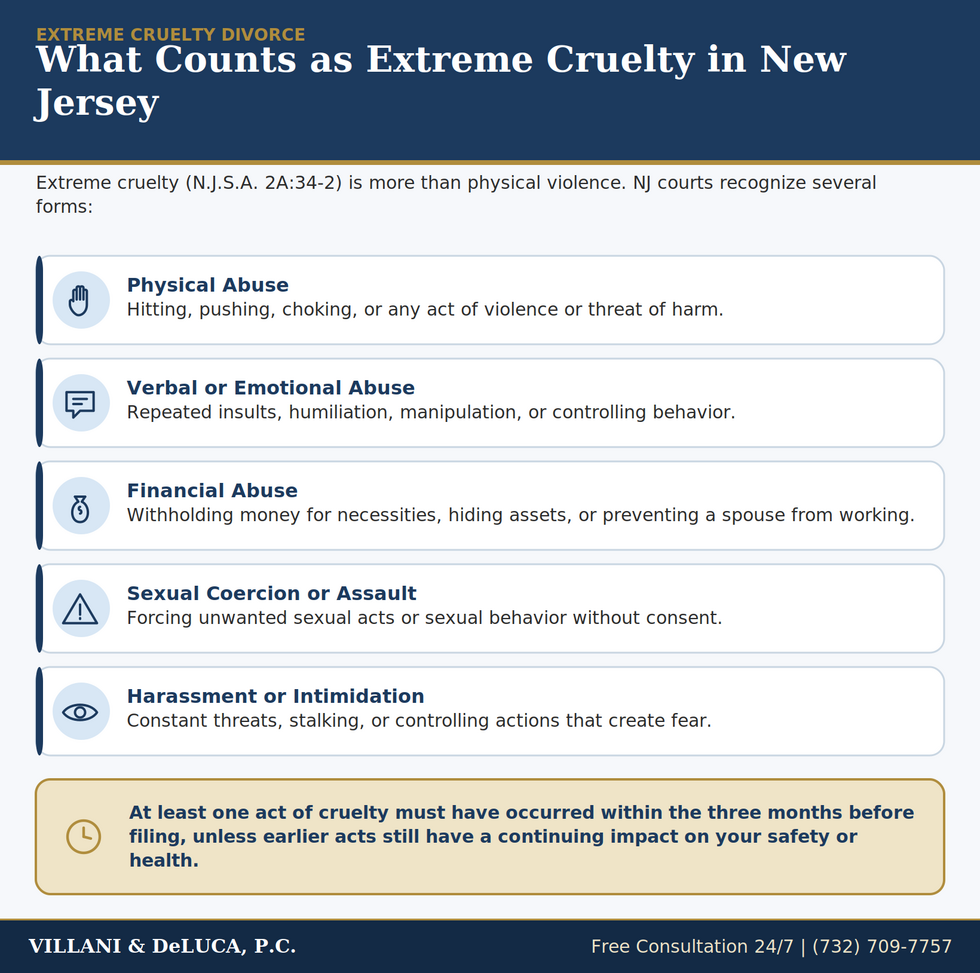
Examples of extreme cruelty include:
-
Physical abuse: Hitting, pushing, choking, or any act of violence or threat of harm. Even a single serious incident may qualify.
-
Verbal or emotional abuse: Repeated insults, humiliation, manipulation, or controlling behavior that damages a spouse's mental health.
-
Financial abuse: Withholding money for necessities, hiding income or assets, or preventing a spouse from working.
-
Sexual coercion or assault: Forcing unwanted sexual acts or engaging in sexual behavior without consent.
-
Harassment or intimidation: Constant threats, stalking, or controlling actions that create fear and emotional distress.
Under New Jersey law, acts of cruelty must have occurred within the three months before filing unless the victim can show that earlier acts still have a continuing impact on their safety or health.
Proving Extreme Cruelty in a Divorce Case
To succeed in an extreme cruelty divorce, you must present evidence that your spouse's conduct made it unreasonable to continue living together. This evidence can take many forms, such as:
-
Medical or therapy records documenting injuries or emotional trauma.
-
Police reports or restraining orders showing prior incidents of domestic violence.
-
Witness testimony from friends, relatives, or neighbors who observed the abuse.
-
Texts, emails, or voicemails demonstrating threats, harassment, or controlling behavior.
-
Financial records showing economic control or manipulation.
Because the burden of proof lies with the spouse filing, it's crucial to work with a lawyer who understands how to document and present evidence effectively. The attorneys at Villani & DeLuca, P.C. know how to build a strong case while protecting your privacy and safety throughout the process.
How Extreme Cruelty Can Affect the Outcome of Your Divorce
While proving cruelty does not automatically result in punishment for the abusive spouse, it can significantly influence key aspects of the divorce:
-
Alimony: If abuse caused financial dependence or emotional trauma that limited your ability to work, the court may award higher or longer-term alimony.
-
Property Division: Although New Jersey follows equitable distribution, evidence of financial abuse or dissipation of assets may affect how property and debts are divided.
-
Child Custody and Parenting Time: Courts always act in the best interests of the child. Proven cruelty, especially if children witnessed it, can weigh heavily against the abusive parent.
-
Protective Orders: When violence or threats are involved, restraining orders and temporary support orders can be issued to ensure your safety and that of your children.
Challenges of Filing for Extreme Cruelty Divorce
Fault-based divorces can be more complex than no-fault cases, and extreme cruelty claims require courage and documentation. Some challenges include:
-
Gathering evidence. Strong, credible proof is essential.
-
Increased emotional strain. Discussing abuse in open court can be painful.
-
Higher cost and longer timelines. Proving fault often requires more hearings and preparation.
-
Public nature of proceedings. Details of the abuse may become part of the public record, though judges often take measures to protect victims' privacy when possible.
Despite these difficulties, pursuing an extreme cruelty divorce can be an important step toward protecting yourself and your children, all the while reclaiming control over your life.
How We Handle Extreme Cruelty Cases
We build a strong, well-documented case while protecting your privacy and safety, and where there is violence or threats, we move quickly to secure protective orders and temporary support alongside the divorce.
Client Testimonial
Monmount: "Sometimes topics of concern that need to be brought to a lawyer's attention can be both good and bad. A serious family matter needed a lawyer's eye to make sure that we were signing something that would benefit our family, not just in the immediate future, but also moving forward years from now. I sought out Vince and his firm, again, to help us make sense of a difficult situation that had some positive rewards in the end. Vince calls me directly, in a very reasonable amount of time, and puts me at ease, helps me focus my concerns, and especially helps my family overall. This is the third time in my life that I've needed legal counsel and Villani and DeLuca are my guys. If you ask me, I'd say, "They're one of us." Thanks Vince and team for bringing our ship in on some rocky seas." – J.B.
"Mr. Villani really helped me out. He knew his stuff and was very confident about what he was doing. Great guy" – Erica Aborlleile
"Worth every penny!" – Justin Mailloux
Frequently Asked Questions:
1. What is considered "extreme cruelty" under New Jersey law?
In New Jersey, an extreme cruelty divorce is defined as any physical or mental cruelty that endangers the safety or health of the plaintiff, or makes it improper or unreasonable to expect that person to continue to cohabitate with the defendant. This is a broad legal category that includes physical abuse, but also extends to non-physical behaviors. As of 2026, New Jersey courts have increasingly recognized that a pattern of control and isolation can meet this legal standard just as clearly as physical acts.
2. Does a history of mental cruelty affect child custody decisions?
Yes. When determining the "best interests of the child," New Jersey judges look closely at the home environment. Evidence of mental cruelty or a history of domestic violence can significantly impact legal and physical custody arrangements. Recent 2026 updates to the Prevention of Domestic Violence Act (PDVA) have strengthened protections for children who have witnessed domestic strife, often leading to supervised visitation or restricted contact to ensure the child's safety.
3. Can emotional abuse impact the division of assets or alimony?
Generally, New Jersey is an equitable distribution state, meaning assets are divided based on fairness rather than "punishment" for bad behavior. However, if emotional abuse led to "economic misconduct"—such as a spouse intentionally depleting bank accounts or preventing the other from working—the court may adjust the equitable distribution to compensate the victim. In 2026, judges are granted broader discretion to consider the long-term economic impact of the abuse on the victim's earning capacity.
4. What should I do if I am currently experiencing physical abuse?
Your immediate safety is the highest priority. If you are a victim of physical abuse, you can seek a Temporary Restraining Order (TRO) through the local police or the Family Part of the Superior Court. A TRO can remove the abuser from the home and provide temporary financial support. Our firm frequently assists clients in transitioning from a restraining order to a formal complaint for divorce, ensuring that the safety protections remain in place throughout the legal process.
5. Is there a time limit on when the "cruelty" must have occurred?
To file for an extreme cruelty divorce, at least one of the acts must have occurred more than three months before the complaint is filed. However, 2026 case law clarifies that courts will look at the "totality of the circumstances," meaning a long-standing history of behavior can be used to establish the grounds for divorce, even if the most recent incident was several months ago.
Speak with a New Jersey Divorce Lawyer Experienced in Extreme Cruelty Cases
If you are considering divorce based on extreme cruelty, it's critical to have an attorney who understands both the emotional and legal complexities of these cases. At Villani & DeLuca, P.C., our team — led by Vincent C. DeLuca, Esq., a Certified Matrimonial Law Attorney by the New Jersey Supreme Court — has represented clients in complex family law matters for more than 27 years.
We will work tirelessly to safeguard your safety, your finances, and your family's future.
Call (732) 709-7757 today for a free consultation. Our attorneys are available 24/7 to help you take the next step toward a safer, more stable future.
The Bottom Line
If you are considering divorce based on extreme cruelty, it is critical to have an attorney who understands both the emotional and legal complexities. Led by Vincent C. DeLuca, Esq., a Certified Matrimonial Law Attorney, the family law team at Villani & DeLuca has represented clients in complex matters for more than 27 years, working to safeguard your safety, finances, and family's future. Call for a free consultation.
About the Author: Vincent C. DeLuca, Esq., NJ Supreme Court Certified Matrimonial Attorney, is a partner at Villani & DeLuca, P.C. He handles extreme cruelty and other fault-based divorces, custody, and support matters for families throughout Ocean and Monmouth Counties.
Related Articles
Trusted Resources
- New Jersey Courts, Self-Help (Domestic Violence): https://www.njcourts.gov/self-help/domestic-violence
- New Jersey Courts, Family Division (Superior Court): https://www.njcourts.gov/courts/superior/family
- New Jersey Legislature, N.J.S.A. 2A:34-2 (Grounds for Divorce): https://www.njleg.state.nj.us/laws/2a/2a-34-2
- Villani & DeLuca, P.C., Legal Glossary: https://www.villanideluca.com/resources/legal-glossary