

Key Point:
• New Jersey is a no-fault state which means it does not whether someone did something such as cheat or leave the marital home. Most divorces proceed on irreconcilable differences under N.J.S.A. 2A:34-2(i), which requires a breakdown of at least six months and no reasonable prospect of reconciliation.
• To file for an absolute divorce, one spouse must have been a New Jersey resident for at least one year, except in adultery cases. A divorce resolves custody, child support, alimony, and equitable distribution.
• An uncontested divorce is faster and less costly than a contested one and can often be finalized in about 30 days once all terms are agreed.
Deciding you need a divorce is never easy. Once you have made that decision, understanding how the New Jersey process works lets you move forward with some clarity instead of dread.
The most useful thing you can do early is talk to an experienced New Jersey divorce attorney. Not because you have to file tomorrow, but because knowing what you are entitled to, and what you are exposed to, changes how you handle the next six months. The attorneys at Villani & DeLuca, P.C. are here to help.
The Dissolution of Your Marriage
In New Jersey, a divorce is officially called a dissolution. Either spouse can file, as long as the residency requirement is met.
Your marriage is your own, but the terms that have to be resolved are the same in every case: the equitable distribution of marital assets, child custody, child support, and alimony.
In practice, two of those cause most of the fighting: custody, which drives child support, and equitable distribution. Resolve every term without asking a judge to decide, and your divorce stays uncontested. That is almost always the faster and cheaper road.
The Grounds for Your Divorce
New Jersey recognizes nine grounds for divorce under N.J.S.A. 2A:34-2. Two of them are no-fault, and those two account for the overwhelming majority of filings.
The no-fault grounds:
-
Irreconcilable differences, subsection (i). The marriage must have broken down for a period of six months, with no reasonable prospect of reconciliation. This is the most common ground in New Jersey.
-
Separation, subsection (d). The spouses must have lived separate and apart in different habitations for at least 18 consecutive months, with no reasonable prospect of reconciliation.
The fault grounds:
-
Adultery
-
Willful and continued desertion for 12 or more months
-
Extreme cruelty, physical or mental, which endangers your safety or health or makes it unreasonable to expect you to keep living with your spouse
-
Voluntarily induced addiction to a narcotic drug, or habitual drunkenness, for 12 or more consecutive months
-
Institutionalization for mental illness for 24 or more consecutive months
-
Imprisonment of your spouse for 18 or more consecutive months after the marriage
-
Deviant sexual conduct performed by your spouse without your consent
Fault grounds are available, but pleading one usually means you have to prove it. That makes the case longer, more expensive, and more adversarial. Most people who could plead a fault ground still file on irreconcilable differences, because the outcome on money and children is generally the same and the road there is shorter.
One timing note on extreme cruelty: no complaint may be filed until three months after the last act of cruelty alleged in the complaint. That rule does not apply to a counterclaim.
The Divorce Filing Process in New Jersey
-
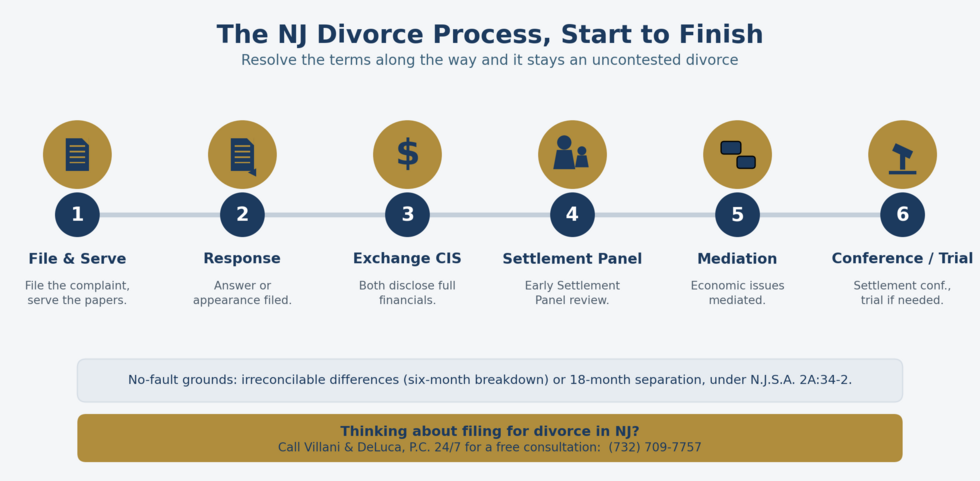
You or your spouse files the divorce complaint, and the other party is served with the divorce papers.
-
The other party responds with an answer, which may include counterclaims, or an appearance, meaning they do not object to the divorce itself but may object to the proposed terms.
-
Both parties file Case Information Statements (CIS) disclosing all relevant financial information.
-
The parties attempt to settle. If that does not work, the case goes to an Early Settlement Panel.
-
Economic Mediation follows, addressing equitable distribution, alimony, and child support.
-
An Intensive Settlement Conference at the courthouse is the last step before a trial date.
-
Anything still unresolved is decided by the court at trial.
If you finalize the terms without a trial, your divorce stays uncontested no matter how much legal work it took to get there. That distinction matters for both cost and tone.
.
The Legal Information You Need to Know
Residency. For an absolute divorce, one spouse must have been a bona fide New Jersey resident for the one year before the complaint is filed. Adultery is the exception; that ground has no one-year requirement. There is a second route as well: if either spouse became a New Jersey resident after the cause of action arose and has lived here for the year before filing, that satisfies the requirement.
Where to file. Venue is set by court rule, not by statute. Under R. 5:7-1, you file in the county where the plaintiff was domiciled when the cause of action arose. If the plaintiff was not domiciled in New Jersey then, you file where the defendant was domiciled at that time. If neither was, you file where the plaintiff is domiciled when the action starts, and failing that, where the defendant is domiciled when served. For an extreme cruelty case, the cause of action is treated as arising three months after the last act of cruelty alleged.
Attorney fees. The judge has discretion to order one party to pay some or all of the other's fees, either while the case is pending or at its conclusion, based on the relevant factors including the parties' finances and how reasonably each side has litigated.
How We Handle Your Divorce
We get involved early, protect your parental and financial rights, and push for terms that work for you and your children. We settle where settling serves you, and we try the case where it does not.
Client Testimonial
Ocean County: "I appreciate very much the way you handled my divorce. It is nice to know that it is possible to get through a difficult time with your dignity and sense of humor intact." - S.D.
"I just wanted to send you an email to say thank you for yesterday you are truly a pleasure to work with. You without a doubt made a 13 month long drawn out battle with my ex-husband a bit easier, if only you were the mediator that was assigned to us in the first place this may have been over a lot sooner.Again Thank you! " – R.H.
"Mr. Villani really helped me out. He knew his stuff and was very confident about what he was doing. Great guy" – Erica Aborlleile
Frequently Asked Questions:
How much does the average divorce cost in New Jersey?
It depends almost entirely on whether the divorce is contested. An uncontested divorce, often the product of mediation, can typically cost a few thousand dollars when every term is agreed before filing. Contested divorces likely cost more. Many start contested and settle anyway, and only a small percentage go to trial. The fees incurred are unique to each situation and the circumstances surrounding the matter.
How much does a divorce cost if both parties agree?
If you agree on everything, total costs can likely be a few thousand dollars. The lawyers put the agreement in writing as a marital settlement agreement, then file the complaint and response.
How long do you have to be separated before divorce?
You do not have to be separated at all. New Jersey is a no-fault state, and you can divorce on irreconcilable differences without ever living apart. What you do need is that one spouse has lived in New Jersey for at least a year before filing.
What are the divorce steps?
Decide to divorce, retain a lawyer, and file a complaint setting out your grounds and what you are asking for. The complaint is served, your spouse responds, and the court holds a case management conference and issues a scheduling order. The case then moves through mandatory mediation and, if it does not resolve, to trial.
How much does it cost to file for divorce in New Jersey?
The filing fee for the divorce complaint is $300 in every case. Where custody, parenting time, or child support is at issue, each parent also pays a $25 Parents' Education Program registration fee. The responding spouse pays a $175 appearance fee. These are usually paid from your retainer. There are additional fees for later motions, and you may have process server costs. Fees are set by court rule and can change.
What is a spouse entitled to in a New Jersey divorce?
New Jersey divorce law is gender neutral and applies the same way to both spouses. If one spouse earns more and the children live primarily with the other, the lower-earning spouse may be entitled to both alimony and child support. Most divorces come down to three things: the children, alimony, and equitable distribution of marital assets.
Is New Jersey a 50/50 divorce state?
No. New Jersey is an equitable distribution state, which means marital property is divided fairly but not necessarily equally. Courts weigh the 16 statutory factors in N.J.S.A. 2A:34-23.1, including the length of the marriage, each party's age and health, what each brought into the marriage, the standard of living, and each party's earning capacity. The longer the marriage, the closer the division tends to come to equal. With that said, the typical presumption is usually 50/50 absent compelling circumstances.
Who gets the house in a New Jersey divorce?
It depends on where the children live, whether the parties agree on what the home is worth, and whether one spouse can afford to buy the other out. If you cannot agree, the court can order the home sold. If it was bought during the marriage, each spouse is likely entitled to a share of the equity.
How long does it take to be served with divorce papers?
Service can happen within a few days of filing, usually through a process server. Once served, the defendant has 35 days to respond.
What are the grounds for divorce in New Jersey?
There are nine, listed under N.J.S.A. 2A:34-2. The fault grounds are adultery, willful desertion for 12 or more months, extreme cruelty, addiction or habitual drunkenness, institutionalization, imprisonment, and deviant sexual conduct without consent. The no-fault grounds are separation, meaning living apart in different habitations for at least 18 consecutive months, and irreconcilable differences, meaning a breakdown lasting at least six months. Irreconcilable differences is by far the most common, because it lets both people end the marriage without assigning blame.
What is the difference between a fault and no-fault divorce?
A fault divorce requires you to prove specific wrongdoing, which can mean contested hearings. A no-fault divorce on irreconcilable differences under N.J.S.A. 2A:34-2(i) requires only that one spouse assert a six-month breakdown with no reasonable prospect of reconciliation. New Jersey courts prefer no-fault proceedings because they are less adversarial, though the choice of grounds can carry strategic weight in some cases.
How long must I be separated before filing on separation grounds?
Filing on separation under N.J.S.A. 2A:34-2(d) requires living in different habitations for at least 18 consecutive months, with no reasonable prospect of reconciliation. You do not need to wait at all if you file on irreconcilable differences, which needs only a six-month breakdown. That is the faster route and the reason the separation ground is rarely used anymore.
Can my spouse contest the grounds for divorce?
If you file on irreconcilable differences, not effectively. A court will not order two people to stay married. If you file on fault grounds, your spouse can contest the allegations and the court may hold a hearing.
Does the reason for my divorce affect alimony or property division?
Usually not directly. New Jersey applies separate statutory factors to those questions. The exception is economic misconduct. If a spouse dissipated marital assets through gambling, wasteful spending, or concealment, that can be raised in equitable distribution under N.J.S.A. 2A:34-23.1. Courts draw a line between emotional fault, which typically does not move the financial outcome, and financial fault, which can.
When can you file for divorce after marriage?
Any time after the marriage, subject to the residency requirement. To proceed on irreconcilable differences you will need the six-month breakdown. For a very short marriage, an annulment may also be worth discussing.
The Bottom Line
Your divorce will have a profound impact on your parental and financial rights, so proceeding with care is well advised. The seasoned New Jersey divorce attorneys at Villani & DeLuca understand the gravity of your situation and are committed to advocating for terms that support your rights and work for you and your children. Contact us to book your free consultation today.
About the Author: Vincent C. DeLuca, Esq., NJ Supreme Court Certified Matrimonial Attorney, is a partner at Villani & DeLuca, P.C. He handles divorce, custody, support, and mediation matters for families throughout Ocean and Monmouth Counties.
Related Blog Posts
Learn more about divorce in New Jersey in our blog:
Trusted Resources
New Jersey Courts, Self-Help - Divorce, https://www.njcourts.gov/self-help/divorce
New Jersey Courts, Family Division - Superior Court, https://www.njcourts.gov/courts/superior/family
New Jersey Legislature, N.J.S.A. 2A:34-2 (Grounds for Divorce), https://www.njleg.state.nj.us/laws/2a/2a-34-2
New Jersey Legislature, N.J.S.A. 2A:34-23 (Alimony, Maintenance), https://www.njleg.state.nj.us/laws/2a/2a-34-23
New Jersey Legislature, N.J.S.A. 2A:34-23.1 (Equitable Distribution Factors), https://www.njleg.state.nj.us/laws/2a/2a-34-23.1
Villani & DeLuca, P.C., Legal Glossary, https://www.villanideluca.com/resources/legal-glossary