

Key Points
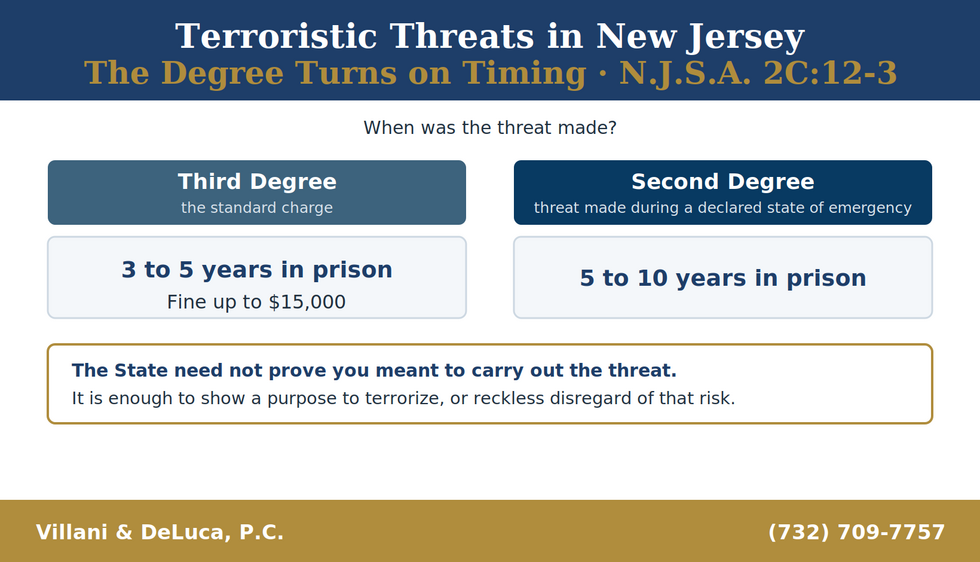
• Terroristic threats under N.J.S.A. 2C:12-3 are generally a third-degree crime, carrying 3 to 5 years in prison and fines up to $15,000.
• The charge rises to second degree, with 5 to 10 years in prison, if the threat is made during a declared state of emergency (N.J.S.A. 2C:12-3).
• The State need not prove you meant to carry out the threat, only the purpose to terrorize or reckless disregard of that risk (N.J.S.A. 2C:12-3).
It may have been a simple Facebook message. It could have been a rather nasty text sent at the wrong time. However, now it has become much more. If you are facing a terroristic threat charge, you know how serious it can be. This is why you should contact the law offices of Villani & DeLuca in Point Pleasant Beach, New Jersey. We have qualified and experienced attorneys on staff to help you through this rough time. Our criminal defense lawyers are here to make sure what could have been a simple prank does not end up a black mark on your criminal record.
What is a Terroristic Threat?
According to New Jersey law (N.J.S.A. 2C:12-3), an individual can be charged with terroristic threats if he or she threatens to commit a crime of violence towards another person causing the victim to have an imminent fear of death from the offender. A person is also guilty of terroristic threats if he or she threatens to commit any crime of violence with the purpose to terrorize another or to cause evacuation of a building, place of assembly, or facility of public transportation, or otherwise to cause serious public inconvenience.
Degrees of Terroristic Threats in NJ
A terroristic threat offense is considered to be a third degree offense when an individual causes imminent fear of death in another as a result of their threats. However, if the threat was made in a time of county, state or national emergency, the charge will be upgraded to a second degree crime. It is not a viable defense to claim no knowledge of a state of emergency.
Defenses for Terroristic Threats
It is important to obtain qualified and experienced legal counsel to provide the best defense possible for a serious charge like terroristic threats. One way to dispute a terroristic threats charge is by establishing that the victim could not have reasonably feared serious injury or death as a result of the alleged threat committed by the accused. In order to prove this, courts often use what is called the reasonable person test, which asks whether a reasonable person fear imminent danger in the same circumstances. Proving that the victim merely overreacted is often a common strategy for the defense.
Sentencing for Terroristic Threats
If the terroristic threat is upgraded due to a state of emergency, the offender could face up to ten years of incarceration for being found guilty of a terroristic threat. If the terroristic threat is a third-degree offense, the offender could face a maximum of five years in jail.
Client Testimonial
"Amazing work would hire again 100%" – Christopher Teutsch
"Amazing service, these guys are truly on your side and pay full attention to each of your problems. We've all seen lawyers that aren't really fully engaged with their clients and I can honestly say this is not the case with this law firm. If you want to feel at ease with your issues and you want someone that's truly got your back, you need to get in touch with these guys." – Steve Medeiros
"I had a great experience with Carmine and he was amazing, will definitely recommend him to anyone who is seeking a great lawyer who will make sure you're in good hands. Thank you so much again for everything Carmine!" – Jim Elsma
Frequently Asked Questions
1. What constitutes a terroristic threat under New Jersey law?
In New Jersey, a charge of terroristic threats (under N.J.S.A. 2C:12-3) occurs when someone threatens to commit a crime of violence with the purpose to terrorize another person, cause an evacuation of a building, or cause serious public inconvenience. It also applies if a person threatens to kill another to put them in imminent fear of death. New Jersey courts have clarified that "threats" are not limited to verbal statements; they include digital communications, social media posts, and even certain physical gestures intended to convey a violent intent.
2. Does the state have to prove I actually intended to carry out the threat?
No. The prosecution does not need to prove that you had the capability or the actual intent to execute the act of violence. The core of the law focuses on the intent to terrorize or the reckless disregard for the terror the statement would cause. Judges use an "objective" standard, meaning they ask if a reasonable person in the victim's position would believe the threat was immediate and likely to be carried out. If you are facing these allegations, a criminal defense attorney can help challenge whether your words truly met this legal threshold.
3. What are the potential penalties for a terroristic threats conviction?
A charge of terroristic threats is typically classified as a third-degree crime in New Jersey. If convicted, you could face 3 to 5 years in state prison and fines up to $15,000. However, the charge is elevated to a second-degree crime—carrying 5 to 10 years in prison—if the threat is made during a declared period of national, state, or county emergency. Recent legislative updates have also increased the scrutiny on threats made against public officials and healthcare workers, often leading to more aggressive prosecution.
4. Can a "heat of the moment" statement be defended in court?
Yes. One of the most common defenses is showing a lack of "purpose to terrorize." Statements made in a fit of anger, transitory frustration, or "emotional outburst" may not legally qualify as terroristic threats if they lack the requisite intent. An experienced lawyer will look at the history of the relationship and the specific context of the statement to argue that it was an exaggerated expression of anger rather than a credible threat of violence.
5. What should I do if I am being investigated for making a threat?
If you are contacted by the police, you should not attempt to "explain your way out" of the situation, as your statements can be used as evidence of your intent. Instead, you should exercise your right to remain silent and contact a criminal defense lawyer immediately. Law enforcement often uses digital forensics to recover deleted messages or social media data, making it essential to have legal counsel manage the evidence and protect your rights from the start.
Hire an NJ Lawyer for Your Terroristic Threats Charge
Due to the serious nature of these charges, it is best to get an attorney who can help you navigate through these times. If you are charged with making a terroristic threat, it is important to contact the offices of Villani & DeLuca immediately to ensure we get started making the best defense possible for you as soon as possible. Call today for your free initial consultation!
Related Articles
Learn more about terroristic threat charges in New Jersey in our blog:
Trusted Resources
- New Jersey Courts, Criminal Division - Superior Court, https://www.njcourts.gov/courts/superior/criminal
- New Jersey Division of Criminal Justice, Official Website, https://www.njoag.gov/about/divisions-and-offices/division-of-criminal-justice-home/
- Villani & DeLuca, P.C., NJ Criminal Statutes Resource Library, https://www.villanideluca.com/resources/new-jersey-statutes
- Villani & DeLuca, P.C., Terroristic Threats N.J.S.A. 2C:12-3 Breakdown, https://www.villanideluca.com/resources/new-jersey-statutes/nj-assault-laws/terroristic-threats-nj-2c-12-3
- Villani & DeLuca, P.C., Legal Glossary, https://www.villanideluca.com/resources/legal-glossary