

Key Point:
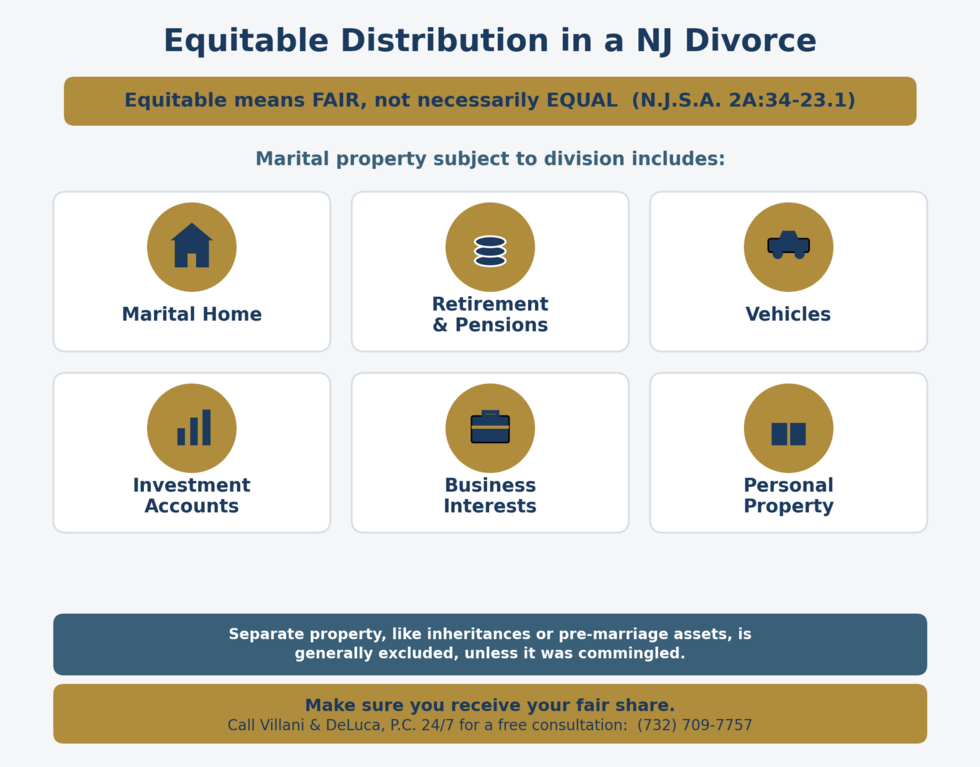
• New Jersey is an equitable distribution state: marital property is divided fairly, not necessarily 50/50, under N.J.S.A. 2A:34-23.1.
• Courts weigh 16 statutory factors, including the length of the marriage and each spouse's economic circumstances.
• Property owned before the marriage or received by inheritance is generally separate, but commingling it with marital assets can make it divisible.
Dividing what you built together is often the hardest part of a New Jersey divorce, and it is where the most money is won or lost. The rules are not intuitive, and the outcome depends heavily on how well the assets are identified, valued, and argued.
The divorce attorneys at Villani & DeLuca, P.C. handle complex equitable distribution matters for clients throughout Ocean and Monmouth County.
What Is Equitable Distribution in NJ?
New Jersey divides property acquired during the marriage. "Equitable" means fair, not equal. There is no presumption of a 50/50 split, and courts routinely order divisions that are not even.
What the court does is weigh 16 factors set out in N.J.S.A. 2A:34-23.1:
-
The duration of the marriage
-
The age and physical and emotional health of each spouse
-
The income or property each brought to the marriage
-
The standard of living established during the marriage
-
Any written agreement made before or during the marriage about how property would be divided
-
The economic circumstances of each spouse when the division takes effect
-
The income and earning capacity of each spouse, including education, training, work experience, time out of the job market, custodial responsibilities, and what it would take to become self-supporting
-
Each spouse's contribution to the education, training, or earning power of the other
-
Each spouse's contribution to acquiring, preserving, depreciating, appreciating, or dissipating marital property, including contributions as a homemaker
-
The tax consequences of the proposed distribution
-
The present value of the property
-
The need of a parent with physical custody to keep the marital home and household effects
-
The debts and liabilities of the parties
-
Whether a trust fund needs to be created for foreseeable medical or educational costs
-
The extent to which a spouse deferred achieving their career goals
-
Any other factors the court finds relevant
Two points buried in that statute are worth pulling out. The court must make specific written findings of fact on asset eligibility, valuation, and distribution. And there is a rebuttable presumption that each spouse made a substantial financial or nonfinancial contribution to acquiring income and property during the marriage. If you spent the marriage raising children rather than earning, that presumption is working for you.
How Assets Actually Get Divided
The starting point is a complete accounting: every asset, every debt, and what each is worth. Marital debts offset marital assets, and the net is what gets divided.
Even a straightforward divorce can get contentious here. The stakes climb quickly when the marriage involves significant assets, a business, complicated finances, real estate beyond the marital home, or separate property that has been mixed with marital property over the years.
Where the spouses have similar earning power and the other factors are balanced, a division close to 50/50 is likely. The further apart the circumstances, the further the outcome tends to move from equal.
How We Handle Equitable Distribution
We identify and value every asset and debt, including the complicated ones, and bring in forensic accountants and valuation experts where the case calls for it. Then we argue for a division that is fair under the statutory factors and protects your financial future.
Client Testimonial
"My representative was Mr. Carmine R. Villani. He was my son's representative and he did a very good and helped my son in a very big way. I would 100 percent recommend him because he went above and beyond to represent my son (Jaden) and got us results we didn't even know were possible." – Trivale Kerr
"I just wanted to send you an email to say thank you for yesterday you are truly a pleasure to work with. You without a doubt made a 13 month long drawn out battle with my ex-husband a bit easier, if only you were the mediator that was assigned to us in the first place this may have been over a lot sooner.Again Thank you! " – R.H.
"I would highly recommend him for all your legal needs" – Ken Murphy
Frequently Asked Questions
Does New Jersey require a 50/50 split of marital assets?
No. New Jersey is an equitable distribution state, not a community property state. Under N.J.S.A. 2A:34-23.1, equitable means fair, and fair is not always equal. The court weighs 16 statutory factors, and the list is expressly not exhaustive, so a judge can consider anything else relevant to your situation. However, the presumption typically begins at a 50/50 split.
Can I keep my inheritance or property I owned before the marriage?
Generally yes. Assets you owned before the marriage or received by inheritance or gift from a third party are usually separate property and not subject to distribution. Commingling is what changes that. If inheritance money went toward a down payment on a jointly titled home, or separate funds were deposited into a shared account and used for household expenses, those assets can become marital property. The more thoroughly separate money was mixed with marital money, the harder it is to pull back out.
How are cryptocurrency and other digital assets handled?
The same way as anything else acquired during the marriage. Cryptocurrency, NFTs, and other digital holdings are marital property subject to disclosure and division. What makes them different is practical, not legal: they are volatile, easy to move, and harder to trace than a bank account. Courts frequently rely on forensic experts to make sure nothing has been hidden.
What happens to the marital home?
The court considers whether a parent with physical custody needs to stay in the home, what the home is worth, and whether either spouse can realistically refinance the mortgage and buy the other out. If the parties cannot agree on value or on who keeps it, the court can order it sold and the proceeds divided.
Does cheating affect how assets are divided?
Usually not. New Jersey is a no-fault state, and typical marital fault such as adultery generally does not change the property division. Economic misconduct is the exception. If a spouse dissipated marital assets through gambling, concealment, or spending on an affair, the court can award the other spouse a larger share to make up for it. That is factor nine in the statute, contribution to the dissipation of marital property. If you suspect financial foul play, tell your attorney early, while the records are still obtainable.
The Bottom Line
How your marital property is divided will shape your finances long after the divorce is final. The New Jersey divorce attorneys at Villani & DeLuca build strong client relationships and advocate for the most advantageous resolution available. Contact us to schedule your free consultation.
About the Author: Vincent C. DeLuca, Esq., NJ Supreme Court Certified Matrimonial Attorney, is a partner at Villani & DeLuca, P.C. He handles equitable distribution, divorce, alimony, and custody matters for families throughout Ocean and Monmouth Counties.
Related Articles
Trusted Resources
- New Jersey Courts, Family Division (Superior Court): https://www.njcourts.gov/courts/superior/family
- New Jersey Courts, Self-Help (Divorce): https://www.njcourts.gov/self-help/divorce
- New Jersey Legislature, N.J.S.A. 2A:34-23.1 (Equitable Distribution Factors): https://www.njleg.state.nj.us/laws/2a/2a-34-23.1
- Villani & DeLuca, P.C., Legal Glossary: https://www.villanideluca.com/resources/legal-glossary