

Key Points:
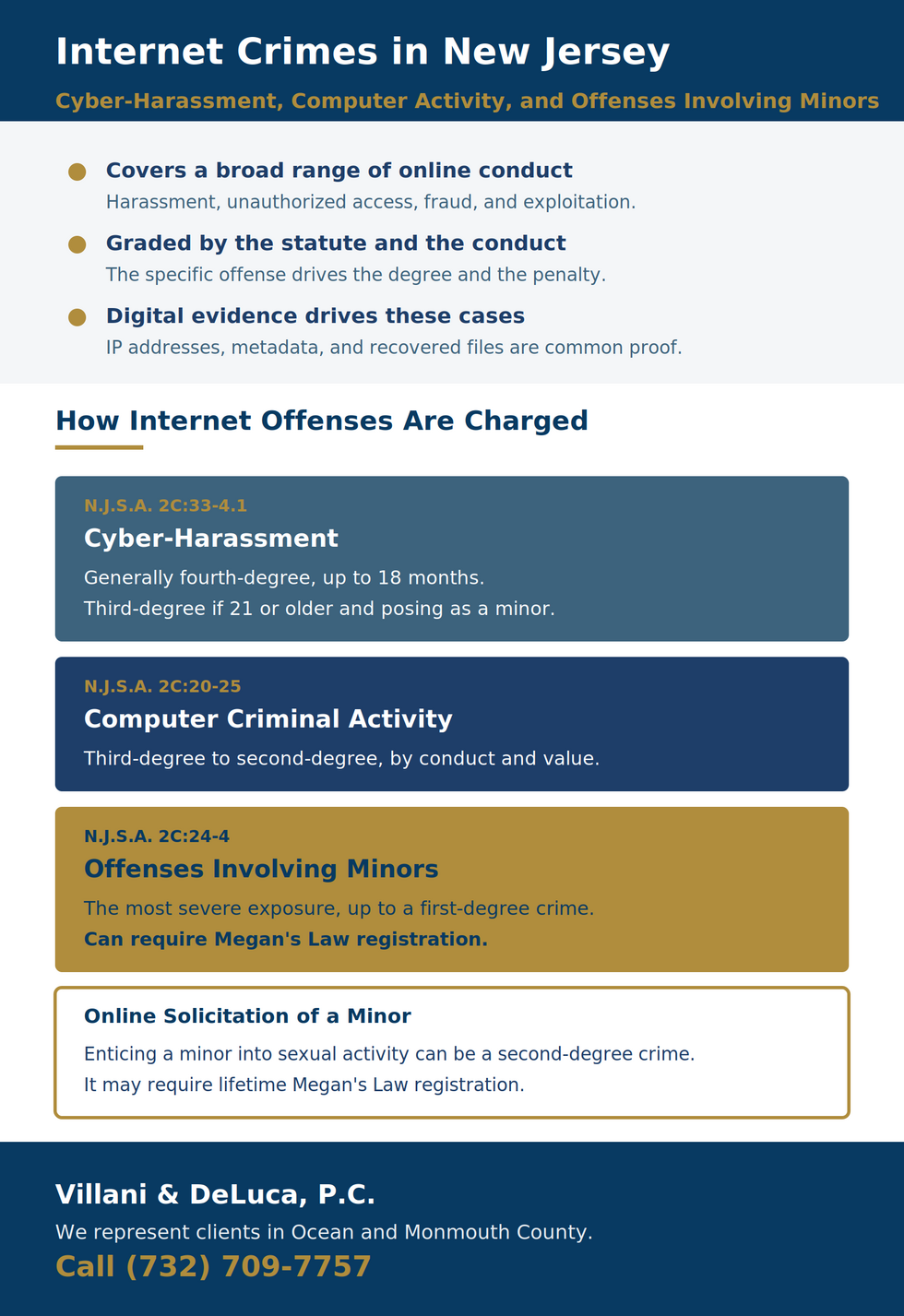
• Under N.J.S.A. 2C:33-4.1, cyber-harassment is generally a fourth-degree crime, rising to third degree if the actor is 21 or older and poses as a minor to harass a minor.
• Computer criminal activity under N.J.S.A. 2C:20-25 ranges from a third-degree to a second-degree crime based on the conduct and the value of the data or property involved.
• Internet offenses involving minors under N.J.S.A. 2C:24-4 carry the most severe exposure and can require Megan's Law registration.
Internet crimes refer to a broad range of criminal offenses that involve computers, networks, or online communications. In New Jersey, digital activity that violates criminal law, whether through harassment, exploitation, fraud, unauthorized access, or other harmful conduct, can result in serious charges. Understanding how New Jersey law defines these offenses and their potential penalties is essential if you or someone you know is facing allegations.
At Villani & DeLuca, P.C., our criminal defense attorneys assist clients throughout Ocean County, Monmouth County, and surrounding areas with internet crime matters. By explaining the applicable statutes and how they may apply to your situation, we help you understand your options and what you might expect.
Cyber‑Harassment
New Jersey law, specifically N.J.S.A. 2C:33‑4.1, defines cyber‑harassment as the use of online communication to harass another person. This includes sending threats, posting obscene or indecent material, or threatening to commit a crime against a person or property online. Cyber‑harassment is generally a fourth‑degree offense, but becomes a third‑degree offense if the offender is 21 or older and impersonates a minor to harass a minor online.
-
Threaten to injure a person or damage property.
-
Send, post, or propose lewd, indecent, or obscene material intended to harm a reasonable person or place them in fear, emotionally.
-
Threaten to commit any crime against a person or their property through online means such as email, social media, or messaging.
Computer Criminal Activity
Under N.J.S.A. 2C:20‑25, unauthorized and harmful use of computers or networks is prohibited. This includes accessing systems without permission, altering data, or using computers to commit fraud. Penalties depend on the severity of the conduct and the value of property or data involved, ranging from third‑degree to second‑degree crimes.
-
Accessing a computer system without authorization.
-
Altering or damaging data or systems.
-
Obtaining or copying information without permission.
-
Using a computer to commit fraud or obtain property or services.
Child Exploitation and Endangering the Welfare of Children
New Jersey's N.J.S.A. 2C:24‑4 addresses internet-related offenses involving minors. This includes distributing, possessing, or storing online images depicting the sexual exploitation or abuse of a child, as well as using file-sharing tools to host or make such material available. Penalties vary depending on the quantity and intent, ranging from third-degree crimes for smaller amounts to first-degree offenses for distribution or larger volumes.
-
Distributing, possessing with the intent to distribute, or storing online images depicting child exploitation.
-
Using file-sharing or other internet tools to host or make such material available.
-
Viewing or possessing digital material depicting child exploitation.
Solicitation and Sexual Exploitation via the Internet
Communicating with a minor online with the intent to entice them into sexual activity is criminalized under New Jersey law. These offenses can result in second-degree charges and may require lifetime registration under Megan's Law.
Other Related Offenses
New Jersey also prohibits unauthorized access, hacking, identity theft, and online fraud under various criminal statutes. These offenses include:
-
Unauthorized access or hacking into computer systems.
-
Identity theft or false documentation using online tools.
-
Cyber-related fraud schemes, financial scams, and theft.
Who Can Be Charged With an Internet Crime?
Anyone whose online conduct violates these statutes can face criminal charges in New Jersey. This includes:
-
Individuals harassing or threatening others online.
-
Persons accessing systems without permission.
-
Adults exploiting minors through online content or communications.
-
Individuals committing fraud, identity theft, or unauthorized computer access.
Aggravating factors such as targeting children, using deception, impersonating another person, or causing significant financial or emotional harm can elevate charges and penalties.
Defending Against Internet Crime Charges
Internet crime cases can be legally and technically complex. Common defense strategies may involve showing:
-
The absence of criminal intent.
-
Lack of evidence linking the defendant to the alleged conduct.
-
Violations of constitutional protections during search or evidence collection.
-
Errors in how digital evidence was obtained or preserved.
Experienced attorneys can assess the facts, review digital proof, and help craft a strategy tailored to your case.
How Villani & DeLuca, P.C. Can Help
At Villani & DeLuca, P.C., our attorneys have decades of experience handling internet crimes and related criminal defense matters throughout Ocean County and Monmouth County, New Jersey. We can help you understand how statutes like N.J.S.A. 2C:33‑4.1, N.J.S.A. 2C:20‑25, and N.J.S.A. 2C:24‑4 may apply to your situation.
Whether you are facing charges involving online harassment, unauthorized computer access, exploitation of minors, or other internet-related offenses, we provide knowledgeable advocacy and clear explanations of the law.
Protect Your Rights Today
If you are facing internet crime charges or have questions about potential violations under New Jersey law, it is essential to understand your rights and legal options. Being informed can help you take the necessary steps to protect your future.
Villani & DeLuca, P.C. offers free consultations, in person or over the phone, to review your situation and explain your options. Call us today at (732) 709‑7757 to speak with an experienced criminal defense attorney.
Client Testimonial
"Great team and a pleasure to work with. Extremely happy I decided to move forward with Villani and Deluca. Definately reccomend this firm." – Sarah Gutman
"If you are looking for a lawyer to represent you, look no further, you just found him- Carmine Villani from the firm Villani and DeLuca. While on vacation in New Jersey, I got into trouble, and I had no one to refer me to a good lawyer. So, I had to take it upon myself to find one. I called several firms before I called Villani and DeLuca, and I didn't feel at ease with any of them. After I read Carmine's reviews, I called his office. Ruby Goldberg, his paralegal answered the phone and she was so nice. She reassured me that Carmine will do his very best to protect me and did. After I spoke to her, she put a call out to Carmine and within 10 minutes, he called me as he was driving in his car . After I hystericaly explained my situation to him, he told me to relax . He gave me feedback on my situation, I thought to myself, - this is the lawyer I want - he knows the law! Also, Ruby is always so friendly and she will always keep you updated . Carmine has your best interest and is there for you. Although I live in New York, I always felt like I was in good hands, because I knew he was going to do whatever it takes to protect me, and he did. As I wrote in the first sentence, No need to look for a lawyer, you just found him!" – Marylou Cilurzo
"The staff is great, professional, responsive and always super helpful. Mr. Carmine is great at his job. Even through a pandemic things were hassle free. He kept everything super simple and stress free. Even when I had questions and just emailed him and he literally responded back immediately. I would recommend to anyone that needs a lawyer. He is the BEST."– Jayson Le
Frequently Asked Questions
1. What exactly constitutes an "Internet Crime" in New Jersey?
Internet crimes, often referred to as cybercrimes, encompass any illegal activity conducted via a computer, network, or connected device. Under New Jersey law, this is a broad category that includes everything from hacking and identity theft to more serious allegations involving the distribution of prohibited materials or online solicitation. Because digital evidence is easily tracked by specialized task forces, anyone facing these allegations should consult an internet crime attorney as early as possible in the investigation.
2. What is the legal definition of "Cyber Harassment" in New Jersey?
Under statute N.J.S.A. 2C:33-4.1, cyber harassment occurs when an individual uses an electronic device or social media platform to communicate with the intent to harass another person. This includes threatening to inflict physical harm, sending lewd or obscene material, or posting repeated communications that place the victim in reasonable fear of emotional distress. Cyber harassment nj laws are strictly enforced to protect individuals from online stalking and digital bullying.
3. Can I be charged with a crime for something I posted on social media?
Yes. Many people mistakenly believe that "free speech" protects everything they post online. However, if a post contains a credible threat, constitutes harassment, or involves the unauthorized sharing of intimate images (often called "revenge porn"), it can lead to criminal cyber harassment charges. New Jersey law treats digital communications with the same weight as face-to-face interactions; if the intent is to harm, alarm, or intimidate, it is punishable under the criminal code.
4. What are the potential penalties for an internet-based conviction?
The penalties vary significantly depending on the "degree" of the crime. For example, cyber harassment is typically a fourth-degree crime, which can carry up to 18 months in prison. However, if the person committing the harassment is over 21 and posing as a minor to contact another minor, the charges can be elevated to a third-degree crime. More severe internet crimes, such as those involving the exploitation of minors, can carry second-degree penalties, resulting in 5 to 10 years in state prison and mandatory registration requirements.
5. How does the "digital footprint" affect my case?
In internet crime cases, the prosecution relies heavily on digital forensics. This includes IP addresses, metadata, browser history, and deleted messages. Even if you delete a post or a file, law enforcement agencies often have the tools to recover that data. A knowledgeable internet crime attorney will often work with independent forensic experts to challenge the "chain of custody" of this digital evidence or to prove that a device was accessed by someone other than the defendant.
Trusted Resources
- New Jersey Courts, Criminal Division, Superior Court, https://www.njcourts.gov/courts/superior/criminal
- New Jersey Division of Criminal Justice, Official Website, https://www.njoag.gov/about/divisions-and-offices/division-of-criminal-justice-home/
- Villani & DeLuca, P.C., Computer Crimes N.J.S.A. 2C:20-25, https://www.villanideluca.com/resources/new-jersey-statutes/nj-computer-crimes-laws/computer-crimes-nj-2c-20-25
- Villani & DeLuca, P.C., Legal Glossary, https://www.villanideluca.com/resources/legal-glossary