

Key Point:
• Desertion is a fault ground under N.J.S.A. 2A:34-2: willful, unjustified abandonment for at least 12 consecutive months.
• Desertion can be physical (leaving the home) or constructive (refusing marital relations while remaining in the home).
• Desertion rarely changes property division or custody by itself, but a lack of support during the abandonment can be weighed.
Desertion Divorce in New Jersey: Understanding Your Options
When a marriage breaks down, New Jersey law provides both no-fault and fault-based options for divorce. One of the recognized fault grounds is desertion, which occurs when one spouse abandons the other without justification for at least twelve consecutive months.
Desertion can mean physically leaving the marital home or refusing to engage in marital relations. Either way, it represents a complete withdrawal from the marriage. It's a serious legal basis for divorce under N.J.S.A. 2A:34-2, and proving it requires a clear understanding of the facts and the law.
If you believe your spouse has deserted you, the attorneys at Villani & DeLuca, P.C. can help you gather evidence, understand how desertion might affect alimony, custody, and property division, and guide you through the process from start to finish.
What Desertion Means in a New Jersey Divorce
Under New Jersey law, desertion means one spouse has willfully and unjustifiably abandoned the other for at least one year. It's not enough that the marriage has become distant. The law requires proof that one spouse made a deliberate choice to withdraw from the relationship.
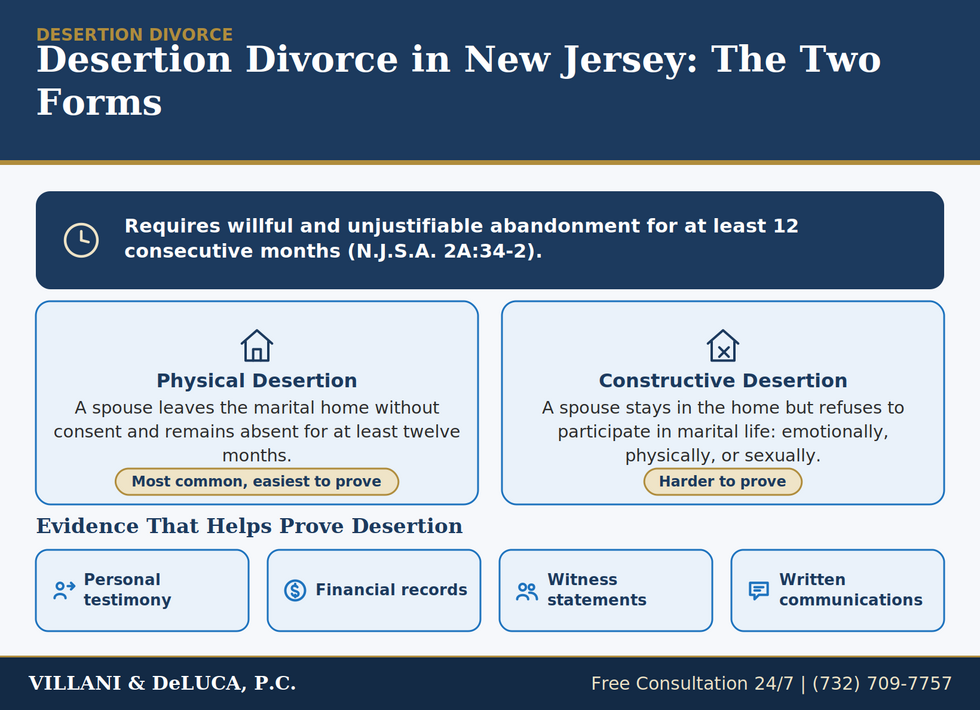
There are two primary forms of desertion recognized in New Jersey:
-
Physical desertion occurs when a spouse leaves the marital home without consent and remains absent for at least twelve months. This is the most common form and typically the easiest to prove.
-
Constructive desertion occurs when a spouse remains in the home but refuses to participate in marital life, such as emotionally, physically, or sexually. This can be more difficult to prove because it relies on patterns of behavior rather than physical absence.
Both types demonstrate a breakdown of the marital relationship and can serve as valid grounds for a fault-based divorce.
Proving Desertion in Court
Unlike no-fault divorces, a desertion case requires evidence that one spouse intentionally abandoned the other. The burden of proof lies with the spouse who files the complaint.
Evidence might include:
-
Personal testimony about when the desertion began and whether reconciliation was attempted.
-
Financial records showing the absence of support during the period of abandonment.
-
Witness statements from friends, relatives, or neighbors who can confirm the separation.
-
Written communications (or the lack thereof) demonstrating the spouse's withdrawal from contact or involvement.
Because proving desertion requires credible documentation and clear testimony, working with an experienced divorce attorney is essential to presenting a strong case.
How Desertion Can Affect the Outcome of Your Divorce
Filing for divorce based on desertion does not automatically punish the spouse who left, but it can affect how certain issues are decided.
-
Alimony: If one spouse's abandonment caused financial hardship, the court may take that into account when setting support. A spouse who walked away without providing financial help could face higher obligations later.
-
Property Division: New Jersey uses equitable distribution, meaning assets and debts are divided fairly, not necessarily evenly. If one spouse deserted the marriage and failed to contribute, that fact may influence how the court allocates marital property.
-
Child Custody: Desertion can raise concerns about a parent's commitment or reliability, especially if the abandoning spouse left the children behind or stopped providing support.
In many cases, the desertion itself becomes part of a broader pattern that informs the court's view of fairness and responsibility.
Challenges of a Desertion Divorce
Desertion claims are not without their difficulties. They require patience, documentation, and emotional resilience.
The main challenges include:
-
Meeting the one-year requirement. Desertion must last a full twelve months before filing.
-
Gathering evidence. Without clear proof, the claim may fail and default back to a no-fault filing.
-
Increased conflict and expense. Fault-based cases tend to take longer, cost more, and involve more emotional strain than no-fault divorces.
Because of these hurdles, many couples ultimately choose to file under irreconcilable differences unless there's a strong strategic or emotional reason to pursue fault-based grounds.
How We Handle Desertion Divorce Cases
We help you document the timeline and the lack of support, present the testimony and records the court needs, and, where it matters, argue for an equitable distribution that accounts for the abandonment.
Client Testimonial
Monmouth: "You never expect that when you are married and have children that you will be getting a divorce. I was incredibly fortunate to have Vince as my divorce lawyer. He explained everything to ahead of time and he guided me through the entire process in a manner that always made me feel comfortable and prepared. Everything went the way he told me it would, there were no surprises. Vince is very personable and very knowledgeable. I developed great rapport with him very quickly and felt as though he was always looking out for my best interest. Vince was very instrumental in helping me obtain a settlement that allowed me and my children to retain the marital home thereby minimizing the impact of the divorce on my children. I highly recommend Vince and his team" – D.S.
"Carmine Villani was very knowledgeable. I would highly recommend him." – Karen Roche
"The office of Carmine Villiani from the front to Carmine was pleasant and professional.The outcome of my situation, better then I expected.Carmine was always available to speak with at anytime . I definitely would recommend this attorney to family or friends." – Grace Elia
Frequently Asked Questions
1. What is the legal definition of desertion in a New Jersey divorce?
In New Jersey, desertion divorce occurs when one spouse leaves the marital home and remains absent for a continuous period of at least 12 months. To qualify as a "fault-based" ground for divorce, the departure must be willful and against the will of the remaining spouse. This means that if both parties agreed to live apart, it might not meet the strict legal definition of desertion.
2. What is the difference between physical and "constructive" abandonment?
Physical abandonment is straightforward—one spouse simply moves out. However, abandonment in divorce can also be "constructive." This occurs when one spouse remains in the home but behaves in a way that makes it impossible or unsafe for the other to continue the marriage, such as a total cessation of marital relations or domestic cruelty. While constructive desertion was historically harder to prove, 2026 evidentiary standards have clarified how digital communications and financial records can be used to support these claims.
3. How long must a spouse be gone before I can file for divorce on grounds of abandonment?
Under New Jersey law, the period of desertion must last for at least 12 or more consecutive months. If the spouse returns to the home and cohabitation resumes, even briefly, the "clock" for desertion usually resets. If you are facing a situation where a spouse has left but the one-year mark hasn't been met, you may still be able to file for divorce based on "Irreconcilable Differences," which does not require a waiting period of physical separation.
4. Does filing for divorce on grounds of abandonment give me an advantage in alimony or asset division?
Generally, New Jersey is a "no-fault" state regarding the distribution of assets. This means that proving a spouse deserted you does not automatically entitle you to a larger share of the marital property or higher alimony payments. However, desertion can be highly relevant if the departing spouse also stopped contributing to the mortgage or marital debts. An experienced family law attorney can help you argue for "equitable distribution" that accounts for any financial "waste" or lack of support during the period of abandonment.
5. Is it better to file for desertion or irreconcilable differences?
Filing for a desertion divorce requires providing specific proof of the 12-month absence, which can lead to a more contentious and expensive legal battle. Most divorce lawyers in New Jersey suggest filing based on "Irreconcilable Differences" because it is often faster and less emotionally taxing. However, there are specific strategic instances—particularly regarding international marriages or certain religious requirements—where filing on the grounds of desertion is necessary.
Talk to an Experienced Desertion Divorce Lawyer in New Jersey
If you believe you've been deserted by your spouse and are considering filing for divorce on those grounds, you don't have to navigate the process alone. These cases require detailed evidence and careful legal strategy.
The attorneys at Villani & DeLuca, P.C. have decades of experience handling both fault-based and no-fault divorces throughout Monmouth County, Ocean County, and across New Jersey. We understand what's at stake — financially, legally, and emotionally — and we're here to protect your rights every step of the way.
Call (732) 709-7757 today for a free consultation. Our team is available 24/7 to answer your questions and help you take the next step toward a more secure future.
The Bottom Line
If you believe you have been deserted and are considering filing on those grounds, you do not have to do it alone; these cases require detailed evidence and careful strategy. The attorneys at Villani & DeLuca have decades of experience with fault-based and no-fault divorces across Monmouth and Ocean County. Call for a free consultation.
About the Author: Vincent C. DeLuca, Esq., NJ Supreme Court Certified Matrimonial Attorney, is a partner at Villani & DeLuca, P.C. He handles fault-based and no-fault divorce, custody, and support matters for families throughout Ocean and Monmouth Counties.
Related Articles
Trusted Resources
- New Jersey Courts, Self-Help (Divorce): https://www.njcourts.gov/self-help/divorce
- New Jersey Legislature, N.J.S.A. 2A:34-2 (Grounds for Divorce): https://www.njleg.state.nj.us/laws/2a/2a-34-2
- Villani & DeLuca, P.C., Legal Glossary: https://www.villanideluca.com/resources/legal-glossary