

Key Point:
• Adultery is a fault ground for divorce under N.J.S.A. 2A:34-2, requiring proof of the opportunity and inclination to have an affair.
• Adultery alone does not change property division or custody, which turn on equitable distribution and the child's best interests.
• Adultery can matter financially where marital funds were spent on the affair, known as dissipation of assets under N.J.S.A. 2A:34-23.1.
Adultery Divorce in New Jersey: Understanding Fault-Based Divorce
Adultery is one of the recognized fault-based grounds for divorce in New Jersey. To pursue divorce on this basis, a spouse must show that the other engaged in an extramarital affair that contributed to the breakdown of the marriage. While many couples choose a no-fault divorce for privacy and simplicity, an adultery-based filing may be appropriate where issues such as alimony, property division, or custody could be affected. If you are considering filing on adultery grounds in Monmouth County, Ocean County, or anywhere in New Jersey, the attorneys at Villani & DeLuca, P.C. can help you understand your options, gather evidence, and protect your rights.
Proving Adultery in a New Jersey Divorce
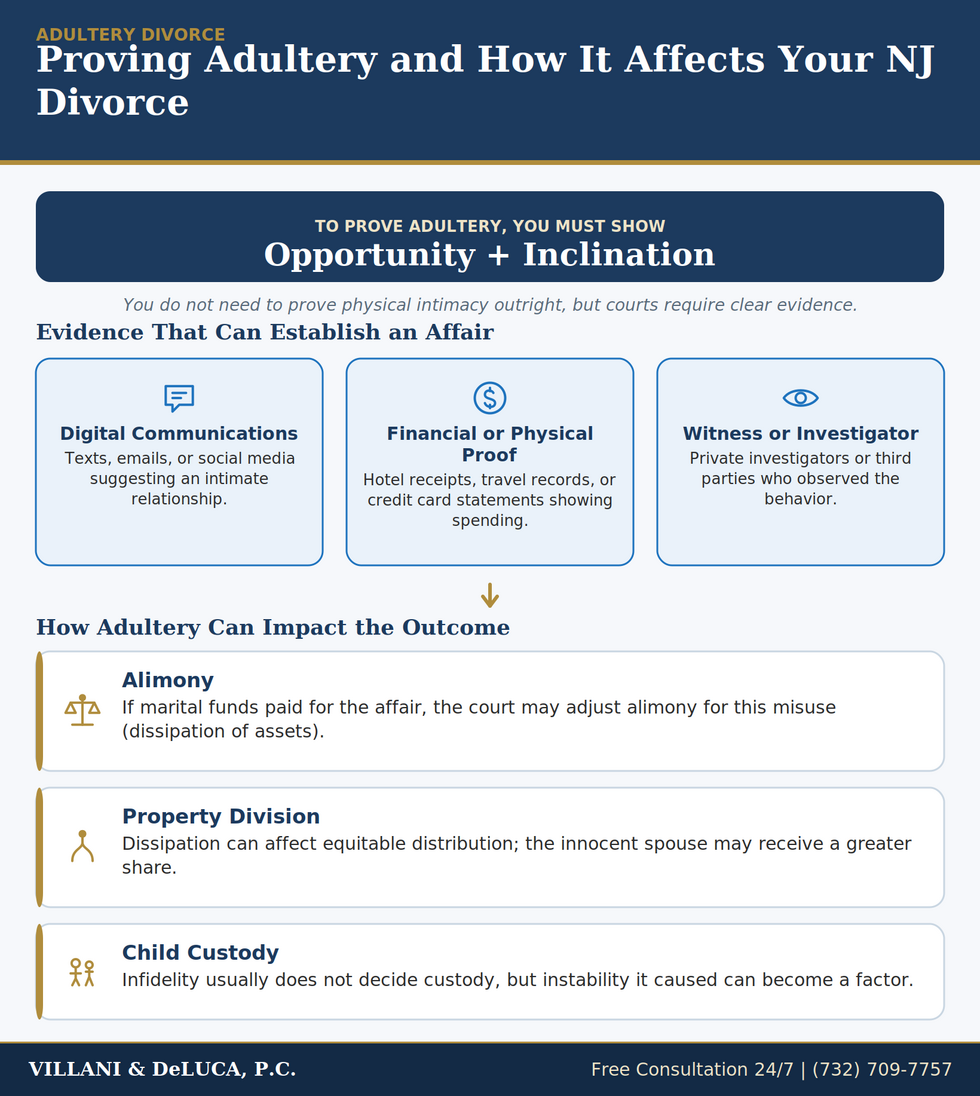
Unlike a no-fault divorce, a divorce based on adultery requires evidence. You do not need to prove physical intimacy outright, but you must demonstrate that your spouse had both the opportunity and inclination to engage in an affair.
Evidence in these cases may include:
-
Digital communications: Texts, emails, or social media messages suggesting an intimate relationship. Courts often view these as persuasive circumstantial evidence.
-
Financial or physical proof: Hotel receipts, travel records, or credit card statements showing money spent on the other person can establish opportunity and intent.
-
Witness or investigator testimony: Private investigators or third parties who observed behavior consistent with an affair can provide corroboration and strengthen your case.
How Adultery Can Impact Divorce Outcomes
Filing for divorce on adultery grounds doesn't automatically result in penalties for the unfaithful spouse, but it can influence certain aspects of the case, especially where marital finances or children are involved.
-
Alimony: If marital funds were used to support the affair, such as paying for gifts, trips, or housing, the court may adjust repayment or alimony to account for this misuse, known as dissipation of assets.
-
Property Division: Similarly, dissipation can affect equitable distribution. The innocent spouse may be compensated through a greater share of marital property.
-
Child Custody: Infidelity itself usually doesn't determine custody, as courts focus on the child's best interests. However, if the affair exposed children to instability or neglect, it can become a factor in parenting decisions.
While adultery can influence these issues, each case depends on its specific facts, including how the misconduct affected the family's finances, emotional stability, or living situation.
The Pros and Cons of Filing on Adultery Grounds
There are both advantages and drawbacks to pursuing divorce based on adultery.
Potential benefits include:
-
Leverage in negotiations, particularly when marital funds were misused or trust was severely breached.
-
Accountability and closure, as some spouses want the record to reflect the true reason for the breakdown of the marriage.
However, challenges include:
-
Greater emotional strain. Adultery cases often require discussing sensitive, personal details in open court.
-
Higher costs and longer timelines. Gathering evidence and presenting witnesses can increase both the duration and expense of the case.
-
Public exposure. Because adultery filings involve naming a co-respondent, the process can be more invasive than a no-fault divorce.
For these reasons, many couples ultimately choose a no-fault divorce unless there's a strong legal or financial reason to pursue an adultery claim.
How We Handle Adultery Divorce Cases
We help you evaluate whether a fault-based filing serves your goals, manage evidence collection carefully, and press any dissipation-of-assets argument where marital funds were spent on the affair.
Client Testimonial
Ocean County: "Vince DeLuca is an excellent attorney. He is extremely patient and knowledgeable. He will walk you through the divorce process and make sure you understand what's going on the entire time. He is very practical in his approach. I would recommend him to anyone who needs help getting divorced or needs to go back to change an agreement. He will get the job done and will take into account your finances, not just his own." - M.B.
"Carmine is a great lawyer and my case was resolved in a minimal amount of time. Even during a pandemic, he responded quickly to any questions and concerns I had. I highly recommend him and his firm. Thank you so much Carmine!" – Karina Testa
"I would highly recommend him for all your legal needs" – Ken Murphy
Frequently Asked Questions
1. How does adultery affect a divorce filing in New Jersey?
While many people choose to file for a "no-fault" divorce based on irreconcilable differences, New Jersey still recognizes adultery as a formal "fault" ground for ending a marriage. One unique benefit of filing for an adultery divorce is that there is no mandatory waiting period; you can file as soon as the act is discovered. However, in 2026, courts still require "clear and convincing" evidence of both the opportunity and the inclination to commit the act. Because proving fault can be legally rigorous and emotionally taxing, many clients work with a family law attorney to determine if a fault-based filing is the right strategic move for their case.
2. Does a spouse's cheating impact how assets are divided?
Generally, "moral fault" does not change the division of property in New Jersey. The state follows the rule of equitable distribution, which focuses on financial fairness rather than punishing bad behavior. However, if a divorce caused by adultery involves "economic misconduct"—such as a spouse spending marital savings on gifts, travel, or hotel stays for a paramour—the court may award the other spouse a larger share of the assets to compensate for that "dissipation of assets."
3. Can adultery prevent a spouse from receiving alimony?
In New Jersey, the 2026 alimony statutes focus primarily on the economic needs of one spouse and the ability of the other to pay. Adultery alone rarely disqualifies someone from receiving alimony or automatically increases the amount paid to the "innocent" spouse. The exception is if the adultery was "egregious" or caused a significant economic impact on the marriage. If you are concerned about how infidelity will influence spousal support, it is best to consult with a lawyer who understands how New Jersey judges currently balance marital fault against financial factors.
4. Will an affair affect child custody or parenting time?
New Jersey courts make custody decisions based exclusively on the "best interests of the child." Adultery typically does not affect custody unless the parent's behavior directly harmed the child or placed them in an unsafe environment. For example, if a parent neglected their child to pursue an affair or exposed the child to inappropriate situations, the court may take that into account. Most judges in 2026 separate the "spouse's behavior" from the "parent's ability" unless the two clearly overlap.
5. What kind of proof is needed to win a divorce case based on adultery?
You do not necessarily need a "smoking gun" or direct photos of the act. In New Jersey, you can prove an adultery divorce through circumstantial evidence. This usually involves showing that the spouse had the "inclination" (romantic intent) and the "opportunity" (time and place) to commit adultery. In 2026, digital evidence such as text messages, social media interactions, and GPS data will be commonly used. Because the burden of proof is higher for fault-based claims, many people find it helpful to have an attorney manage the evidence collection process.
Work with an Experienced Adultery Divorce Lawyer in New Jersey
If you believe your spouse's infidelity contributed to the end of your marriage, it's important to speak with an attorney who understands both the emotional and strategic complexities of adultery-based divorce.
At Villani & DeLuca, P.C., our family law attorneys have decades of experience handling adultery and other fault-based divorce cases across Monmouth County, Ocean County, and throughout New Jersey. We'll help you evaluate whether filing on fault grounds is in your best interest and ensure that your rights and future are fully protected.
Call (732) 709-7757 today for a free consultation. Our attorneys are available 24/7 to answer your questions and help you take the next step with confidence.
The Bottom Line
If you believe your spouse's infidelity contributed to the end of your marriage, speak with an attorney who understands both the emotional and strategic complexities of an adultery-based divorce. The family law attorneys at Villani & DeLuca have decades of experience with fault-based divorce across Monmouth and Ocean County. Call for a free consultation.
About the Author: Vincent C. DeLuca, Esq., NJ Supreme Court Certified Matrimonial Attorney, is a partner at Villani & DeLuca, P.C. He handles fault-based and no-fault divorce, custody, and support matters for families throughout Ocean and Monmouth Counties.
Related Articles
- Divorce in New Jersey
- Fault-Based Divorce in NJ
- No-Fault Divorce in NJ
- Equitable Distribution in a NJ Divorce
Trusted Resources
- New Jersey Courts, Self-Help (Divorce): https://www.njcourts.gov/self-help/divorce
- New Jersey Legislature, N.J.S.A. 2A:34-2 (Grounds for Divorce): https://www.njleg.state.nj.us/laws/2a/2a-34-2
- New Jersey Legislature, N.J.S.A. 2A:34-23.1 (Equitable Distribution Factors): https://www.njleg.state.nj.us/laws/2a/2a-34-23.1
- Villani & DeLuca, P.C., Legal Glossary: https://www.villanideluca.com/resources/legal-glossary