

Key Points:
• Endangering the welfare of a child under N.J.S.A. 2C:24-4 covers physical abuse, neglect, and exposing a child to harmful environments or illegal activity.
• The charge does not require actual injury — only a foreseeable risk of harm to a child under 18.
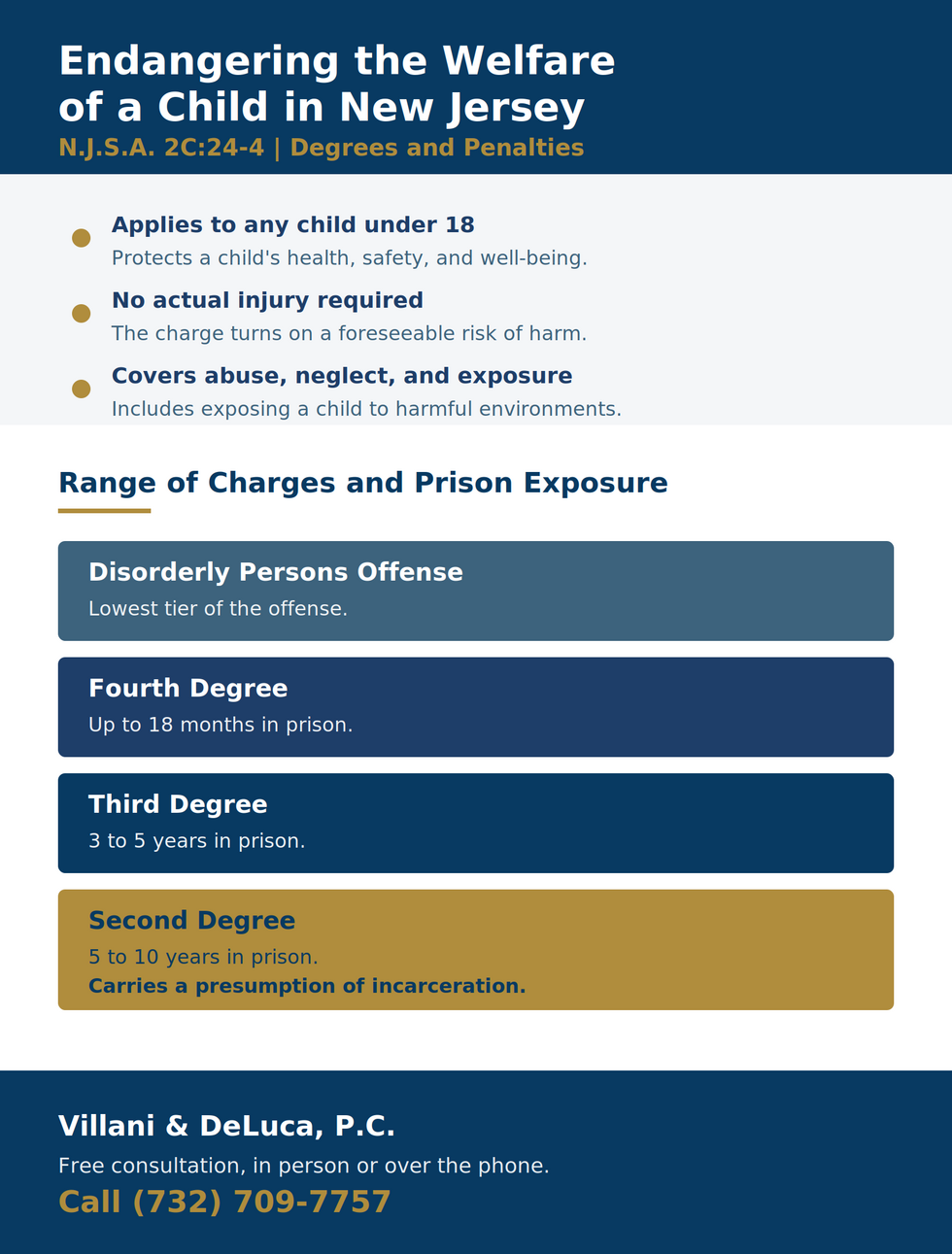
• Penalties range from a disorderly persons offense up to asecond-degree felony carrying 5 to 10 years in prison, depending on the severity and the defendant's duty of care.
Endangering the welfare of a child is a serious offense in New Jersey that can carry significant legal consequences. Understanding what constitutes this offense and how the law addresses it is essential to protecting your rights and the child's interests. Even unintentional actions or failures to act when a child's safety is at risk can result in criminal liability.
At Villani & DeLuca, P.C., our criminal defense attorneys have assisted clients throughout Ocean County, Monmouth County, and surrounding areas on child welfare cases. Knowing the legal definitions, potential consequences, and options for defense can help you make informed decisions and better understand the legal process.
Understanding Endangering the Welfare of a Child in New Jersey
New Jersey law defines “endangering the welfare of a child” as placing a child under 18 in circumstances that could potentially harm their health, safety, or overall well-being. This law is intended to protect children from both physical and psychological harm. Examples of conduct that may lead to charges include:
-
Physical abuse or violent behavior toward a child, such as hitting, shaking, or other corporal punishment.
-
Neglecting a child's basic needs, including food, clothing, medical care, or a safe living environment.
-
Exposing a child to illegal substances, domestic violence, or other unsafe conditions that create foreseeable harm.
-
Encouraging or permitting a child to engage in criminal activity, truancy, or other dangerous behavior.
Charges and penalties vary depending on whether the offense is classified as a disorderly persons offense, a fourth-degree offense, or a higher-level felony. Beyond criminal penalties, a conviction can affect custody rights, employment opportunities, and other aspects of daily life.
Who Can Be Charged with Endangering a Child
Any adult or legally responsible caregiver in New Jersey can face charges if their actions or negligence create a risk of harm to a child. This includes:
-
Parents or legal guardians who fail to provide adequate supervision, care, or protection.
-
Babysitters, relatives, or other household members are responsible for a child's welfare.
-
Adults who knowingly expose a child to dangerous environments or illegal activity.
Charges do not require intent to harm. Even negligent or unintentional actions that put a child at foreseeable risk can result in criminal liability.
Key Statutes and Legal References
The primary New Jersey statute governing child endangerment is N.J.S.A. 2C:24-4, which provides specific guidance on criminal liability:
-
N.J.S.A. 2C:24-4(a): Endangering the welfare of a child by acts that place a child in a potentially harmful environment.
-
N.J.S.A. 2C:24-4(b): Endangering a child through neglect, failure to provide care, or exposing them to illegal activity.
-
N.J.S.A. 2C:24-4(c): Severe cases resulting in injury or risk of serious injury, which may elevate the charge to a higher-degree offense.
Penalties depend on the degree of the offense, prior criminal history, and the circumstances of the case. Fourth-degree charges can carry up to 18 months in prison, while third-degree charges may involve 3–5 years. Felony convictions carry longer sentences and additional long-term consequences.
Defending Against Endangering Charges
Defense strategies require careful review of the circumstances and evidence. Common considerations include:
-
Lack of knowledge or intent that a child was in danger.
-
Demonstrating that reasonable care and supervision were provided.
-
Challenging the sufficiency or credibility of evidence, including procedural errors by authorities.
-
Evidence showing the alleged risk was not foreseeable.
Experienced attorneys can assess the facts, interpret the relevant statutes, and help craft a strategy tailored to your specific case.
How Villani & DeLuca, P.C. Can Help
At Villani & DeLuca, P.C., our attorneys have decades of experience defending clients facing child welfare-related charges in Ocean County and Monmouth County, New Jersey. We guide clients through the law in plain language, explain the implications of N.J.S.A. 2C:24-4, and provide strategic advocacy throughout the legal process.
Whether the charge is a misdemeanor or a felony, our team provides comprehensive advice, representation, and support to help clients understand their options and potential outcomes.
Protect Your Rights Today
If you are facing charges related to endangering the welfare of a child or have questions about New Jersey law, acting quickly is essential. Understanding the statutes and potential penalties can help you protect your future.
Villani & DeLuca, P.C. offers free consultations, in person or over the phone, to review your situation and explain your options under New Jersey law. Call us today at (732) 709-7757 to speak with an experienced criminal defense attorney.
Client Testimonial
"Amazing service, these guys are truly on your side and pay full attention to each of your problems. We've all seen lawyers that aren't really fully engaged with their clients and I can honestly say this is not the case with this law firm. If you want to feel at ease with your issues and you want someone that's truly got your back, you need to get in touch with these guys." – Steve Medeiros
"Carmine is the best. He is sharp and very accessible. Highly recommend for any legal matter. Furthermore, Carmine always delivers phenomenal results. He is the man for the job or legal issue. Don't waste your time with anyone else! 10 out of 10!" – Chris Dio
"Great team and a pleasure to work with. Extremely happy I decided to move forward with Villani and Deluca. Definately reccomend this firm." – Sarah Gutman
Frequently Asked Questions
1. What exactly does "endangering the welfare of a child" mean under New Jersey law?
In New Jersey, "endangering" is a broad legal term found under statute N.J.S.A. 2C:24-4. It covers a wide range of conduct that could potentially harm a minor's physical, mental, or moral well-being. This includes not only physical abuse or neglect (like failing to provide food or medical care) but also "impairing the morals" of a child through exposure to inappropriate sexual conduct or prohibited materials. Because the law is designed to protect children, it applies to parents and guardians as well as any adult who has a legal duty or assumed responsibility for a child.
2. Can I be charged even if the child was not actually injured?
Yes. One of the most misunderstood aspects of this law is that the prosecution does not always need to prove the child suffered a physical injury. The statute focuses on the risk of harm. If an adult knowingly places a child in a situation where their health or safety is jeopardized—such as leaving a young child unattended in a vehicle or driving while intoxicated with a minor passenger—they can be charged with endangerment based on the potential for disaster.
3. What is the difference between a second-degree and third-degree endangerment charge?
The severity (or "degree") of the charge often depends on the relationship between the adult and the child. Generally, if you have a legal duty of care—meaning you are a parent, guardian, or have assumed responsibility for the child (like a babysitter or teacher)—the offense is typically classified as a second-degree crime. If the individual does not have a formal duty of care to the child, the charge is often a third-degree crime. New Jersey law also accounts for recent updates in how digital evidence is handled, which can escalate the degree of the crime regardless of the relationship if certain materials are involved.
4. What are the potential penalties if convicted of child endangerment?
New Jersey treats these offenses with extreme gravity. A conviction for a second-degree crime carries a "presumption of incarceration," meaning the court starts with the intent to send the defendant to prison for 5 to 10 years. A third-degree conviction can lead to 3 to 5 years in prison. Beyond prison time, a conviction can result in a permanent felony record, significant fines, and potential loss of custody or visitation rights. In cases involving a sexual component, mandatory registration under Megan's Law and Parole Supervision for Life (PSL) may also be required.
5. Are there any programs for first-time offenders to avoid jail?
In some cases involving third-degree charges, a first-time offender may be eligible for a diversionary program known as Pre-Trial Intervention (PTI). If a defendant is accepted into PTI and completes the requirements (such as counseling and community service), the original charges may be dismissed, allowing them to avoid a criminal record. However, eligibility is strict, and the prosecution must often consent, making it vital to have an experienced endangering the welfare of a child lawyer to advocate for your entry into the program.
Related Articles
Learn more about endangering the welfare of a child charges in New Jersey in our articles:
Trusted Resources
- New Jersey Courts, Criminal Division - Superior Court, https://www.njcourts.gov/courts/superior/criminal
- New Jersey Division of Child Protection and Permanency (DCPP), Official Website, https://www.nj.gov/dcf/families/services/permanency/
- New Jersey Legislature, N.J.S.A. 2C:24-4 (Endangering Welfare of a Child), https://www.njleg.state.nj.us/laws/2c/2c-24-4
- New Jersey Legislature, N.J.S.A. 2C:43-7.2 (No Early Release Act), https://www.njleg.state.nj.us/laws/2c/2c-43-7.2
- Villani & DeLuca, P.C., NJ Criminal Statutes Resource Library, https://www.villanideluca.com/resources/new-jersey-statutes
- Villani & DeLuca, P.C., Endangering Welfare of a Child N.J.S.A. 2C:24-4 Breakdown, https://www.njleg.state.nj.us/laws/2c/2c-24-4
- Villani & DeLuca, P.C., Legal Glossary, https://www.villanideluca.com/resources/legal-glossaryVillani & DeLuca, P.C., NJ Criminal Statutes Resource
- Library, https://www.villanideluca.com/resources/new-jersey-statutes
- Villani & DeLuca, P.C., Legal Glossary, https://www.villanideluca.com/resources/legal-glossary