

Key Points:
• Under N.J.S.A. 2C:35-10.5, it is illegal to possess, distribute, or possess with intent to distribute a prescription legend drug without a valid order from a licensed practitioner.
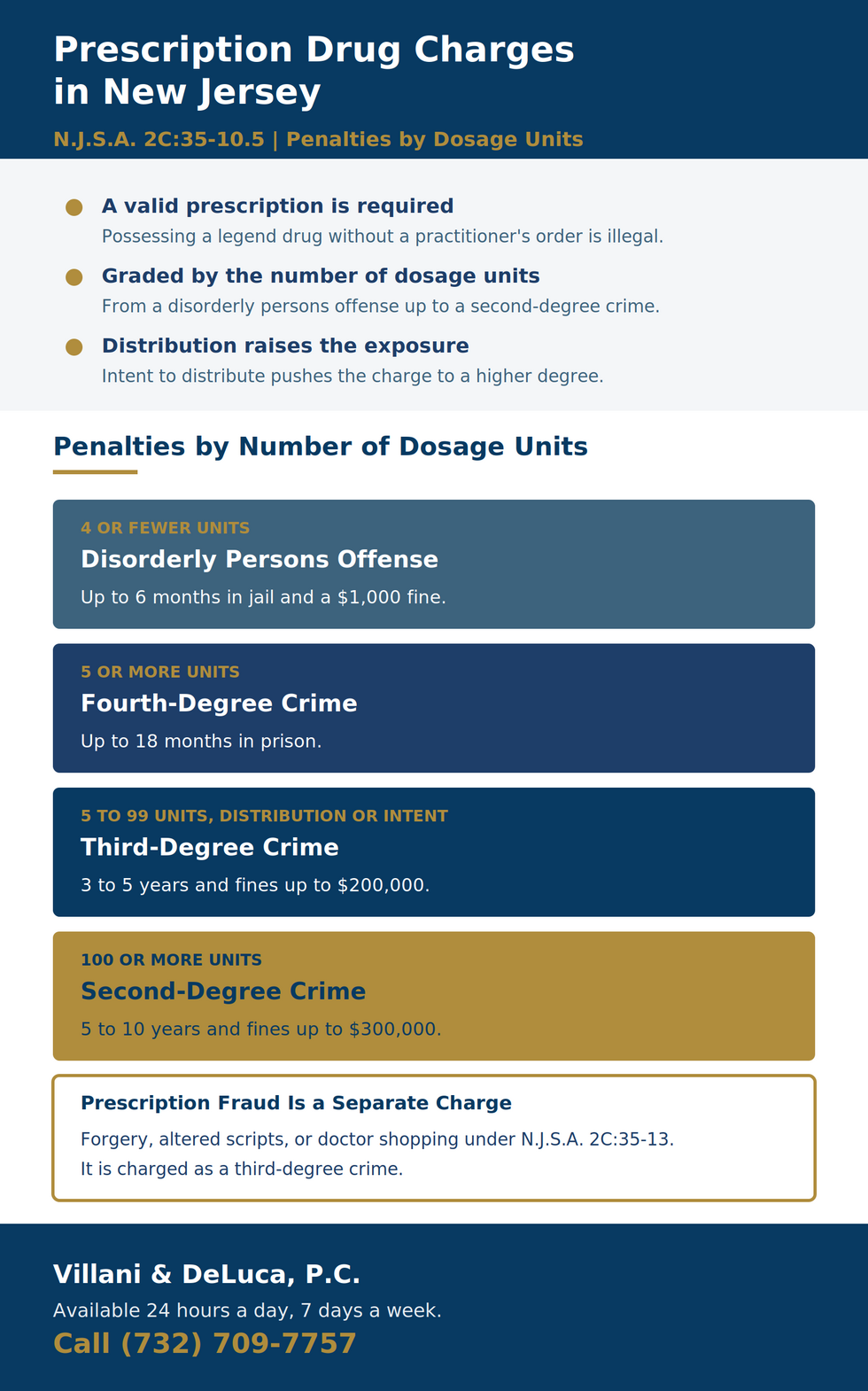
• Charges are graded by the number of dosage units involved, ranging from a disorderly persons offense up to a second-degree crime for distributing 100 or more units.
• Obtaining prescriptions through forgery, altered scripts, or doctor shopping is a separate third-degree offense of prescription fraud under N.J.S.A. 2C:35-13.
Prescription drug abuse continues to grow at an alarming rate at the Jersey Shore. Recognizing the fact that prescription medications are considered gateway drugs that lead to heroin, law enforcement has taken a firm approach to treat them as seriously as they treat possession of heroin or cocaine. A conviction can lead to jail or prison time, loss of your driver's license, and thousands of dollars in fines. Since 1996, the NJ prescription drugs lawyers at Villani & DeLuca P.C. have defended clients for criminal charges throughout New Jersey.
Possession and Distribution of Prescription Drugs in New Jersey (N.J.S.A. 2C:35-10.5)
It is illegal to carry prescription drugs and certain medications without a valid prescription issued by a licensed physician, dentist, veterinarian, or pharmacist. New Jersey classifies not only well-known drugs like marijuana, heroin, and cocaine as controlled dangerous substances (CDS), but also the compounds used to manufacture them, such as codeine. An individual who possesses prescription medications, including opiates and painkillers, in a manner outside of the law may be charged with a criminal offense.
If you have been arrested for illegal possession or distribution of prescription drugs in New Jersey, call our criminal defense and prescription drug possession attorneys at Villani & DeLuca, P.C. for your free consultation at (732) 709-7757.
CDS Classifications (N.J.S.A. 24:21-5, -6, -7, -8, & -8.1)
Pharmaceuticals are considered controlled dangerous substances under New Jersey Law. New Jersey divides CDS into five “Schedules.” Schedule I lists the most dangerous drugs, which have a high probability of abuse and addiction, and no recognized medical value. Schedules II, III, IV, and V decrease in dangerousness and probability of abuse, as they increase in their recognized medical uses.
Penalties for Possessing Prescription Drugs or CDS in New Jersey (N.J.S.A. 2C:35-10)
Penalties for possessing CDS in New Jersey vary according to the type and amount of CDS involved in the violation, as described below.
- Crime in the third degree: Possessing any amount of a schedule I, II, III, or IV CDS incurs a fine of up to $35,000, at least three (and up to five) years in prison, or both.
- Crime in the fourth degree: Possessing any amount of a Schedule V CDS incurs a fine of up to $15,000, up to 18 months in prison, or both.
- Disorderly person offense: Using or being under the influence of any CDS not for the purpose of treating a sickness or injury (as legally prescribed by a licensed physician) incurs a fine of up to $500.
Prescription Drug Fraud (N.J.S.A. 2C:35-13)
Prescription fraud is the illegal acquisition of prescription drugs for personal use or profit. This can take place in various ways, such as forging prescriptions, going to several doctors to get multiple prescriptions, and altering prescriptions to increase the quantity. If you forge a prescription to obtain prescription medication, you will be charged separately for prescription drug forgery. Some of the drugs most commonly sought, according to the law enforcement agencies, are Valium (diazepam), Vicodin (hydrocodone), Xanax (alprazolam), OxyContin (oxycodone), Lorcet, Dilaudid, Percocet, Soma, Darvocet, and morphine. This offense is considered a Third-Degree crime and can include jail time and substantial fines.
Sale of CDS in New Jersey (N.J.S.A. 2C:35-5)
It is illegal in New Jersey to make or sell CDS. Penalties vary according to the type and amount of CDS involved in the violation. Making or selling CDS near public property such as a park, library, or museum (N.J.S.A. 2C:35-7.1) can bring penalties of up to $150,000, at least 5 (and up to ten) years in prison, or both.
Client Testimonial
"Villani and his firm were extremely knowledgeable and professional handling my case. I'm extremely satisfied with the outcomes. God bless you and your firm for your dedicated work." – Bernard Perutti
"I would highly recommend him for all your legal needs" – Ken Murphy
"Great firm ...great attorneys..." – Chris H
Frequently Asked Questions
1. What are prescription drug crimes under New Jersey law?
In New Jersey, prescription drug crimes cover a wide range of illegal activities beyond just the possession of pills. Under N.J.S.A. 2C:35-10.5, it is illegal to distribute, possess with intent to distribute, or simply possess a "prescription legend drug" without a valid order from a licensed practitioner. This also includes related offenses such as forging a prescription, theft of prescription pads, or "doctor shopping" to obtain multiple prescriptions through fraud or deception.
2. Can I be charged for carrying someone else's medication?
Yes. Unless you are a licensed professional (like a pharmacist or doctor) or a designated caregiver acting within your duties, possessing a prescription drug that was not specifically prescribed to you is illegal. Even if a friend or family member gave you the medication for a legitimate health reason, you can still face a possession charge. As of 2026, New Jersey law also requires that any lawfully prescribed medication be kept in its original dispensed container, though a 10-day supply may be kept in a different container if you can provide proof of a valid prescription upon request.
3. What are the potential penalties for a conviction?
The penalties for prescription drug crimes depend largely on the number of "dosage units" (pills) involved and whether there was an intent to distribute:
-
Disorderly Persons Offense: Possession of 4 or fewer units. Penalties include up to 6 months in jail and a $1,000 fine.
-
Fourth-Degree Crime: Possession of 5 or more units, or distribution of 4 or fewer units for profit. Penalties include up to 18 months in prison.
-
Third-Degree Crime: Distribution or possession with intent to distribute between 5 and 99 units. Penalties include 3 to 5 years in prison and fines up to $200,000.
-
Second-Degree Crime: Distribution or possession with intent to distribute 100 or more units. Penalties include 5 to 10 years in prison and fines up to $300,000. A prescription drug defense lawyer can often challenge the "dosage unit" count or the evidence of intent to help reduce these severe grading levels.
4. What is "prescription fraud" or "doctor shopping"?
Prescription fraud involves using misrepresentation, deception, or forgery to obtain controlled substances. This includes altering a legitimate prescription, stealing a doctor's prescription pad, or visiting multiple doctors to obtain several prescriptions for the same ailment ("doctor shopping"). In 2026, the New Jersey Prescription Monitoring Program (NJPMP) is highly sophisticated and automatically flags patterns of multiple-practitioner visits, which often serve as the primary evidence for a third-degree prescription fraud charge.
5. Why should I hire a prescription drug defense lawyer?
Prescription cases are often complex because they involve medical records, pharmacy logs, and constitutional questions regarding search and seizure. A prescription drug defense lawyer can identify if the police lacked probable cause to search your vehicle or home, or if the state cannot prove you "knowingly" possessed the drugs. In 2026, with the prevalence of digital health records, an attorney is vital to ensuring that your private medical information is protected and not misused by the prosecution.
Experienced Prescription Drug Attorneys Can Help You
Consulting an experienced criminal defense and prescription drug possession attorney in NJ is essential when charged with a drug crime. Villani & DeLuca P.C. is comprised of seven lawyers with over 100 years of combined experience. We have been representing individuals charged with the unlawful possession of prescription drugs throughout Ocean County and Monmouth County, New Jersey. If you have been charged with prescription fraud, contact our law firm today for your free consultation so we can review the facts of your case, explain your options, and advise you of the possible consequences. The New Jersey attorneys for possession of prescription drugs at Villani & DeLuca can be reached 24 hours a day, 7 days a week (weekends and evenings available) at (732) 709-7757. Contact us today for a complimentary consultation on how to safeguard your rights.
Trusted Resources
- New Jersey Courts, Criminal Division, Superior Court, https://www.njcourts.gov/courts/superior/criminal
- New Jersey Division of Criminal Justice, Official Website, https://www.njoag.gov/about/divisions-and-offices/division-of-criminal-justice-home/
- Villani & DeLuca, P.C., Prescription Drugs N.J.S.A. 2C:35-10.5, https://www.villanideluca.com/resources/new-jersey-statutes/nj-drug-crimes-laws/prescription-drugs-nj-2c-35-10-5
- Villani & DeLuca, P.C., Drug Possession N.J.S.A. 2C:35-10, https://www.villanideluca.com/resources/new-jersey-statutes/nj-drug-crimes-laws/drug-possession-nj-2c-35-10
- Villani & DeLuca, P.C., Legal Glossary, https://www.villanideluca.com/resources/legal-glossary