

Key Points:
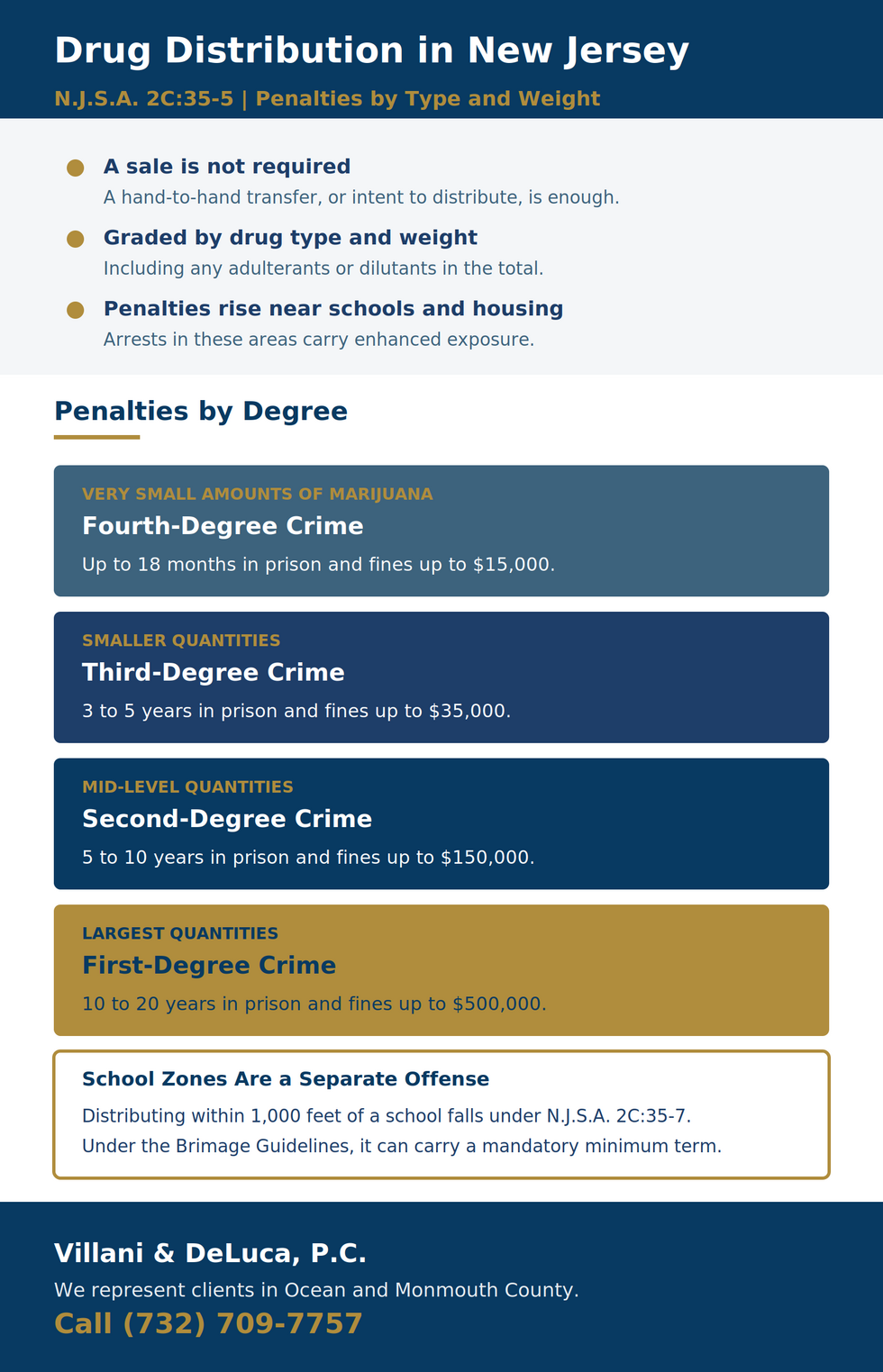
• Under N.J.S.A. 2C:35-5, distribution does not require a sale; a simple hand-to-hand transfer, or even possession with intent to distribute, is enough to be charged.
• Charges are graded by degree based on the drug type and weight, ranging from a fourth-degree crime up to a first-degree crime carrying 10 to 20 years in prison.
• Distributing within 1,000 feet of a school is a separate offense under N.J.S.A. 2C:35-7 and, under the Brimage Guidelines, can carry a mandatory minimum term.
If you're facing drug distribution or possession-with-intent charges in New Jersey, the stakes are high. Convictions can lead to years in prison, heavy fines, loss of employment, and a permanent criminal record. Whether the allegations involve marijuana, heroin, cocaine, prescription medications, or other controlled substances, you need an experienced NJ drug-distribution lawyer to fight for your future.
At Villani & DeLuca, P.C., we know how prosecutors build these cases, and we know how to challenge them. Our goal is to protect your rights, reduce exposure, and pursue the best outcome possible.
What Counts as “Distribution” in New Jersey?
Distribution doesn't only mean selling drugs. Under New Jersey law, charges can arise from:
-
Actual sales or deliveries of controlled substances
-
Possession with intent to distribute, even if no sale occurs
-
Manufacturing or cultivation of drugs, including marijuana plants, which remain illegal to grow in NJ
-
Transporting or packaging drugs in a way that suggests resale
Prosecutors often rely on circumstantial evidence, such as:
-
Large quantities of drugs beyond personal-use limits
-
Multiple small baggies or vacuum-sealed packages
-
Scales, cash, or transaction notes
-
Arrests near schools or public housing (which enhance penalties)
Penalties for Drug Distribution in New Jersey
The degree of crime depends on the type and weight of the drug, including any adulterants or dilutants. Sentences can also be enhanced if the offense occurs near schools, parks, or public housing.
-
First-Degree Crime
-
Applies to the largest quantities (e.g., 5+ ounces of heroin, cocaine, or meth; 25+ pounds of marijuana).
-
Penalty: 10–20 years in prison and fines that can reach up to $500,000.
-
-
Second-Degree Crime
-
Mid-level quantities (e.g., ½ ounce–5 ounces of heroin, cocaine, or meth; 5–25 pounds of marijuana).
-
Penalty: 5–10 years in prison and fines up to $150,000.
-
-
Third-Degree Crime
-
Smaller amounts (e.g., less than ½ ounce of heroin, cocaine, or meth; 1 ounce–5 pounds of marijuana).
-
Penalty: 3–5 years in prison and fines up to $35,000.
-
-
Fourth-Degree Crime
-
Very small amounts of marijuana (less than 1 ounce).
-
Penalty: Up to 18 months in prison and fines up to $15,000.
-
Drug Paraphernalia and Related Offenses
Prosecutors may also add charges for drug paraphernalia, including packaging or equipment linked to distribution. Selling or advertising paraphernalia without authorization is a separate crime, punishable by prison time and fines.
Collateral Consequences
Beyond fines and incarceration, distribution convictions can affect nearly every part of your life:
-
Employment and professional licensing
-
Student loans, scholarships, and campus housing
-
Rental or mortgage applications
-
Firearm ownership and federal benefits
Possible Defenses
Our attorneys review every case for weaknesses in the prosecution's evidence. Common defenses include:
-
Illegal search and seizure
-
Lack of intent to distribute
-
Entrapment
-
Evidence chain-of-custody problems
-
Eligibility for diversionary programs or conditional dismissals
Why Choose Villani & DeLuca, P.C.?
With decades of criminal defense experience in Ocean and Monmouth Counties, Attorney Carmine R. Villani and our team provide:
-
Strategic defenses tailored to your circumstances
-
Aggressive courtroom representation
-
Knowledge of local courts and prosecutors
-
Guidance on minimizing both legal and collateral harm
Client Testimonial
"I use Mr. Hoffman for all my family matters. He is great!!!! I recommend him and his firm highly!!!!" – Myriah Stanley
"Carmine is the best. He is sharp and very accessible. Highly recommend for any legal matter. Furthermore, Carmine always delivers phenomenal results. He is the man for the job or legal issue. Don't waste your time with anyone else! 10 out of 10!" – Chris Dio
"Carmine is a great lawyer and my case was resolved in a minimal amount of time. Even during a pandemic, he responded quickly to any questions and concerns I had. I highly recommend him and his firm. Thank you so much Carmine!" – Karina Testa
Frequently Asked Questions
1. What is the legal difference between drug possession and drug distribution?
While possession simply means having a controlled substance on your person or property, distribution of drugs involves the transfer of that substance to another person. Under N.J.S.A. 2C:35-5, the state does not have to prove that money was exchanged to charge you with distribution; a simple hand-to-hand transfer is sufficient. In 2026, prosecutors often rely on "intent to distribute" theories, using evidence like digital scales, small plastic baggies, or large amounts of cash to upgrade a simple possession charge to a more serious distribution offense.
2. How are drug distribution charges graded in New Jersey?
Drug distribution charges are graded by "degree" based on the type of substance and the quantity involved.
-
First Degree: Involves large quantities (e.g., 5 ounces or more of heroin or cocaine). Penalties include 10 to 20 years in prison.
-
Second Degree: Involves moderate quantities (e.g., 0.5 to 5 ounces of cocaine). Penalties include 5 to 10 years in prison.
-
Third Degree: Involves smaller quantities. Penalties include 3 to 5 years in prison. As of 2026, New Jersey has intensified penalties for any distribution involving fentanyl or fentanyl-analog mixtures due to the high risk of overdose, often pushing these cases into the first- or second-degree categories regardless of the total weight.
3. Can I be charged with distribution if I was just "gifting" a substance?
Yes. Under New Jersey law, the "delivery" of a controlled substance includes any actual or constructive transfer from one person to another. Even if you did not profit from the interaction, you can still face drug distribution charges. While 2026 regulations allow for the "gifting" of very small amounts of legal cannabis between adults, this exception does not apply to any other controlled substances or to "gifting" schemes used to circumvent retail laws.
4. What are the consequences of distributing drugs in a "School Zone"?
Distributing or possessing drugs with the intent to distribute within 1,000 feet of school property or a school bus is a separate and additional offense under N.J.S.A. 2C:35-7. These cases are subject to the "Brimage Guidelines," which often require mandatory minimum prison terms without the possibility of parole. In 2026, these zones are strictly enforced, and it is not a valid defense to claim you did not know you were near a school. A criminal defense attorney is essential in these cases to argue for waivers or downgrades of these mandatory sentences.
5. Can a drug distribution lawyer help me avoid prison?
Yes. An experienced drug distribution lawyer will investigate the methods used by law enforcement, such as the use of confidential informants or undercover surveillance. If the police violated your constitutional rights during a search or used illegal entrapment techniques, the evidence against you may be suppressed. In 2026, many cases are resolved by demonstrating that the defendant was a "low-level" participant or was acting under duress, which can lead to a significant reduction in charges.
Take the First Step Toward Protecting Your Future
Drug distribution charges, whether involving marijuana, prescription pills, or other controlled substances, are serious and demand immediate legal action. If you or a loved one is facing charges in Ocean County, Monmouth County, or anywhere in New Jersey, contact Villani & DeLuca, P.C. for a free consultation.
Call (732) 709-7757 today to speak with an experienced drug-distribution lawyer.
Trusted Resources
- New Jersey Courts, Criminal Division, Superior Court, https://www.njcourts.gov/courts/superior/criminal
- New Jersey Division of Criminal Justice, Official Website, https://www.njoag.gov/about/divisions-and-offices/division-of-criminal-justice-home/
- Villani & DeLuca, P.C., Drug Distribution N.J.S.A. 2C:35-5, https://www.villanideluca.com/resources/new-jersey-statutes/nj-drug-crimes-laws/manufacturing-distributing-or-dispensing-nj-2c-35-5
- Villani & DeLuca, P.C., School Zone Distribution N.J.S.A. 2C:35-7, https://www.villanideluca.com/resources/new-jersey-statutes/nj-drug-crimes-laws/distribution-on-or-within-1-000-feet-of-school-property-nj-2c-35-7
- Villani & DeLuca, P.C., Legal Glossary, https://www.villanideluca.com/resources/legal-glossary