

Key Point:
• A marital settlement agreement (MSA) is a binding contract that resolves all divorce terms: custody, child support, alimony, and equitable distribution.
• Most New Jersey divorces end by agreement rather than trial. Once signed and incorporated into the final judgment, an MSA carries the force of a court order.
• Courts generally enforce an MSA that is fair and entered voluntarily with full financial disclosure, and it can be modified on a substantial change in circumstances under Lepis v. Lepis.
Most people filing for divorce picture a courtroom. In reality, the large majority of New Jersey divorces are resolved by a written agreement between the spouses, and the judge never decides anything.
That document is the marital settlement agreement, and it will govern your life for years. The family law attorneys at Villani & DeLuca, P.C. draft and enforce these agreements for clients throughout Ocean and Monmouth County.
What a Marital Settlement Agreement Does
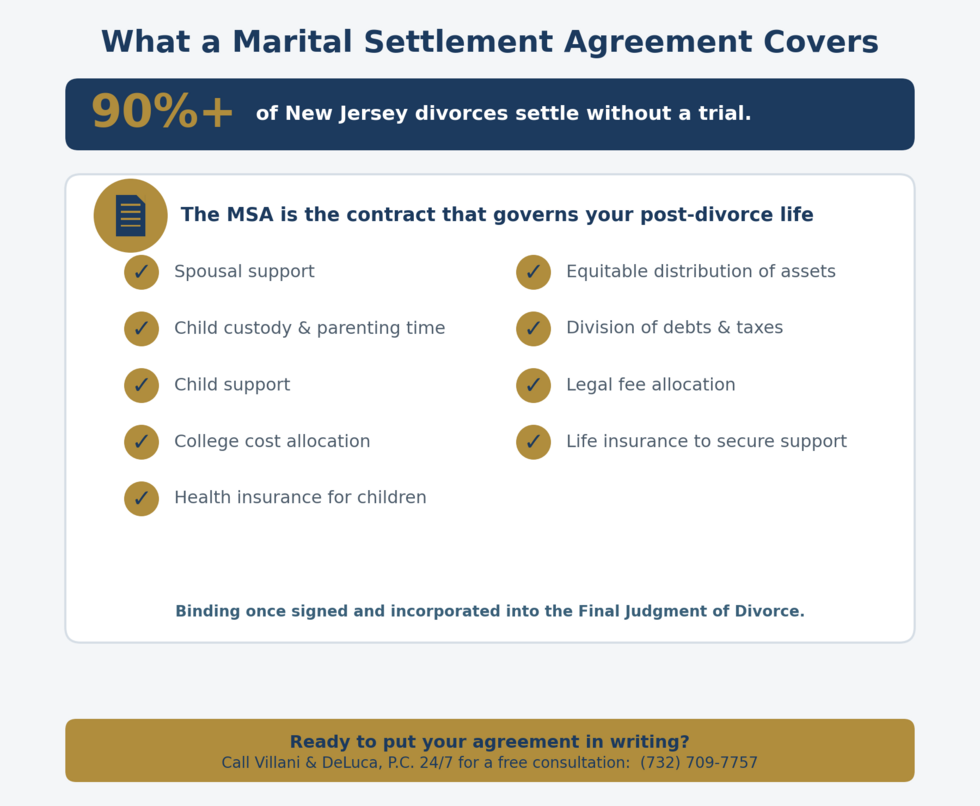
An MSA is a contract that defines every term of your divorce. It has to be complete, and each issue has to be spelled out with specificity. A typical agreement addresses:
-
Spousal support (alimony)
-
Child custody and the parenting time schedule
-
The amount of child support and how college costs will be allocated
-
Health insurance for the children after the divorce
-
The equitable distribution of marital assets, the division of marital debts, and tax issues
-
Allocation of legal fees
-
Life insurance to secure support obligations
These agreements typically run 20 to 50 pages. Once it is signed and incorporated into your Final Judgment of Divorce, it has the same effect as a court order, and it can be changed only by mutual consent or a court order.
Negotiating the Terms
Start with the finances, and be thorough about it. The prior tax returns, Case Information Statements, paystubs, W-2s, 1099s, and more get exchanged and reviewed. Retirement and financial account statements get analyzed. Real estate may need an appraisal.
Give your attorney the most complete financial picture you can, including the parts you would rather not discuss. An agreement built on incomplete information is an agreement that gets challenged later.
Once the documentation is in, the attorneys often bring the clients together to work through the terms. Where there is real disagreement, the attorneys may jointly select a mediator to close the gap.
Provisions about the children need particular care. Vague parenting time language is the single most common reason people end up back in court two years later. A well-drafted agreement anticipates the disputes that are likely to come up and answers them in advance: who gets which holiday, how a schedule change gets requested, what happens when a parent wants to move.
One rule that surprises people: side agreements and oral promises are not enforceable. If it is not in the signed document, it does not exist. Everything you have agreed to has to be in writing.
What Happens at the Divorce Hearing
Once the agreement is signed, the divorce itself is straightforward.
At the uncontested hearing, the judge's focus is on whether both of you entered the agreement knowingly and voluntarily, free of coercion, and with an understanding of its terms. The court is not conducting a line-by-line fairness review of a document you both negotiated with counsel. New Jersey courts respect settlement agreements and generally enforce them where they are fair and were entered voluntarily.
That is precisely why the drafting matters so much. The protection you get is the protection you negotiated. Nobody is going to catch a bad term for you at the hearing.
Enforcing the Agreement
If your former spouse does not comply, you file a Motion to Enforce Litigant's Rights asking the court to compel compliance and showing specifically how the agreement was violated. Where the violation is willful, the court can award counsel fees to the complying party.
How We Handle Your Settlement Agreement
We make sure you understand the full financial picture before you sign, draft each provision with the precision that keeps you out of court later, and move promptly to enforce the agreement if your former spouse violates it.
Client Testimonial
"I could not have asked for a better attorney. Mr. Villani spoke with me the same day I called his office, he was able to make my situation swift and painless. I couldn't have asked for a better out come. Thank you for you amazing services" – Steve Voorhees
"Carmine Villani was very knowledgeable. I would highly recommend him." – Karen Roche
"Carmine and his staff are the best around! Very professional and friendly, but most of all they make you feel comfortable in handling your legal issues. I would highly reccomend using Villani & Deluca for any legal matter big or small!" – Emily Woszczak
Frequently Asked Questions
What is a marital settlement agreement, and is it binding?
An MSA is a written contract between spouses setting out the terms of the divorce, including property division, alimony, and everything involving the children. Once both parties sign it and it is incorporated into a Final Judgment of Divorce, it is legally binding and enforceable like any court order. New Jersey courts favor these agreements because they let a couple control their own outcome rather than handing it to a judge.
Can a divorce settlement be changed after it is finalized?
Yes, in limited circumstances. An MSA is meant to be final, but New Jersey law allows modification on a substantial change in circumstances under the standard from Lepis v. Lepis, 83 N.J. 139 (1980). A significant change in income, health, or a child's needs may justify a change. The party asking for it carries the burden. Note that alimony modifications involving retirement, cohabitation, or an involuntary loss of income also have their own statutory rules under N.J.S.A. 2A:34-23.
What happens if my spouse did not disclose all of their assets?
Full and fair disclosure is required, and an agreement signed without it is vulnerable. If a spouse concealed an asset, whether cryptocurrency, a business interest, or a retirement account, a court may set the agreement aside for fraud or unconscionability. You cannot knowingly waive rights to something you did not know existed, and courts understand that.
How should custody and a child's safety be handled in the agreement?
With specificity. Parenting time, decision-making, and dispute resolution should all be spelled out clearly enough that you do not need a judge to interpret them. A court reviews the children's provisions against the best-interests standard of N.J.S.A. 9:2-4 and can decline to incorporate an agreement that does not adequately protect a child.
What are my options if my ex-spouse violates our agreement?
File a Motion to Enforce Litigant's Rights. Whether the problem is a refusal to list the marital home, unpaid alimony, or withheld parenting time, the court has a range of remedies, and it can award counsel fees where the violation was willful.
The Bottom Line
A well-drafted marital settlement agreement puts your future in your hands instead of a judge's, and keeps you out of a contested trial. The New Jersey family law attorneys at Villani & DeLuca have extensive experience drafting and enforcing these agreements. Talk to us before you start the process, not after you have already agreed to something.
About the Author: Vincent C. DeLuca, Esq., NJ Supreme Court Certified Matrimonial Attorney, is a partner at Villani & DeLuca, P.C. He drafts and enforces marital settlement agreements and handles divorce, custody, support, and mediation matters throughout Ocean and Monmouth Counties.
Related Articles
Trusted Resources
- New Jersey Courts, Self-Help (Divorce): https://www.njcourts.gov/self-help/divorce
- New Jersey Courts, Family Division (Superior Court): https://www.njcourts.gov/courts/superior/family
- New Jersey Legislature, N.J.S.A. 2A:34-23.1 (Equitable Distribution Factors): https://www.njleg.state.nj.us/laws/2a/2a-34-23.1
- Villani & DeLuca, P.C., Legal Glossary: https://www.villanideluca.com/resources/legal-glossary