

Key Point:
• New Jersey calculates child support using the Child Support Guidelines in Rule 5:6A and Appendix IX of the Rules of Court, based on both parents' income and the number of overnights.
• Child support ends automatically when a child turns 19 and can be continued to 23 in specific circumstances under N.J.S.A. 2A:17-56.67.
• Support can be modified on a substantial change in circumstances, but past-due support cannot be forgiven, and it cannot be reduced retroactively past the date you filed.
Divorce is harder when children are involved. Child support is one of the ways you keep your children's lives steady through it, but the rules are detailed and most people get at least one thing wrong about them.
Here is what parents in Ocean and Monmouth County ask us most often. When you are ready to talk about your own numbers, the child support attorneys at Villani & DeLuca, P.C. are here.
Who Pays Child Support
Both parents owe a duty of support. In the typical arrangement, the parent the child does not primarily live with pays support to the parent the child lives with. Where parents share custody, both still have the obligation, and the Guidelines account for that through a shared-parenting calculation.
How Long the Obligation Lasts
This changed, and a lot of older information online is still wrong about it.
Child support now terminates by operation of law when a child turns 19. No motion, no court order, no hearing. It just ends, unless one of a handful of exceptions applies.
Support can continue past 19 if:
-
A court order or judgment already specifies a later termination age, which cannot go past 23.
-
The child has a severe mental or physical incapacity causing financial dependence, and continuation is specified in a court order.
-
The custodial parent asks the court, before the child turns 19, to continue support, and the court approves. Usually this is the case when a child is enrolled full-time in college.
-
The child is in an out-of-home placement through the Division of Child Protection and Permanency.
Where the custodial parent requests continuation, the grounds are specific: the child is still in high school or another secondary program, the child is in a post-secondary program and enrolled full time as that school defines it during some part of the academic year, or the child has a physical or mental disability determined by a federal or state agency that existed before the child turned 19. A parent can also file a motion asking the court to extend support for exceptional circumstances.
You will get warning. The Probation Division sends two notices of proposed termination, the first at least 180 days out and the second at least 90 days out. Those notices matter. If you need support to continue and you ignore them, it ends.
At 23, support terminates by operation of law, with one exception: a child with a severe mental or physical incapacity causing financial dependence. In that case support continues until the court finds the incapacity relieved or the dependence ended. Separately, a court can order other forms of financial maintenance for a child past 23, but that is not child support and Probation does not enforce it.
How New Jersey Calculates Child Support
The Child Support Guidelines live in Rule 5:6A and Appendix IX of the Rules of Court. The court applies them unless there is good cause to deviate, and when a proposed award differs from the Guidelines number, the worksheet has to say why.
Three principles sit underneath the Guidelines: both parents have a continuing duty to support their children, children are entitled to share in the current income of both parents, and children should not be the economic victims of a divorce. The numbers themselves estimate what parents in intact families at similar income levels actually spend on their children.
Two worksheets do the work. The shared-parenting worksheet applies when the child spends the equivalent of two or more overnights per week with the parent of alternate residence. The sole-parenting worksheet applies below that threshold.
What goes into the calculation:
-
Each parent's gross and net income, and whether either is a high earner
-
Other sources of income
-
Employment skills and work history
-
The number of overnights with each parent
-
The child's share of the health insurance premium
-
Court-approved extraordinary expenses
-
The number of children
-
Any public assistance received
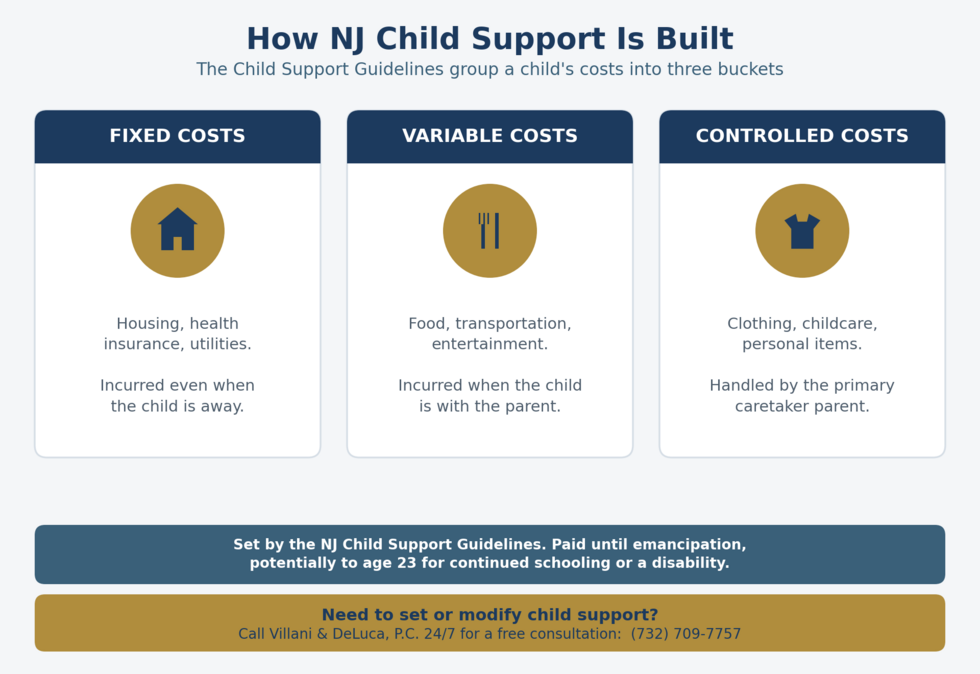
Support is built from three cost categories. Fixed costs like housing and utilities, which you pay whether or not the child is with you that night. Variable costs like food and transportation, which you incur when the child is with you. Controlled costs like clothing and personal care, which the primary caretaker pays. The court also accounts for each child's individual needs.
Where the parents' combined income exceeds the top of the Guidelines schedule, the court applies the Guidelines up to that ceiling and then adds a supplemental amount using the statutory factors in N.J.S.A. 2A:34-23(a).
The Guidelines are published on the New Jersey Courts website. Our child support lawyers can run your actual numbers and tell you what to expect.
Settling Child Support Through Mediation
When a judge decides, you have very little control over the result. The Guidelines are a tool for the court, and the court applies them.
Mediation puts the decision back with the parents. A neutral mediator helps you reach a figure you both accept, and an agreed number tends to hold up better over time than an imposed one. Supporting your children is a shared job, and an arrangement both parents can live with is worth real effort.
Enforcing Child Support
When payments stop, the receiving parent can enforce the order. New Jersey's Probation Services Division handles enforcement through the court, using:
-
Income withholding
-
Enforcement hearings
-
Seizure of bank funds
-
Interception of state and federal tax refunds
-
Suspension of driver's and recreational licenses
-
Entry of judgments
-
Credit reporting
Probation can also locate a parent who owes support, establish paternity, and collect payments on the receiving parent's behalf. Because each unpaid installment becomes a judgment by operation of law on the date it comes due, arrears can also cloud title and interfere with buying or selling property. Missed support damages credit.
Lowering Child Support in New Jersey
Support orders are meant to be followed, but New Jersey law recognizes that lives change. A serious illness, a job loss, or another substantial change in circumstances can justify a different number.
Start by talking with the other parent, if that is realistic. If you cannot agree and your reasons are legitimate, the paying parent can request a hearing in the Superior Court, where an attorney presents the case. The court can apply the Guidelines to your new circumstances and increase or decrease support.
File promptly, and here is why. New Jersey law bars retroactive modification of child support except back to the date a motion was filed, or back to the date you mailed written notice of changed circumstances if you file within 45 days of that notice. Every month you wait is a month of support you cannot get back. This is the single most expensive mistake parents make in this area.
Support can also be adjusted for inflation through a cost-of-living adjustment tied to the Consumer Price Index, and modified when the child's circumstances change, such as a new long-term illness that raises medical expenses.
Can Child Support Arrears Be Forgiven in NJ?
No. Even when an order is modified or ends entirely, past-due support still has to be paid. What has already come due cannot be wiped out unless consented to by the parties.
How We Handle Child Support Matters
Whether you are setting support, seeking a modification, or enforcing an order, we apply the Guidelines correctly to your facts, document income and parenting time, and put the strongest version of your case in front of the court.
Get a Free Consultation Today. Call (732) 709-7757 24/7, or contact us online.
Client Testimonial
"Couldn't have asked for a better lawyer. Was more than happy" - Rocco DeCorso
"Carmine and his staff are the best around! Very professional and friendly, but most of all they make you feel comfortable in handling your legal issues. I would highly reccomend using Villani & Deluca for any legal matter big or small!" – Emily Woszczak
"Mr. Villani really helped me out. He knew his stuff and was very confident about what he was doing. Great guy" – Erica Aborlleile
Frequently Asked Questions
Who is responsible for child support payments?
Both parents. What each pays depends on custody, the living arrangement, income, and how many overnights the child spends with each parent.
How long will I have to pay child support?
Support ends automatically at 19 unless an exception applies. It can continue to 23 where the child is still in secondary school, is a full-time post-secondary student, or has an agency-determined disability that began before 19, or where the court approves an extension for exceptional circumstances. It can also end earlier if the child marries, dies, enters the military, or is emancipated.
Can I get out of paying child support?
No. Child support belongs to your child, not to your former spouse, and it cannot be waived or bargained away. It can be increased or decreased in limited circumstances.
Can I reduce my child support payments?
You can ask, by showing a substantial change in circumstances that prevents you from paying the ordered amount. You file with the court and have a hearing. File as soon as the change happens, because a reduction generally cannot reach back before your filing date.
What if my former spouse stops paying child support?
You can enforce the order through Probation, which can garnish wages and use the other tools available under New Jersey law, including license suspension and tax refund interception.
What if I need more child support?
You can file for an increase by showing a substantial change since the last order that justifies a higher number.
The Bottom Line
Child support is about your children's security, and the rules on calculating, modifying, and enforcing it are detailed enough that guessing is expensive. Our New Jersey child support lawyers will tell you where you actually stand. Speak with us today.
About the Author: Vincent C. DeLuca, Esq., NJ Supreme Court Certified Matrimonial Attorney, is a partner at Villani & DeLuca, P.C. He handles child support, custody, divorce, and mediation matters for families throughout Ocean and Monmouth Counties.
Related Articles:
What Does Child Support Cover in New Jersey?
How Much is Child Support in NJ?
How Is Child Support Calculated in New Jersey?
NJ Family Law: Paying Child Support to Multiple Families
Trusted Resources
New Jersey Courts, Self-Help - Child Support, https://www.njcourts.gov/self-help/child-support-custody
New Jersey Courts, Family Division - Superior Court, https://www.njcourts.gov/courts/superior/family
New Jersey Child Support, Official Website, https://www.njchildsupport.org
New Jersey Legislature, N.J.S.A. 2A:17-56.23a (Child Support Guidelines), https://www.njleg.state.nj.us/laws/2a/2a-17-56.23a
Villani & DeLuca, P.C., Legal Glossary, https://www.villanideluca.com/resources/legal-glossary