

Key Point:
• New Jersey decides child custody under the best-interests standard of N.J.S.A. 9:2-4, which starts from the public policy of assuring children frequent and continuing contact with both parents.
• Custody has two parts: legal custody (major decisions about health, education, and upbringing) and physical or residential custody (where the child lives). Parents often share joint legal custody.
• New Jersey law treats both parents equally, and custody, parenting time, and relocation can be modified on a substantial change in circumstances.
Separating is hard enough. Doing it while working out where your children will live, and how much of their lives you will be part of, is harder.
We at Villani & DeLuca handle custody matters for families throughout Ocean and Monmouth County. Below is how these cases actually get decided in New Jersey, what the different kinds of custody mean, and what to watch for.
Starting With Negotiation or Mediation
Most custody disputes come down to the same set of issues: the parenting time schedule, holidays and vacations, decision-making, and child support. Many of them can be worked out without a judge.
Negotiation is you and the other parent discussing what each of you wants, directly or through your child custody lawyers, and finding a compromise.
Mediation is that same conversation with a neutral mediator in the room to keep it productive and suggest ways through the sticking points. In New Jersey, the court may order parents into mandatory custody mediation. Court mediators are experienced in these disputes, but they do not give legal opinions and they do not represent either parent.
Both routes are cheaper and faster than a custody trial, and both leave you in a better position to co-parent afterward, which matters for the next decade of your life.
They are not right for every family. Where there is substance abuse, physical abuse, or a genuine power imbalance, mediation can do harm. And some cases simply reach a dead end. Then court is the answer, and we will tell you honestly when you are at that point.
When It Goes to Court
If your case has to be tried, our attorneys will advocate for the arrangement you want. New Jersey courts decide custody on the best interests of the child under N.J.S.A. 9:2-4, weighing these factors:
-
The parents' ability to agree, communicate, and cooperate in matters relating to the child
-
The parents' willingness to accept custody, and any history of unwillingness to allow parenting time not based on substantiated abuse
-
The interaction and relationship of the child with its parents and siblings
-
The history of domestic violence, if any
-
The safety of the child and the safety of either parent from physical abuse by the other parent
-
The preference of the child, when of sufficient age and capacity to reason so as to form an intelligent decision
-
The needs of the child
-
The stability of the home environment offered
-
The quality and continuity of the child's education
-
The fitness of the parents
-
The geographical proximity of the parents' homes
-
The extent and quality of the time spent with the child before and after the separation
-
The parents' employment responsibilities
-
The age and number of the children
The statute also says a parent is not deemed unfit unless their conduct has a substantial adverse effect on the child. That is a meaningful protection, and it is worth knowing about if the other parent is building a case out of your worst moments.
If you are the father, understand that New Jersey custody law treats both parents equally. There is no presumption favoring mothers. The question is what serves your child.
Physical Custody and Legal Custody
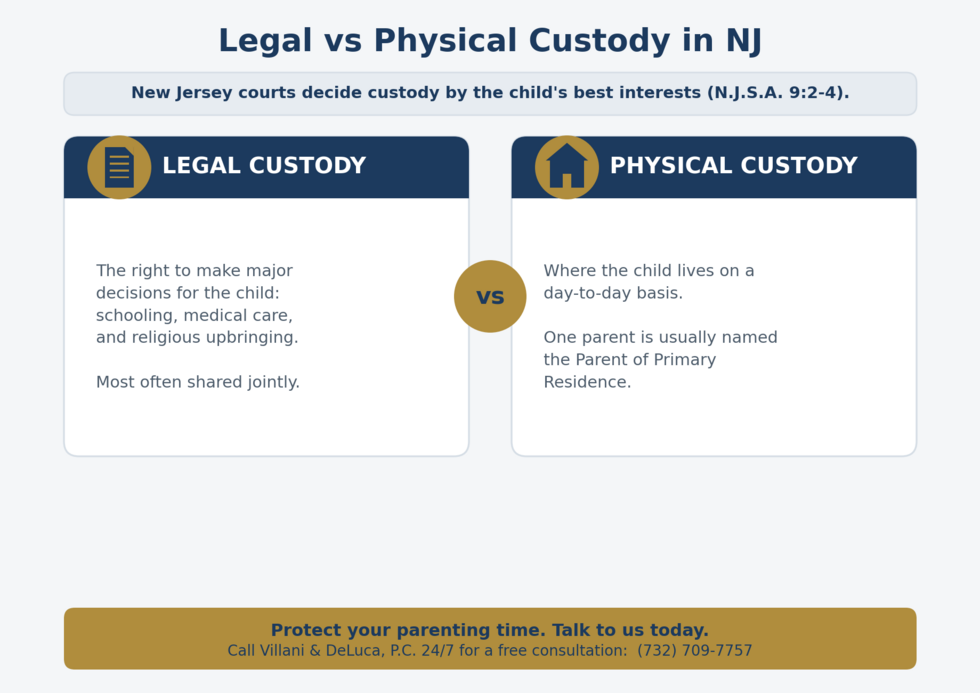
Physical or residential custody is where the child lives most of the time. The parent the child lives with is the parent of primary residence; the other is the parent of alternate residence and is generally entitled to scheduled parenting time. In rare cases a court orders split custody, where parents with more than one child each become the primary residential parent for a different child.
Legal custody is the authority to make major decisions about the child's welfare, including health and education. New Jersey cases often result in joint legal custody, giving both parents an equal say.
These are separate questions and they do not have to match. Joint legal custody with one primary residential parent is a common outcome. We will advocate for the combination you want.
Changing a Custody Order
Children grow and circumstances shift. New Jersey courts can modify legal custody, physical custody, and parenting time.
If both parents agree to the change, the court will generally approve it. If you do not agree, you are back in the litigation process, and the question is the same one as the first time: what is in your child's best interests.
Relocation. If a parent wants to move out of state with the child, talk to a lawyer first. New Jersey restricts a move that would reduce or interfere with the other parent's parenting time, and moving without permission or a court order can put your custody arrangement at risk.
Enforcement. Where the other parent is withholding parenting time or making major decisions unilaterally, you can ask the court to enforce the existing order. We will seek enforcement or modification, whichever fits.
How We Handle Your Custody Matter
Custody is decided on facts, so we build the record the court relies on: the parenting history, each parent's actual involvement, stability, and your child's needs. We pursue negotiation or mediation where that serves your family, and we are ready to try the case where it does not.
Client Testimonial
"Worth the money. Carmine Villani was so helpful throughout the court process. He answered any questions I had about my case, helping to keep me calm when I got stressed. The outcome was terrific and Mr. Villani was the most professional lawyer in the court that day. I couldn't have asked for better representation." - Heather Popielarczyk
"I just wanted to send you an email to say thank you for yesterday you are truly a pleasure to work with. You without a doubt made a 13 month long drawn out battle with my ex-husband a bit easier, if only you were the mediator that was assigned to us in the first place this may have been over a lot sooner.Again Thank you! " – R.H.
"Carmine Villani was very knowledgeable. I would highly recommend him." – Karen Roche
Frequently Asked Questions
Can a parent who does not have custody access the child's records?
Generally yes. Both parents typically have access to medical, dental, and educational records even when the child lives with only one of them. You can ask the court to limit the other parent's access if a judge finds that limiting it serves the child's best interests or that access is being used to harm you.
I am a relative. Can I get custody?
Usually not. There is a strong presumption that a child's best interests are served by living with one or both parents, so a court generally will not award custody to a grandparent, aunt, or cousin unless both parents are found unfit. A relative may be able to get temporary custody where neither parent can care for the child and neither objects.
How do I change an existing custody order?
You petition the court and generally have to show a significant change in circumstances since the last order. There are specific forms to file. Court staff can answer questions about the paperwork but cannot advise you on strategy or on whether your change is significant enough.
What is the difference between custody and parenting time?
Custody covers legal custody, the right to make major decisions, and physical custody, where the child lives. Parenting time is the schedule. A parent without physical custody can still have substantial parenting time. The New Jersey Judiciary publishes parenting time guidelines on the NJ Courts website.
In which state do I file for custody?
New Jersey has adopted the Uniform Child Custody Jurisdiction and Enforcement Act (UCCJEA). You generally file in the child's home state, which is usually where the child has lived with a parent for at least six consecutive months, or since birth if the child is under six months old. There are exceptions, so talk to a lawyer about your specific situation.
Can I get support for my children and myself?
Yes, but they are separate decisions. Child support is generally set using the Child Support Guidelines, which account for both parents' incomes, the child's needs, and parenting time. Support for you is alimony, decided under different statutory factors, and it is only available if you were married or in a civil union.
Can I get temporary emergency custody?
You can seek it by filing an Order to Show Cause, showing that your child faces substantial, immediate, and irreparable harm without relief. That means real danger: abuse, neglect, or a credible threat of abduction.
If there is a custody order, can I take my children out of state?
Generally not without the other parent's permission or a court order. Doing it anyway can expose you to a contempt action and can hurt you in any later custody proceeding.
What if I fear the other parent may abduct my child?
Contact a lawyer immediately. A court can take steps to prevent an abduction, including emergency orders and, where there is a risk of international flight, directing that the child's passport be secured.
How will a judge decide custody?
Under N.J.S.A. 9:2-4, the judge weighs the full list of best-interests factors set out above. New Jersey's stated public policy is to assure children frequent and continuing contact with both parents after a separation, and to encourage parents to share the rights and responsibilities of raising them.
Does my child get to choose which parent to live with?
Not exactly, and there is no magic age. The statute directs the court to consider the child's preference "when of sufficient age and capacity to reason so as to form an intelligent decision." That is an individual assessment, not a birthday. A judge weighs a mature 13-year-old's reasoning differently than a 13-year-old repeating what a parent told them, and the preference is one factor among many rather than the deciding vote.
Do I need a child custody lawyer?
Not legally, no. But custody orders shape years of your life and are harder to change than to get right the first time. If you do represent yourself, it is still worth having a lawyer review your filings before they go in.
Can a parent who committed domestic violence get parenting time?
Possibly. An isolated act does not automatically end a parent's right to parenting time. The outcome depends on the severity, whether it was directed at you or at the child, and what the child's safety requires. A judge may order supervised parenting time.
The Bottom Line
Custody is one of the most important issues you will face, and New Jersey decides it based on the best interests of your child. Our New Jersey child custody lawyers offer a free consultation and pride themselves on a close attorney-client relationship. Contact us today to speak with an experienced attorney.
About the Author: Vincent C. DeLuca, Esq., NJ Supreme Court Certified Matrimonial Attorney, is a partner at Villani & DeLuca, P.C. He handles custody, divorce, support, and mediation matters for families throughout Ocean and Monmouth Counties.
Related Blog Posts
Learn more about child custody in New Jersey in our blog:
Trusted Resources
New Jersey Courts, Self-Help - Child Custody, https://www.njcourts.gov/self-help/child-support-custody
New Jersey Courts, Family Division - Superior Court, https://www.njcourts.gov/courts/superior/family
New Jersey Legislature, N.J.S.A. 9:2-4 (Child Custody Best Interests), https://www.njleg.state.nj.us/laws/9/9-2-4
New Jersey Legislature, N.J.S.A. 2A:34-23 (Alimony, Maintenance), https://www.njleg.state.nj.us/laws/2a/2a-34-23
Villani & DeLuca, P.C., Legal Glossary, https://www.villanideluca.com/resources/legal-glossary